
Glenda León left an ice cube to melt and I didn’t know what to think. It happened some twelve years ago, during a bustling performance festival in Cienfuegos, a province in central Cuba, which I remember more for its energetic and open spirit than for its program and its formalities. A few powerful actions under the scorching sun in the city’s boulevard do come to mind, as do the mystery of Luis Gómez’s camera obscura, Sandra Ramos’s installation about processions in San Lázaro, and Sandra Ceballos’ intrepid street performances. In the midst of such outbursts and spillovers all around the storied town, Glenda León left an ice cube to melt, and it was as if nothing had happened: a window half-opened by the light afternoon breeze, without anyone inside the room noticing. Much later I learned that her intervention was part of a series titled Cada Forma del Tiempo. Let’s be clear: art on the island is healthy and vigorous. Music is omnipotent. Visual artists are the legatees of a solid, century-long modern tradition. The subtle nothingness of that ice melting alerted me to the existence of sub-public artistic forms and raised in me great suspicions.
The artist came equipped with knowledge of classical dance, as well as studies in painting and Art History; everything and nothing seemed alien to her. As a student, she was put to sleep by Gothic art, the Renaissance, the Baroque, and all that; one day, though, she was jolted out of her long lethargy by mentions of Dada and Duchamp, and that long history immediately acquired meaning for her, becoming efficient and active. This only increased my suspicions.
Perhaps motivated by such inclinations, in the year 2000 León joined the project Desde una pragmática pedagógica (DUPP), led by artist and teacher René Francisco Rodríguez from the Instituto Superior de Arte (ISA), which has welcomed and trained some of the most interesting artists in today’s Cuba, from Los Carpinteros to Wilfredo Prieto. Of course, the experimental amplitude of DUPP left an important imprint on our ice melter.
That small ice cube was nothing other than a perception of time expressed by an extremely inquisitive personality. Inquisitive of tangential inquisitions such as, for an artist, the laws of physics, acoustics, the biochemistry of certain compounds, the nature of the cosmos, and some of those social natures that never cease to encase and motivate us.

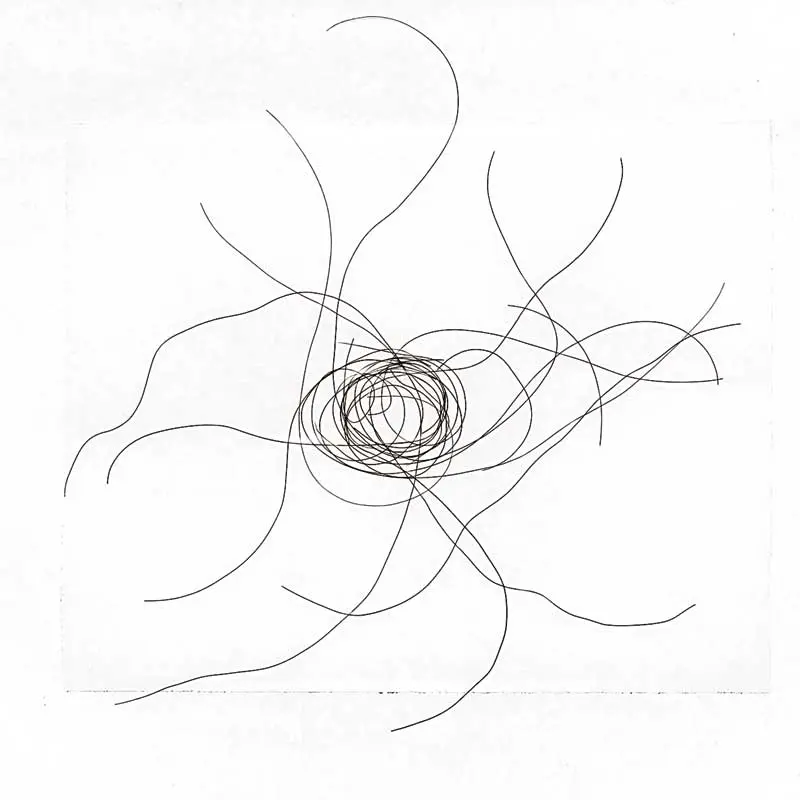
The audio recording of human steps or a drawing using hairs that fall from our bodies added to an oeuvre whose central strategy was a close observation of the passage of time, requiring León to use forms and actions so every day that they may go unnoticed. The flow of things became her first great theme, and her entire sensibility was directed towards the search for evidence of time, that imposing physical dimension, as if scientists had let the most cardinal aspect of the matter slip through their hands: each being’s intimate, non-transferable time, which is not included in treatises because it has no bearing for general laws, yet fills the known universe with billions of individual trajectories that criss-cross incessantly, randomly, to form that which we call existence.

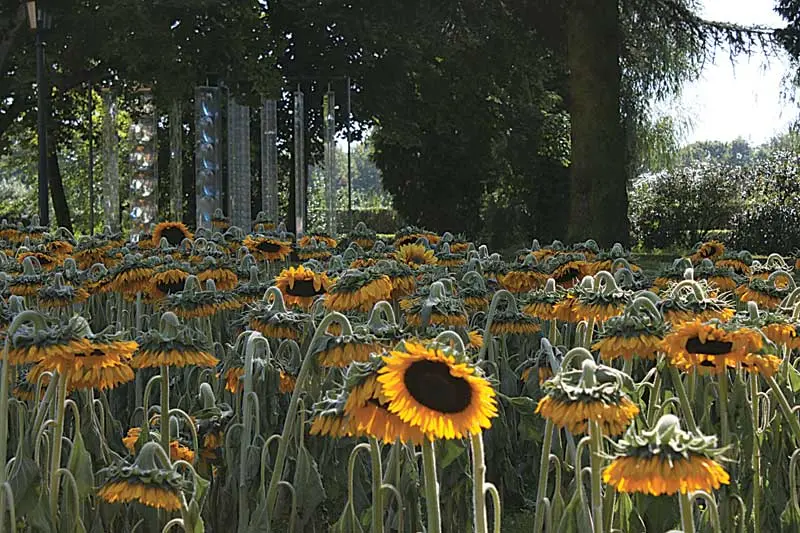
In the midst of such ceaseless flow, began to signal the logic of a second series, by 2000, which could be nothing but a corollary of the passage of time. There appeared then flowers by the seashore, on a sandy substratum where we know they cannot grow, so all those languid, wilting plants are emphasized as natural while their artificial counterpart remains standing. In 2009, León repeated the process with 200 natural sunflowers planted on the walls of the Morsbroich museum in Germany, which also were unable to grow while a single sunflower made in modern resins rose with the appearance of life. Along that path, we arrive at a consideration of the relationship between the instant and the eternal, another one of the artist’s accurate titles, where the dichotomy between what is natural and what is created is renewed for Cuban Art, just as José Manuel Fors’ photographs did thirty years ago.

This journey takes us, with the support of installations, performances, and digital photography, to the special place where the artist wants us to be: an inner garden. And it is in that very interiority that a large portion of her work is located.
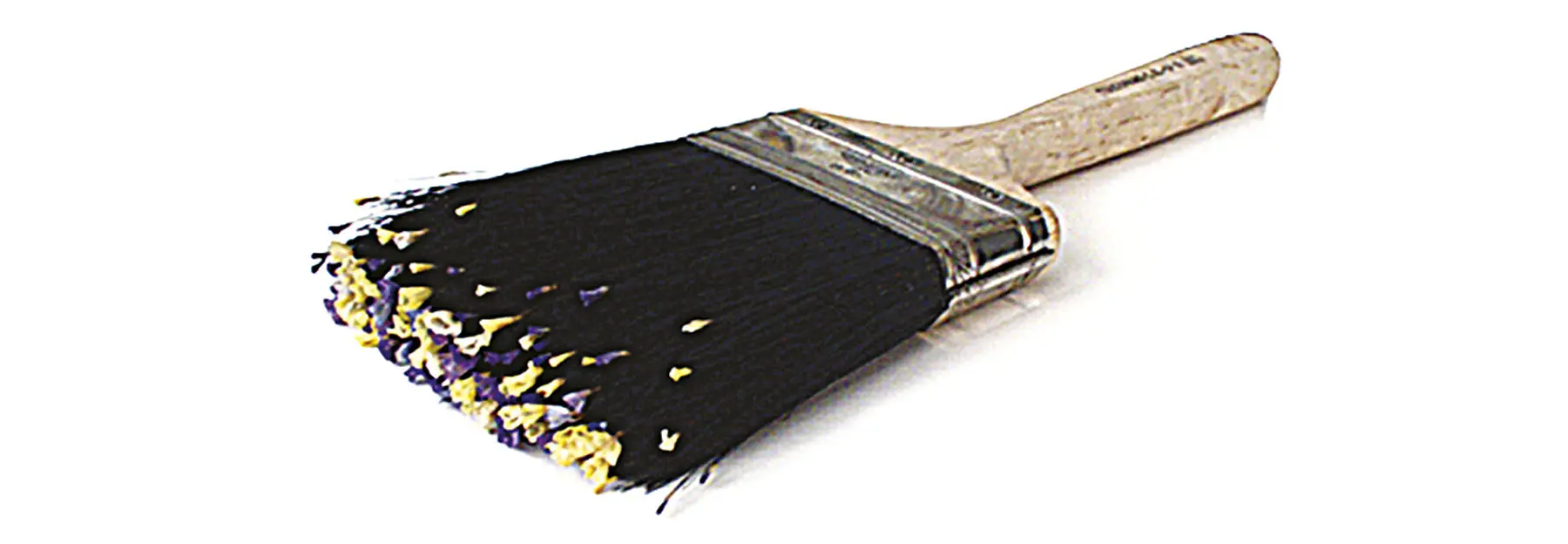
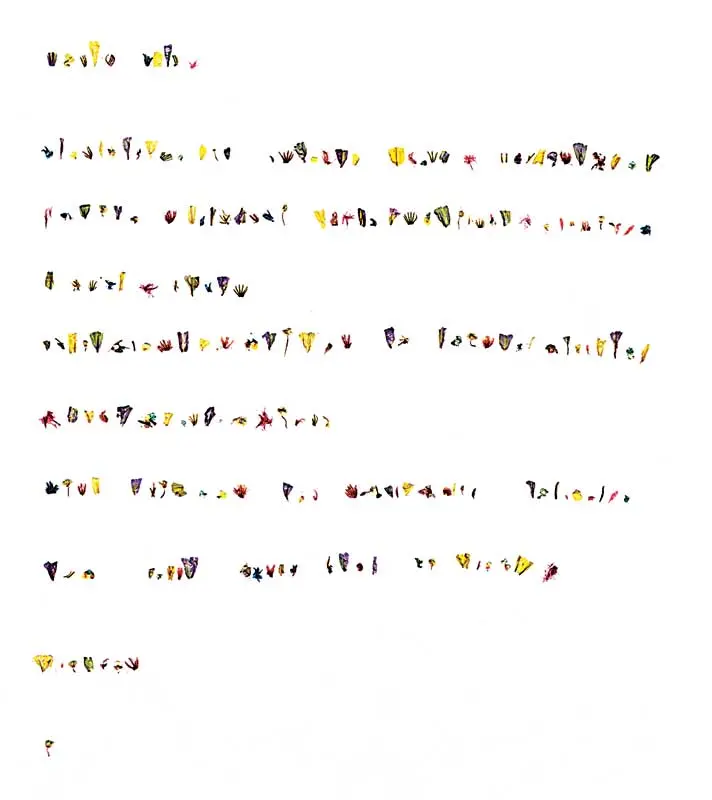
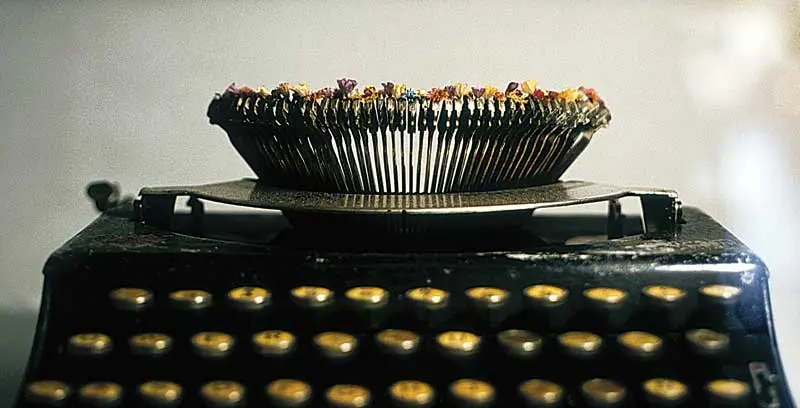
This interiority houses, for instance, an entire world of magical found objects, as indicated by her series of that title (Objetos mágicos encontrados), which started around 2003. With great charm, these glasses, brushes, or pianos carry small flowers, symbols of finding, and speak of how we can achieve greater happiness through the magic that objects hide so that, in perceiving it, subjects are moved towards beauty, the good, and tolerance, and are made to externalize what they carry inside.


Habitat is a startling installation of nature as our home, with a white-cloud sky and a bed of damp earth and fresh grass, while the spectacle of the stars and of creation is presented in the wall across by the associated work Noche de fantasía. I wonder what more could be asked in order to deal with the universe than this haven for thought, enlightenment, and seclusion. In yet another work, viewers can have the unending passage of clouds entirely for themselves: a large, dimly lit gallery where a video projection allows us to imagine, at will, a mapamundi of geopolitical cloud formations. Confronted with an immensity that makes us feel by turns ridiculous and transcendent, we can afford the luxury of abandoning ourselves to the mystery of the unknown.
The strong appearance of simplicity in León’s works, their ways of unassumingly being on the walls and the rooms of her exhibitions, contrasts powerfully with her continued suggestion of refined and surreptitious interpretations. A striped butterfly whose fixed wings are hidden inside the wall, the photograph of a solitary tree with birds for its foliage, or the weightless plumage that substitutes for the birds are displayed for reasons beyond their succinct corporeity. I came to understand them as subtle ruses rather than soothing works of art, from an artist who feels herself an observer of the world and an investigator of the grand question of existence. León’s is a singular repertoire of actions that assays the flow of things and of humanity. In her videos, she explores her own self as well: she takes account of her deafening heart, scrutinizes the passage of air through her lungs, and compares and calibrates her vital rhythms to the rhythms of waves and clouds. Glenda León self-observes. She observes us. And she brings forth her works like trophies of recognition and expectation. What León presents us with is not mere lyricism or a desire for bauble skies, but a keen awareness of small everyday actions that connect with certain decisions in our own lives.

I do not believe that the earrings used for stars against a large, dark-colored field, or that the chewing gum adopted as white clouds, wheedle us to choose between reality and fiction, degrade our illusion of the real, or are made only to confound with the same old workaday sleight of hand. Rather, I think—with Magritte—that “if one looks at a thing with the intention of trying to discover what it means, one ends up no longer seeing the thing itself, but thinking of the question that has been raised.” That was exactly what I found in León’s clouds and in her work in general: an investigation around questions of existence.
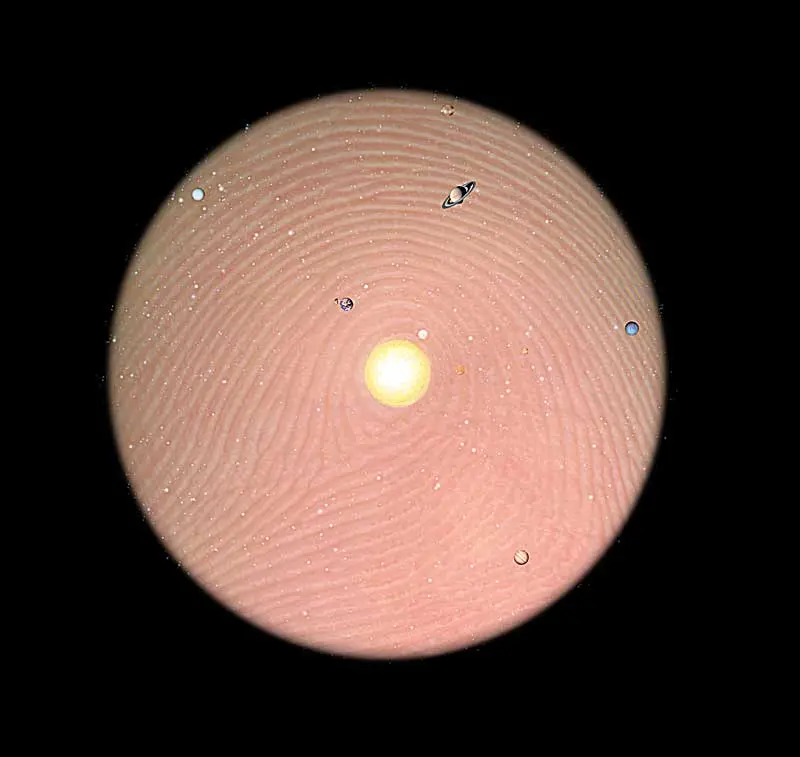
These speculations acquire greater density in the correlation between self and cosmos. A set of works from 2008 began to suggest the reversibility of identities from the macro- to the microcosmic: Man can be the cosmos, the cosmos can be Man. Peering through the opening of a small black box on the wall, we see a glowing fingerprint that could come from our own hand and, at the same time, be a cosmic trace, a mark of creation. This desire to perceive the system of the universe as unity has large cosmological resonances and resolves itself in works of art of rare intellectual intensity.
Although her ecstasy is infectious, I was overly unsettled by León’s repertoires of descent and the extreme plasticity of her vision. We sat together in a quiet colonial patio in Havana’s O’Reilly Street. There I heard her say that her greatest influence has been a peculiar storybook: La mano de la hormiga, a gift from a friend. These confessions put me on guard, as I remembered having been told that Duchamp explained that the true origin of his The Bride Stripped Bare by her Bachelors, Even… had been a theatrical presentation of Raymond Rousell’s Impressions of Africa, where he discovered a wealth of conceptual possibilities.
And how my suspicions were confirmed when, in the course of our chat in O’Reilly Street, León mentioned the impression made on her the contemplation, at Tokyo’s Palais, of a Theremin! In a flash, I became aware of her Duchamp-like mechanical, engineering side. She told me she had been rendered speechless by that 1920s device, a fruit of the Russian avant-garde and a pioneering landmark in the electro-acoustic universe!
The Theremin, Thereminophone, or Termenvox, invented by Lev Sergeyevich Theremin (St. Petersburg, 1896-1993), is considered the first electronic music device.
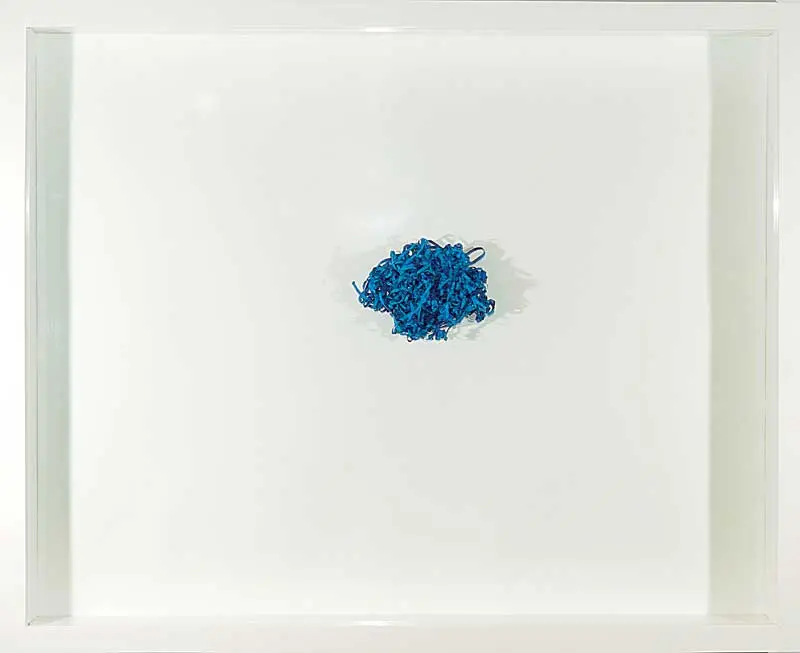
León left me no alternative but to recognize the phenomenon of transposition. I had never needed it; I don’t really know what it is. But nothing gets me closer to her work. We see it in Un ruido azul (Havana Gallery, 2010), a show filled with transpositions where music and the world of sound are mesmerizingly entwined with volumetric forms, photographs, and drawings. We see a music box made of vinyl discs or an exceptional Radiohead song expressed through a graph built from its audiotape recording. We see wonderful acoustic drawings wherein we are invited to hear ourselves, the stars, or the beating of a heart. Un ruido azul is a minimal drawing made by painting an audiotape ribbon and making it into a tangle, which then appears as a splotch on a piece of construction paper, like one of Yves Klein’s anthropometries. This succinct indigo splotch, wrapped in its synthetic-fiber labyrinth and placed soberly inside an unimpeachably white, indispensably thick box frame, creates an artifact that is plural in its synesthesia mystery, while a current of vibrations invites us to listen to who knows what manner of noises or voices filtering through from our own inner garden. The series Delirio delights in the hallucinated observation of shifted natural elements: the grass in a peaceful meadow sprouts butterflies instead of flowers; the leaves of the solitary tree become birds about to take flight; in the safety of the night sky, the stars that watch over us are actually flowers showering down a celestial musical score by Fernando Fors.
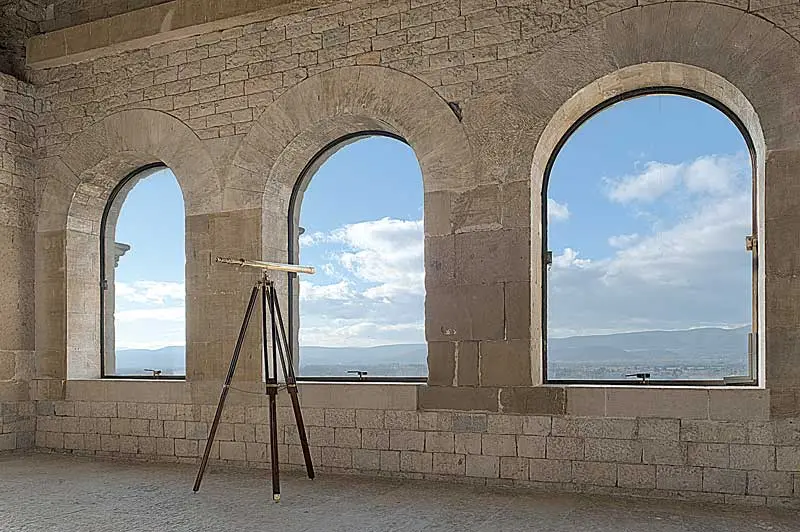
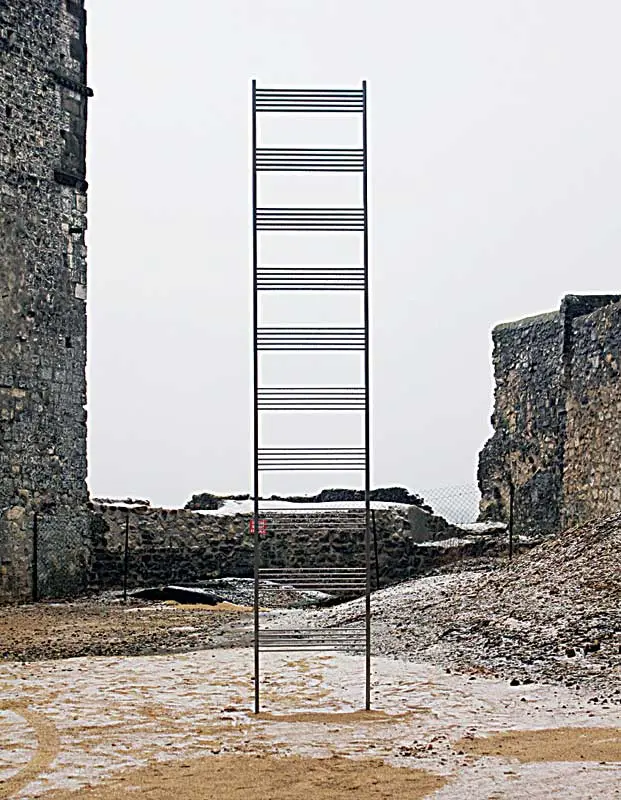
In her most recent show at Château des Adhémar, León revisits the issue of the identity of Man and Cosmos and opts to present us with a telescope pointed to the sky through a large opening in the castle. The artist is sure that if we focus the lenses toward the incommensurable diorama of cosmic existence, we will find answers that are equally valid for the humble nanometry of our inner gardens. Thus, what the observer sees through the telescope is still the fingerprint of Man, now ringed by planets. And for those not content with contemplation, outside the fortress she placed an instrument of ascent: a veritable stairway to heaven, made in iron, with steps like pentagrams and improbable physical stability, inviting us to the elevation of our spirit.
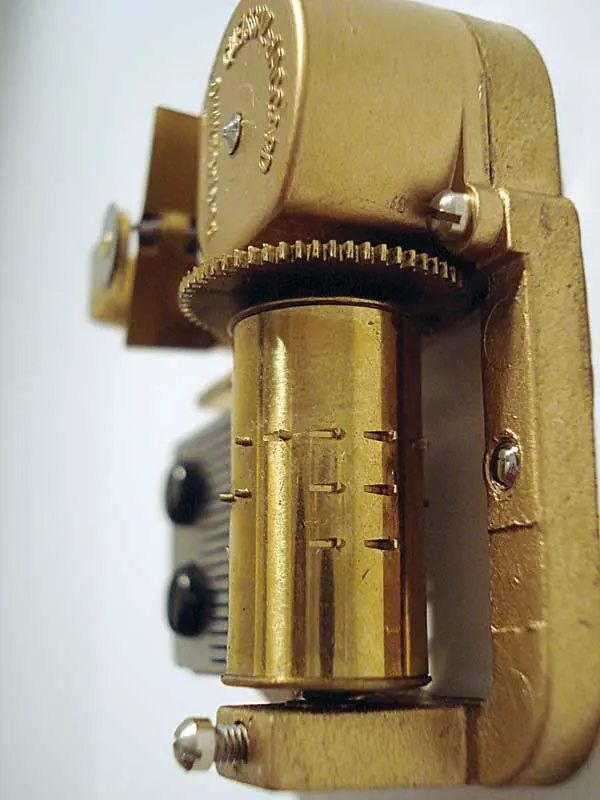
The apotheosis of transposition occurred in Mundo interpretado (2009). An idea with verbal roots—the names of God according to the world’s most populous religions—was translated into the Braille alphabet. From an initial writing-based vision, León had jumped to the hand tracing a relief. And from that tactile experience, all the names were transferred to a world of sound: using well-tempered Swiss mechanisms, the sacred names were recorded in the five metallic cylinders of five music boxes, in order to give us a circular space where we were able to see, hear, read, and feel, in sensorial plenitude, the absolute concord of the world vibrating in the names of its deities.
So much plasticity, so many cosmological explorations, so much listening to silence, such tactile labyrinths, such interest in the dream-like explosion of molecules, so much horizontality bursting from so many sensitive avenues could not but result in the unique creative practice—centered on a cognitive, propositive and ecumenical cosmology that abounds in curiosity, inventiveness, and verbal engineering—that comprises the triangular dream that is the work of Glenda León. I couldn’t find a better way to approach her oeuvre than through a story by Pessoa, as I did through Duchamp. León’s associative world comes close to the triangulation of synesthesia in the poet’s brief narrative.
When we were about to part ways at O’Reilly Street, by Factoría Habana, León told me she was drawing Estados transitivos: an even greater transposition, using the musical scores for two hundred national anthems transferred to music boxes. A giant Theremin would invite us, through an overabundance of sounds coming at us all at once, to disengage from the inflamed notes of warlike nationalism, forcing their acoustic waves to jumble together, somewhat dislocated from their beats but ready to leap towards the final transposition: the moment when we shall become, as in a feat of magic, a deliriously better world.
CORINA MATAMOROS
Writer and curator of contemporary art at the National Museum of Fine Arts, Havana, Cuba.