
The work of Iván Navarro is a critical reinterpretation of the minimalist legacy. His well-known neon sculptures, heavily loaded with political content, challenge minimalistic asepsis and establish themselves as an uncomfortable question posed to the public that comes attracted by the light.
Iván Navarro: Fluorescent Sculptures is the title of the exhibition presented by the Frost Art Museum at Florida International University (FIU), which opened its doors during Art Basel Miami Beach. Curated by Julia P. Herzberg, the exhibition is comprised of three videos and seventeen sculptures (three of which rest on the floor, the rest are on the wall). The exhibition includes a premiere, as this is the first time that the series Nowhere Man is presented in its entirety in an American museum. This work has been previously exhibited in London, in 2009.
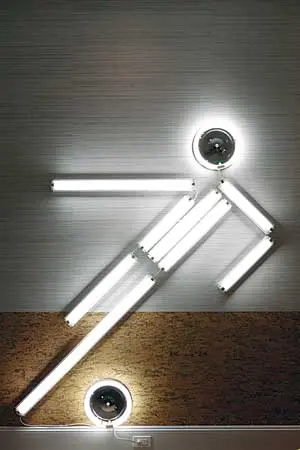
Nowhere Man, which takes its title from the famous song by the Beatles, appropriates Otl Aicher’s iconic pictograms for the 1972 Munich Olympic Games. Aicher’s pictograms, with their previously unseen simplicity, soon became universal symbols. His stick figures are reinterpreted in this series by Navarro by means of common, industrially-produced white neon tubes that emphasize the generic idea behind the work. The light silhouettes that surround the visitor appear in the midst of completing sporting feats and are built according to Leonardo’s ideal proportions. This series is an unsettling counterpoint between the humanistic sense that holds up the celebration of the Olympics as an ideal, and the logic of consumerism that animates post-industrial society.
Navarro’s schematic figures serve as a backdrop for the sculptures that, arranged on the floor, establish a direct dialog with them. Among these sculptures, a standout is Electric Chair Blue and Red (2003), which comes from the Margulies collection. Electric Chair… is a symbiosis of the chair designed by Gerrit Rietveld in 1917, with its neo-plastic features, and the minimalist light-based work of American artist Dan Flavin. The chair possesses a strong conceptual charge. First, the object is, at the very least, ambiguous. Its functionality is doubtful. Based on color neon lights, the fragile seat, powered by electricity, becomes threatening…
This work brings to mind another one of Navarro’s well-known chairs, created some years ago: You Sit, You Die (2002), a folding chair built of white neon tubes on whose seat were inscribed the names of all the people executed in Florida to date. Three years later, Navarro made another version of Rietveld’s chair, all in white neon tubes. He tiled it Electric Chair.
All the artifacts created by the artist are common objects: chairs, openings, ladders, inhabited by a disquieting tension: they are beautiful and dangerous at the same time. For Navarro, whose childhood took place in the dark years of Pinochet’s dictatorship, more than a functional furniture item a chair is an object of torture. This is also the case of his doors, as epitomized by the installation Death Row, presented by the artist at the Venice Biennale in 2009, representing his native country.
In the case of the ladders, from which the Frost museum exhibits Red Ladder, belonging to the Cricket Taplin collection, we encounter a space of transit and desire. The light invites us to ascend. However, we know that it is impossible to scale this fragile structure.
The insoluble relationship with light that characterizes Navarro’s work was born from his own childhood. Power outages were so common at the time as an instrument of coercion by the dictatorship, which in that way forced citizens to remain inside their homes and respect the imposed curfew. Light becomes in the artist’s proposal an element of control that contaminates and predetermines our existence and behavior.
JANET BATET