
Master/Copy is the title of an exhibition featuring works by two Colombian artists, Wilson Díaz (Pitalito, 1963) and Juan Mejía (USA, 1966). At the beginning of this story, they were both living in Cali.
I first became acquainted with their work at a Regional Salon in 1995. These Salons were exhibitions held in different regions of the country for the selection of participants to the following year’s National Salon. On that occasion, I was a member of the jury, with Álvaro Barrios and Gustavo Zalamea.
I remember that the three of us walked around the Salon in the Roldanillo Valle museum on our own, encountering many oil paintings of pink, green, and yellow forests that were easy to combine with the furniture of any living room, greatly admired by buyers and even by the President of the Republic and his wife (with their excellent taste), and even by a number of critics. The three jurors alighted on two works by two unknown artists (unknown at least for me). One of them was a space that truly moved me and still does in my memory; at the time, it reminded me of an adolescent’s room with vinyl records, posters, piggybank figurines, and candy. It was titled Punto de venta and it was a work by Juan Mejía. Today I see it as a space that offered a widening of the coordinates of art-making, which ever since has been defining for Colombian art. Coordinates now closer to me or anyone else, closer to neighborhood bodegas and stationery stores, closer to our school experiences. This work was a meeting point with a collective memory that is not built on the basis of abstractions or concepts but is slowly woven by “trifles”, as Virginia Wolf would say in the voice of her Mrs. Dalloway. Textures and small, unimportant objects are nonetheless witnesses and detonators for the confusion and the pleasure of life.
Another work we encountered at that salon was Sementerio, by Wilson Díaz. It consisted of a series of semen-stained pieces of paper affixed to the wall. They became, visually, a “painting: with all the colors of oxidation and also with a title that inaugurated a notion of the archive of bodily, personal traces.
There weren’t any doubts: through those two works, Colombian art was to enter into Georges Perec’s pious attitude of compiling lists to capture all that the culture had deemed marginal, in bad taste, and meaningless.
But above all these works inaugurated a way of displaying experiences as such, not as a disfigured, stylized, distant representation but “at the heart or their emergence.”
Well, many things happened after that. Juan Mejía insisted on drawing and explored it from many vantage points and through many materials, turning it into the communicating thread of his thoughts. Drawing appears and reappears constantly in his work, mutated into autobiography, an ethnography of the culture, fictions, and archives.
And Wilson with his paintings, especially one that, for me, is an icon of Colombian art in the 1990s: Marte, where two adolescents look at the camera or the viewer, I don’t know which, in a home that is filled with signs of their times, as familiar as they are strange. And also Fallas de origen, the winner of the 1998 National Salon, another work that requires us to read the signs of an era, this time framed in the scenario of the small family home, the family savings, the fairytale, all those illusions traversed, as Wilson says, by TV, dreams, the poverty of the streets, and the “small matter” of coca and poppies, which at the time weren’t talked about all that often.
In truth, these two artists deserve greater space in every sense, but… to the point! This article is intended to celebrate the exhibition curated by Guillermo Vanegas and covering the three years when Wilson and Juan worked together after winning the Regional Salon, 1995 to 1998.
The exhibition records a moment when our exhibition galleries were spaces to share, through photographs, the pleasure felt by two who are together, and that before Sophie Calle appeared in our horizon. We could see the copy of the work of a Colombian artist invited to the Venice Biennale. Not exactly a copy, because in truth, based on Elias Heim’s work these two invented a machine that combined cube, funnel, serious-looking yet useless cables, a device of a laughable appearance of seriousness, a play with modernity.
We were also able to see again a peculiar hall of fame, a collection of portraits of personalities of all kinds: “beautiful, damned talented, interesting, prolix, rich,” which these two artists drew and painted and which became a hall of fame of styles. And we also saw their comic book covers intervened with the misadventures of the silver-masked hero among all kinds of evildoers; horror and pleasure, above all the pleasure of painting.
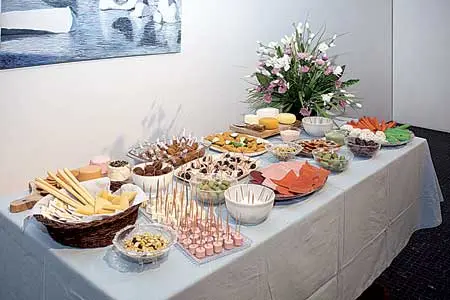
A separate chapter is Primera impresión, a work created on the occasion of the 30th anniversary of the Museo de la Tertulia in Cali, in 1997, where visitors were greeted into a space with a table, a sunshade, and a cement dog with a naïve and perverse security guard and, of course, with tasty snacks made in rare materials that were, nevertheless, effective to make olives and carrot sticks the protagonists of the exhibition. Then as now, with their sharp language games, Juan and Wilson brought forth marginal perceptions that nevertheless revealed twenty years in the history of our culture.
NATALIA GUTÍERREZ