
Leandro Erlich’s splendid exhibition Un ascensor, tres nubes, una tienda, tres fotos, un tren, una puerta rota y un jardín perdido confirms him (Buenos Aires, 1973) as a consummated maker of illusions. According to the artist, the title expresses his intention to create an inventory, because “a list of things is a list of universes”. In that sense, Erlich’s installations, objects, sculptures, videos, and photographs are living worlds that allow viewers to feel like their true protagonists. “I am interested in viewers’ participating in the work, interacting at a 1=1 scale, with the border between space and work of art rendered indistinct.”
Erlich’s works are visual traps, at once concealments and revelations that shift the perceptual field, demand concentration, and shake viewers’ conformity. Erlich, who began his career as a painter and lives and works in Buenos Aires, produces provocateur works of art that travel widely around the world; he was even part of the Argentine delegation to the Venice Biennale in 2001. Visitors to his large-scale installation La Pileta, presented at the Fondaco dei Tedeschi (now the Poste Italiane), used a lateral opening to enter a cube that, seen from the upper levels, simulated a water-filled pool with fully dressed people walking about inside it.
Conceptual in nature and technically inventive, brimming with intelligence and humor, Erlich’s works in the gallery’s two spaces illuminate the possibility of new meanings and sensibilities; they question normalcy and space, creating invisible mechanisms to prod our fantasies. These works invite viewers to use their own memories and experiences and to let themselves be carried into the world of their imagination.
With pure sleight of hand, where some see cotton balls (they are not) encased in a display of lapacho and glass, the artist suggests the presence of captured clouds Nubes (Single Clouds, 2012); he will convince the most reticent member of his audience. His Cambiadores (Changing Rooms), 2008, are not what they seem, either, despite the careful deployment of mirrors, gilded frames, benches, and curtains. It is a labyrinth and not a labyrinth; it is difficult to take a single step without the feeling of losing one’s sense of proportion and balance. Near the Cambiadores, neatly arranged in wooden shelves, Erlich’s Camisas, 2012, is made of clay and appears cracked, like his Puerta Rota (Shattering Door), 2009, which, although astonishingly real-looking, takes us nowhere.
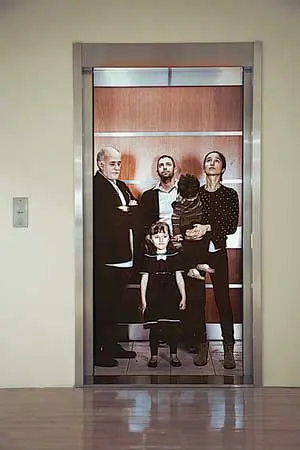
The iron doors in Conversación de Ascensor, 2012—resembling those used in any automatic elevator—open and close in sequence at regular intervals. When open, they reveal a number of people behaving as they would in a regular elevator. If alone, these passengers look up or fix their gaze forward, check the time or their cell phones and act as though no one could see them. If accompanied, they look out from the corner of their eyes, children pull their mother’s clothes, some chat with their neighbors. As the doors open, close, and open again, the elevator seems to fill up and empty out as a real one would. Really? Skillfully, the artist uses back-screen projection and high-definition video to place viewers in the situation of people waiting for their turn to enter the elevator.
Erlich’s works are easy to describe, but they are not simple. For several years now the artist has collaborated with construction worker’s unions too, as in this case, erect walls, place floors and doors, install windows and glass panes, phosphorescent lights, and artificial plants like those in Jardín perdido (Lost Garden), 2009. The photographs on the exhibit belong to the series Bâtiment (Edificio), 2012, created in Paris, where a mirror mechanism reflects visitors as if boldly climbing up a building’s façade. Erlich presented a similar installation for the 2012 inauguration of Usina del Arte, a magnificent, repurposed cultural center owned by the City of Buenos Aires and located in the La Boca neighborhood.
In every one of his works, Erlich presents viewers with specific experiences and specific situations. He lets us interpret his works with great liberty—the same liberty with which he produces them—as in Global Express, 2011, a Blu-Ray disc projected on a plasma screen framed in folded sheet iron and aluminum, resembling a train window in appearance and dimensions. The astonishing images last somewhat over eight minutes and take viewers on a dazzling high-speed train journey through cities like London and Paris.
Halfway between presence and chimera, Erlich’s works question certitudes and presuppositions and pose for the viewer the same question the artist poses for himself: What do we see when we see?
VICTORIA VERLICHAK