
“Brother, esto está en candela” (“Brother, this is on fire”): this is what Cubans say to one another when commenting on the adversities so many of them have endured for over 50 years. Compadre, usted sí que es la candela (My friend, you are really fired up): this second use reveals the word’s polyvalence and ambiguity in the Cuban cultural context. The positive or negative semantic load of candela (being on fire or being fired up) depend on the social use or the many socio-anthropological implications of the term, at times divergent to the point of paradox. But at any rate, and beyond these linguistic considerations, it needs to be said that such a degree of associative digression does not figure into the requisite tropological essay undergirding this new work by Los Carpinteros, presented in one of Madrid’s most appealing exhibition spaces. To approach this site-specific work of art from that vantage denotes a certain hermeneutic clumsiness, as well as certain congestion and paralysis of critical judgment. Especially in center-based circulation spaces, the work of Cuban or Latin American artists who live outside their native contexts is often read from the standpoint of suspicion or “presumption of dissidence” with respect to their place of origin. Yet it may be that plenty of the work produced in the new cultural context is an artist’s greatest and most sophisticated slap in the face of the Art institution that exhibits and commercializes it within the field’s new parameters. I certainly see this as one of the great virtues of this new work produced by Los Carpinteros from within the space of hegemony: using the ambiguity of the aesthetic sign as a rhetorical detour in the chain of meaning to redirect the sources of their discourse.
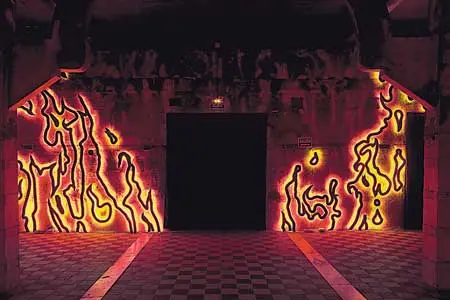
Can anybody deny that Spain is on fire? That Spain is burning or has already burned, inside and out? Who in his or her right mind—no bitterness or irony here—would deny that a scandalous arbitrariness and a concert of glaring paradoxes are now the portraits of a country whose most cherished social supports and constitutional promises have been brought into crisis by economic and social deterioration? Thus, I am obliged to once again acknowledge the presence of two great artists, two great makers of allegories, two chameleons whose powers of interpretation know no bounds. I have said it before and I shall repeat it here, with a certain degree of jouissance: Marco Castillo and Dagoberto Rodríguez could have traded their moniker of “carpenters” for that of visual essayists a long time ago. Their work has become increasingly more sophisticated at several levels of articulation and resolution. Not only at the conceptual level, which has gained them recognition as one of the most significant art collectives in the Latin American context, but also at the formal and structural levels, where they have proven, with abundant dexterity, to be fired up. I can no longer tell whether they are architects, engineers, writers, publicists, performers, or installation artists. Perhaps they are all of that at once and I haven’t understood it yet. What I have undoubtedly understood is that they are excellent artists. They adroitly handle the internal structures of discourse while working with enviable skills in a diversity of supports and materials. In a scene such as Spain’s, so riddled with the kind of art whose muddled structural ideology competes with the mere decorative object for IKEA-worthy status, it is gratifying to encounter a display as superb as Candela, where, I insist, the conceptual element functions in outstanding synergy with form and placement. Here, “artwork” and “space” are the same things: it is impossible not to acknowledge the effectiveness of their selection of a “motif” and its placement on the burned walls of a former cold-storage chamber in the Legazpi abattoir.
The facts that the technique used is common in political propaganda across Latin America, or that backlight drawing is a universal resource in the formal-narrative chain of advertising, are not that relevant; neither is their reference to the famous Che Guevara image that dominates Havana’s Revolution Square. These data are, in the end, useless, and reveal the gap between art criticism and art journalism. While criticism burrows deep into the mass of socio-cultural implications present in the work of art and investigates a given proposal’s ontological density, journalism is distracted by coincidences and seeks to situate the work of art within a landscape where each and every one of its references is credited, regardless of how banal.
With its referential and discursive autonomy, Candela can be understood as a writing exercise that not only revisits a catalog of sources and allusions to more or less conflicted political contexts but also narrates a contemporary situation constantly on fire for both Man and art. A restless, convulsive, schizoid, demented situation bearing the rhetorical and symbolic figure of madness as its standard: madness as the sign of our time, its identity a derailment of the modern promise. Candela makes it clear that the emancipatory gesture contained in the ideals of modernity and in modernity’s utopian impulses against the tyranny of shadows is today nothing but a deathly grimace. What is it that burns among these flames, with their kinetic, ghostly recurrence? What is the purpose of this fire, translated into an orgy of erotic-aesthetic impulses? Perhaps the Inquisition has surreptitiously returned in the models of contemporary corruption. What is burning? Art, artists, the system, writing itself, the Letter… let it all, and more, burn. Something is happening, the smoke signals say, and that at least dulls the edges of our anxiety, dispels our state of paralysis, obliterates all prosthetic models, and celebrates an always limitless lust for freedom.
ANDRÉS ISAAC SANTANA