
The exhibition by Marcolina Dipierro at the Galería Jorge Mara synthetizes the inquiries that this young artist has been working on for approximately five years. The perceptive tensions between plane and space are an important focus of Dipierro’s work. Yes, she does not solely explore the ambiguity between two and three-dimensionality but also delves into the sensorial qualities that they stimulate. Dipierro inquires about the tensions between the homogeneity of the digital rendering and the porousness of paper, between the invariants of the idea, and the accidents of materiality.
As a result, the love triangle between plane, space, and architecture is the connecting thread of an inquiry that the artist has been obsessed with for a while now. She is interested in placing herself at that point of torsion between a drawing of the volute and the volute placed in the architecture; between the structural and the ornamental, two forces at play between the building and its decorative elements. About this problem, and on the occasion of another exhibition by Dipierro (Planograph, 2010), Teresa Riccardi reflected with a beautiful metaphor: “Flatland, 1884 by A. Abbott was the door to subtle geometrical compositions that in this case would tense issues of colorin a struggle to find a new dimension on the wall. Likewise, the exercise Dipierro executes surrounding this tension between the work’s surface and the real space owes credit to the explorations by Lygia Clark, both in her Planos en Superficie Modulada (Planes on Modulated Surface) and in the series Unidades (Unities).”
While Clark embodies a long abstract South American tradition, Dipierro’s adoption of this poetic is not merely a matter of the repetition ad infinitum of form—a path taken by many of Clark’s followers—as she has succeeded in modulating it, transforming it, and even abandoning it when her reflections on a particular space would demand it. Such was the case of her intervention of the stairs of Proa (RAM, 2010), in which she impugned on the wall the strips from an essential axle of that type of architecture. This also occurred in Ficción Encendida (Lit Fiction, CCEBA, 2009), an exhibition that also included artist Julia Masvern, in which the goal was to dismantle the architecture through projections of digital animations; or by inverting the geometry with plants in order to defy any pretension of abstract purity. The work in question was Agencia de Asuntos Sub-Tropicales (Agency of Sub-Tropical Affairs, 2012), at the Espacio de Arte Contemporáneo, in Montevideo, Uruguay.
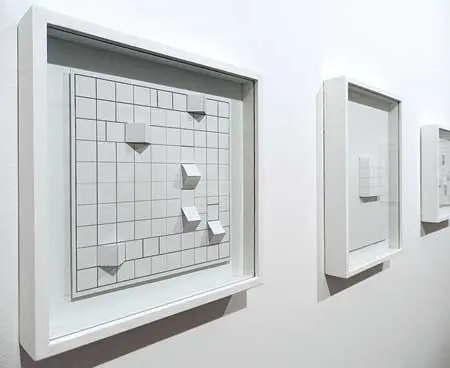
Complemented by a complete catalog, the exhibition presented at the Galería Jorge Mara offers a synthesis of these inquiries. This opportunity explores the volumetry of the plane and the planimetry of the space. In her collages with graph paper, Dipierro underscores the rigorous weave as she produces subtle hiatus and shadows. Both the volumetry of the plane and the variations of the lines that constitute the homogeneity of the weave are light dislocations that provoke our perceptive action. Marcolina Dipierro summons flashes from the inquiries of Kinetic Art, but she is not as insisting on our perceptive possibilities. Unlike the collages, the spatial structures exploit her planimetrical side: the checkered wooden “sculptures” or the iron grid device emphasize her linear side. These are productions interested in losing their third dimension to dissolve into the paper or wall. In this instance between the volumetry of the plane and the planimetry of the space, resides the power of this subtle and reflexive proposal.
MARÍA AMALIA GARCÍA