
Mauro Giaconi (Buenos Aires, 1977) has developed his craft in the fields of sculpture, installation, and more predominantly in recent years, drawing, a discipline he approaches with pencil on large paper. Initially, Giaconi was interested in pursuing a career in architecture. Nonetheless, he abandoned that pursuit to focus on the visual arts full-time. Season of Lead is the title Giaconi gave to the exhibition at the Galería Arróniz, in what is his second exhibition in Mexico City.
To describe the exhibition in the simplest of terms: it is a large drawing presented in the manner of a mural that transforms the environment and the viewers’ walk through space. Nonetheless, it is not solely a drawing but also an intervention of a gallery used as territory for experimentation through a visual and architectural approach. In this work, it becomes possible to observe the influences of architecture in Giaconi’s work as well as his desire to transform it through specific concepts and actions.
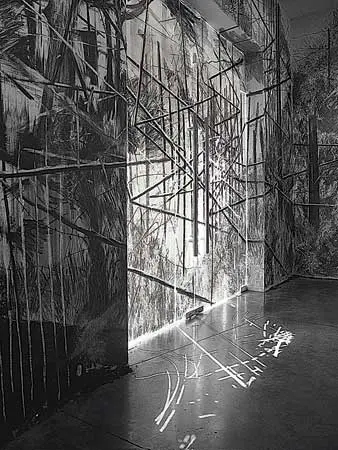
The work has no boundaries, like any limits that divide the exhibition space become some sort of translucent walls that catch sight of the exterior, the surroundings of the gallery. The drawings on the walls have some traces of a fence, a wire fence, light effects, buildings, urban furniture perhaps; but at the same time, it is possible to perceive trees and bodies of water. It is a confusing dialogue between the exterior and the interior, between the park in front of the gallery and the bleak urban setting.
This undefined landscape achieves an unsettling sensation, a tension between reality and the evocation of a timeless, accessible but diffuse space. The gallery’s architecture is transformed into scenography, its walls turn into a large window that merges reality with a new, unfinished, vision of the surrounding that is nonetheless latent and open to various interpretations and sensations.
The architectural space was transformed and, as a result, it acquired other dimensions achieved solely with a pencil and an eraser. The pencil functions as a transformative tool that creates layers and matteric superimpositions that preserve the passing of time and its memory, as it also defines a space that is able to merge the exterior with an imaginary interior. The eraser as a tool that deletes and eliminates the traces but that also draws and creates other marks.
Giaconi creates a work full of textures, forms, lights and a space that is diametrically opposed to the white cube, through an intervention that relies on the pencil to generate atmospheres and territories; where the paper is replaced by walls intended to define the boundaries but also to support the development of other dimensions and to generate space between fiction and the physical interaction between the body and the walls. While the walls serve to frame or outline segments of the work, they also open to showing other surroundings, other images, and other volumes that reach well beyond of that which would appear to be perceived.
Giaconi said in an interview that his intention was to work with a very simple technique, but one that offered a constant contradiction. Pencil and eraser cancel each other out. The eraser eliminates that which the pencil proposes. This superimposition of constructions and destructions are the elements that shape the image.
The artist has also mentioned that the city somehow influences his work, as the urban landscape itself is also a very attractive area for experimentation because of constant chaos that, nonetheless, never prevents it from remaining functional. It is a place of infinite possibilities and transits that, at the same time, is a little menacing. And this is a characteristic that Giaconi conveys in his works: an environment surrounded by layers that keep a manual, detailed, process. The graphite, also referred to as black lead, is included in the title of the exhibition perhaps to metaphorically suggest heaviness or the existence of tension. This would appear to be contradictory if we consider that the meticulous work will eventually be erased to become something ephemeral that will disappear as soon as the gallery begins to get ready for its next exhibition and the walls are back to their traditional white color.
The work by Mauro Giaconi has been presented in solo shows in cities like Marseilles, Miami, and in the artist’s homeland, Buenos Aires. He has also participated in group exhibitions at museums and galleries in London, Boston, and São Paulo. Among other recognitions, Giaconi was granted First Prize at the Philips Award for young talent; Honorable Mention at the Salón Nacional de Dibujo; and was selected for the First and Second Award of the Arte BA-Petrobras Award.
ISAURA RUIZ