
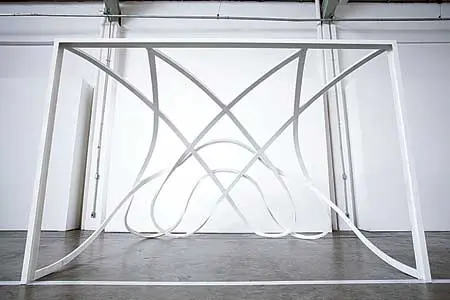
French-Argentinean artist and designer Pablo Reinoso succeeded to infuse the essence of his work in the game of soccer. An exhibition presented at Baró Galería, in São Paulo, became the opportunity for this artist to transform a former hangar where the gallery is located at into a ludic soccer field. The exhibition entitled Fútbol Firulete (Soccer Arabesque) presents a group of pieces arranged across the ample space of the gallery in the form of a large installation. The elements common in a stadium—beams, arches, benches, etc.—were interpreted by Reinoso who relied on a visual resource that is pretty recurrent in his work: the spiral forms known as spaghettis.
The exhibition was also used by the curatorship for the realization of an ”indoor” soccer match between the spectators. It thus became the maximum expression of the artist’s purpose: namely, to create works that offer interaction between art, space, and the public. The title was chosen for the transformation of the cultural space into a “sporting area” that was inspired by the name used in Argentinean Soccer jargon and also to designate a Tango step. It is also a reference to the filete, a typical graphism in the Art Nouveau style that is present in the display windows of businesses in Buenos Aires.
Like the sinuous and asymmetric lines inspired by vegetable-themed decorations of European origin—that emerged during the 19th and 20th centuries—the organic forms are very frequent in the works by Reinoso, whether in wood, marble, steel, among other materials. Both as an artist and as a designer, Reinoso resignifies objects and offers new aesthetic paradigms. He adds design to his art to create works that sometimes even befuddle viewers in terms of their aesthetic and practical function since many a time there are no borders between those two territories.
It is precisely that very thing which occurs in the new installation. The monumental forms of the pieces overfill the gallery and transform it through the occupation of several planes across space. Reinoso proposes in this manner an authentic visual explosion as if he wanted to suggest the highly emotionally-charged environment of the sport. He proposes a poetic version of the atmosphere experienced in a soccer stadium. It is clear in this work the constructive thinking of the “artist-designer,” his interest in space and matter, and, of course, his technical virtuosity.
The characteristics of his work respond to the influence of his academic years, first as an architecture student—not completed—and then followed by a career in psychology, which resulted in an unusual combination between pragmatism and lyricism. The most emblematic elements of his work are the benches with borders that expand to create spiral shapes that go in different directions, often reaching large dimensions and becoming very enigmatic.
Each work presents singular sculptural traits. For instance, the wooden bench installed at the Museo de Arte Latinoamericano in Buenos Aires (MALBA)—whose extremities expand through the walls across two stories of the building—impresses visitors because of its unusual aspect. A similar dialog with the architecture occurs with the wood bench installed at the Hôtel du Marc, in Reims, France, as it also has one of its extremes going through an internal window. One has the feeling that these works are alive as if they were climbing plants that expand on the walls and get all tangled.
When Reinoso works with metal, he reveals an even greater obsession with exploring the limits of the material, as he contorts the forms to the extreme. Benches appear to be melting and intertwined strips represent real challenges to the rigid nature of the material. One example of this is the goal presented in the exhibition Fútbol Firulete. Instead of the regular mesh, the artist installed a lattice made with steel strips. In the work entitled Cinq (2011), steel benches with backs that elevate for over two meters give the sensation of infinitum and extreme levity. In this manner, the artist creates an improbable combination between organic and lightness set against the actual weight and coldness of the metal.
The presence of architectural thought in the work by Reinoso is undeniable. The designer in him is present in the brilliant technical dominion of the work; when he achieves, for instance, unreal dimensions with wood, as a result of his impeccable carpentry skills, even when he is dealing with gigantic dimensions. On the other hand, the philosophical and poetic in him emerge through works that also explore aesthetic concepts and defy the viewer’s imagination. To transit between these two territories, and masterfully so, is what makes Pablo Reinoso a great artist.
ALESSANDRA SIMÕES