
The name of Patrick Steeger (1970) marks a number of key renewals in contemporary Chilean sculpture. In site-specific proposals, intervening galleries, or public spaces, Steeger has built a repertoire of bodies that, behind their minimalist appearance, hide local, vernacular, and even kitsch roots. His operations began by wondering what is and isn’t sculpture in an industrialized, waste-ridden world, and connecting with object-focused work, popular inventiveness, new ways of making and installing. In search of a “lived experience” of the work of art rather than its contemplation, the place has been the key element for dispositions that reveal him increasingly more immersed in the language of architecture.
In Bordes y Límites, Steeger makes visible part of a two-year investigation of industrial processes and materials of the wood family, overtaking in leaps and bounds the frontiers of his previous work, which was already in constant expansion.
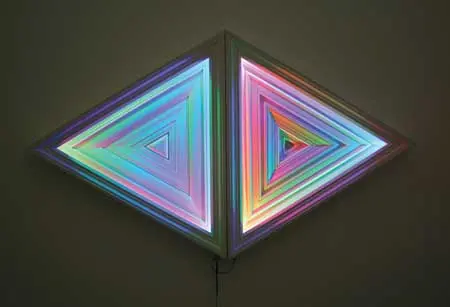
The artist defines this foray in Casa E as an “installation of objectual anomalies,” a staging of works of art that behave as objects belonging to the place they are in: there is a series of white photogravures that repeat the reliefs of ornamental details and cornices, and get confused with wallpaper; a rhomboid work in painted wood and RGB lights appears as a high-tech decorative item that bathes the dimly lit gallery in color; three large works in black glass, set on the floor and leaning against the wall, are three perfect paintings that reflect, mirror-like, the entrance to an old house or an avant-garde club.
Starting with materials and shapes linked to architecture, Steeger then refers to the object, and from there moves on to engraving or painting, then the painting’s frame, and then the gallery’s white cube and, with that, the Victorian-era building where it is located, a Nineteenth-Century construction in Cerro Alegre, Valparaíso, a historic area where several of these homes now serve as boutique hotels. The artist renders it a “boutique gallery.” He makes it resemble a home, a gallery, and also a historic tourist destination; a room filled with decorative objects, space where works of art are exhibited and sold, or an architectural exemplar subject to real estate speculation. Steeger builds echoes of those architectural, symbolic, and identity-related interstices, creating art from their reliefs, cornices, friezes, and moldings, on their grids, shadows, and reflections.
In the midst of these crossings, the artist blurs the border between art and architecture, between the work of art and the decorative item. He achieves these aesthetic/conceptual fluctuations with great simplicity, in an installation that takes no more than five items in a few square meters, where he cites various points in the history of art such as the baroque, the neo-classic period, Suprematism, Minimalism, and kinetic art. Once again, a profusion of forms is administered by an ascetic visuality.
Somehow, in this exhibition Steeger puts together a proposal that is at the same time beautiful and critical: with maximum simplicity, with pulchritude and symmetry, he offers up objects of desire that nevertheless are pure materiality: papers, glass, lighting sets, wood. Empty objects that nevertheless make the place happen in its full density.
The artist describes his proposal as “a collage of pure architectural idioms, of dermis or surfaces emptied of their content, because the issue is their very banal materiality.”
Steeger’s formal solutions have perhaps not as much to do with sculpture as they do with the processes themselves. They are discovered in the workshop, the key being certain industrial and technological resources that enable Steeger to transform those simple materials into luxury items. Thus, the wood is intervened with automotive paint to give it a reflecting sheen, and becomes the support for a light-based work thanks to a remote-control system; meanwhile, the black glass went through a high-temperature pigmentation process in order to become a reference to Malevich’s black square. But Steeger’s work takes place right there, in context. There, the artist gives that sensationalist objectuality.
Bordes y límites is, in a way, a border in itself. To cross the threshold of its entrance—the artist has placed there a low garden wall that obstructs transit into the gallery—is to go to another place where the work of art is the experience of a seductive but problematic space, wondering how much the identity of things is a kind of knowledge already categorized by the cultural imagination.
CAROLINA LARA B.