
Unfathomable, the recent exhibition by US-Venezuelan artist Rafael Barrios (Baton Rouge, Louisiana, 1947) illustrates immeasurable, immense, and undecipherable things. The thirty or so works exhibited address a constant issue throughout this artist’s career: attempting to challenge and disarticulate the viewer’s perception through visual deception and the treatment of volume, as Barrios attempts to evade the laws of two and three-dimensionality, while pointing to the impossibility of graving or understanding how such apparently heavy work can be progressively elevated to the sky, like erect totems.
Immersed in geometric abstraction and optical art traditions as well as in spatial inquiries and the trompe l’oeil, Barrios uses elemental geometric forms, like the square and the rectangle, as well as their analogs: the rhombus, trapezoid, cube, and cylinder. He basically works with sculptures and installations, and also in projects that deal with architectural interventions. During these four decades, he has also produced conceptual works, and pieces of a utilitarian nature, like tables, doors, and, more recently, jewelry. In 2012, Barrios presented a monumental exhibition of 9 stainless steel sculptures in busy Park Avenue in New York City. And as the echo of a great urban installation, today he presents at Galería Art Nouveau, works that are more intimate in dimension and more domestic. These are pieces that resume his line of more recent works, as well as experiments, sketches, never before published works, and some historic pieces.
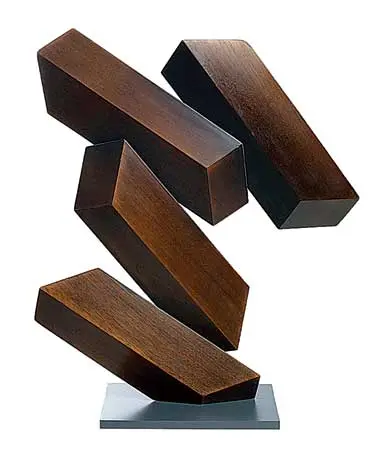
In this exhibition, the artist reaffirms the constant presence of this ascending geometry characterized by his inquiries on volume, color, light, mathematical progressions, and gravity. But above all, his work is characterized by optical trickery and a ludic knowing wink to viewers with regard to the perception of volume. Light also plays an important role. Depending on the type of light, the works can be perceived to be of a certain shape or color. In these works, lights speak to us about the changing nature of things, as well as of the basic essence of materials and light.
Aside from his adherence to geometric rationality and to a formal approach, there is also in Barrios’ body of work the idea of creation as a transformative act in the most spiritual sense. One that, although lacking in narrative intention, does reveal a mystic purpose when it comes to the direct connection to the idea of elevation, as it occurs in recently produced works like Malabarismo Lineal II M55 (Linear Joggling II M55) or in Vertical Dislocado en 3 Tiempos M59 y Nimbus (Dislocated Vertical in 3 Times M59 and Nimbus); or in Irradiación de Glorias M56 (Irradiation of Glories M56, of 2011), a title that makes a direct reference to the connection with the divine.
The instant of the encounter between the viewer and Barrios’ work is perhaps the most important moment when looking at his proposals. Viewers are forced to walk around a figure that appears volumetrically bigger than it actually is. Although the solid or perforated steel or iron planks that Barrio uses in his work indicate volume, they barely have any. The perception of solid volume is achieved through the visual effects caused by the concave and convex folds in the relatively flat planks, and the use of colors that emphasize these cavities or protuberances to fool the gaze.
Standing out from the large group of works exhibited are a pair of singular pieces clearly set apart from the other works in that they do not follow the formal patterns of the rest. The first one is entitled Vertical dislocado M57 (Dislocated Vertical, 1987). The fact that it was created with mahogany does not solely confer warmth to Barrios’ distinctive geometry but also opens new paths for interpreting his work and its evident connection to nature and the humanization of the piece itself. The other piece, Congruente Elipsis (Coherent Ellipsis, 2000) is suspended like a trio of hollow concentric ovals in the shape of a mobile. It is a format that breaks with the rigidity of the prevailing square and the dominance of the straight traces in most works in the exhibition, in favor of curved traces.
The fact that Barrios decided to show works never before published—most of them experimental, games, and others still in the process of development—reveals an artist who remains immersed in resolving technical processes and issues with materials that have yet to be mastered. He is still trying to understand the behavior of color and form, the negation of volume, as well as the tendency to energize the inherently static through the introduction of mobiles from innovative approaches, as occurs in the work Homenaje al Maestro Cruz Diéz (Tribute to Master Cruz Diéz, 2010) and in Derecha versus Contrareloj (Right Versus Counterclockwise). The works by Rafael Barrios in this exhibition are not necessarily like the distinct ones in previous better-known series that address other formal or constructive preoccupations. On the contrary, these new pieces are more conceptual and experimental. They offer viewers, used to his ascending and descending volumes, an open door to a fresh dimension, while they also trigger plausible constructive threads that will lead to future proposals.
AMALIA CAPUTO