
After presenting a beautiful and meaningful installation that paid tribute to Jean-Baptiste Charcot (father of hysteria) at the Maison de l’Amérique Latine, Voluspa Jarpa (Rancagua, Chile, 1971) for the second time in Paris presents a solo show. The Galerie Mor-Charpentier—whose opening to art from Latin America is already evident—chose a group of works that are part of La Biblioteca de la No-Historia (The Library of Non-History), a reflection and research that Jarpa has been working on for many years and that was the object of several presentations in Istanbul, Porto Alegre, Berna, and Toulouse.
Today is possible to understand the dictatorial processes more clearly the secret files of many countries have been released to the public. The most emblematic cases are probably those from the former German Democratic Republic and the former Soviet Union. Voluspa Jarpa’s recent work focuses on an entire continent. Many dictatorships were imposed by force in Latin America during the decade of the 1970s. In Chile, the involvement of the Chilean secret services, and particularly of the CIA from the US, is a fact that has been widely covered. Interested in the declassified archives of the US secret services for the period that expanded between 1960 and 1991, Voluspa Jarpa immerses herself in the past that she did not personally experience but one that nonetheless continues unsettling her intellectual and emotional perception of the continent and its painful history.
The exhibition presents four pieces that have been adapted to the gallery’s space and that are based on some of these documents. The work in the first exhibition room is part of the series La Biblioteca de la No-Historia (The Library of Non-History, 2012). An installation complemented with video, the piece is mainly constructed with “books” containing faxes that Jarpa created with censored documents. The typed contents are just partially visible because large parts of the text are crossed out. But here it is not Jarpa’s goal to decipher these documents—as they are completely illegible—but to show their visual strength. Although the formal minimalism in this work can be surprising at first sight, it nonetheless pulls us into a search for the traces of a history of lies and silences. It is because of this “nude,” and yet eloquent, a voice that we can assess the dimensions of a secret that in these pages becomes translucent like a leitmotiv; a secret we are constantly reminded of by the crossed-out sections of censorship. Accompanying these “books”—which visitors can grab with the condition of stating in writing, anonymously or not, what they intend to do with them—a video in which the artist recorded the declarations left by the visitors. Written in several languages, these spontaneous affirmations unintentionally prolong a never-ending story. Concurrently with the image displayed, a soundtrack reproduces several voices in an intentional cacophony—Voluspa Jarpa and her language professor speaking English, a conversation between Kissinger and Nixon in which they talk about Chile—that reinforces the unsettling environment.
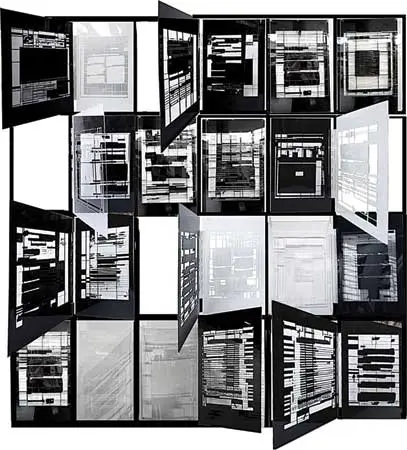
In the basement of the gallery, three groups in black and white (cut acrylic and photographs) enrich and complement the theme of The Library of Non-History. There, like at the Maison de l’Amerique Latine, Voluspa Jarpa with a singular visual conviction successfully conjugates form and concept. The group of six pieces entitled Unclassified Secret and Confidential. Outgoing Message (2012) consists of a series of acrylic modules whose fragments alternate visible and hidden phrases, never legible, save for the words “secret” and “confidential” that appear in these aesthetically constructivist groups of works. Minimal Secret (2012) presents a series of eight pieces created with black, white, and translucent acrylic. The plates that form it were cut with a laser according to the graphic model of the archive. Mounted with hinges, they sometimes superimpose each other as if one could turn them like the “page” of a “book.” Each of the 12 pieces in Caja de Pandora (Pandora’s Box, 2012) consists of two superimposed photographic impressions; one of them is a very sharp print on photographic paper, while the other is translucent, in Kodalite.
Somewhere between the imprecise, the chaotic and erased, between that which is hidden and that which can be observed, Voluspa Jarpa successfully achieves her objective. By getting tangled with the clues, by making the information unreadable, our understanding is clouded, and the gaze wanders. The interaction between shadows and translucencies, as well as the optical illusions generated by the material, refer us to that cruel ghost of recent history that continues to occupy a place in Chilean collective memory.
CHRISTINE FRÉROT