
The work by Polish artist Xawery Wolski appeals to boundaries, whether these are formal, physical, or geographic. Wolski constructs from the limits of the materials themselves—polymers, silicone, nylon. He lays them as if they were the extensions of the drawings with which he begins his proposals. White foreshortenings placed on the wall play with the ideas of a remote past and a future already reached. The weight and form of these perspectives, alongside the light, projected on them, equally invoke fertility rites and clinical asepsis—not to say museographic. These are lines turned into threads that multiply to become invading bodies—like in the visual representation of neuronal activity—in the space. The drama, hope, and suffering Wolski found (discovered) in Tijuana, are manifested in the gestures, among the mold and the apparition in his foreshortenings; bodies expressed through an abstraction that dismembers and disarticulates them to reveal a last violent and transcendent interpretation.
Wolski mentioned that when he arrived in Tijuana for the first time he felt immediately attracted to the place’s character as a border town: “A border town tied to its geography; it is not any city, as drama, hope, limitations, and suffering are an integral part of the daily experience.” The impressions he took from his first trip there, particularly the landscape of crosses that adorn the border fence, would lead him to develop his terracotta piece entitled Los Cruces (The Crosses). In an interview offered to the weekly periodical Zeta, the artist said: “it is a horizontal landscape, a sculpture that develops on the floor and moves up to the walls.” Wolski’s sculptures and installations are, first of all, as literal as their descriptions. Los Cruces is a sculpture made with terracotta links, a chain arranged on the floor of the exhibition room in two piles. The terracotta is so porous that it looks like tricot.
The connections, the bonds—both physical and spiritual—are the elements that define Wolski’s work. Links and chains are recurrent motifs and an obsession. One of the central works in this exhibition is literally a large, white chain that hangs from the ceiling and is tied to the floor. The body of the sculpture elicits the illusion of a fastened space. The chain maintains the ceiling and floor united in evident tension, a restraint that invokes the origin—in the same manner, that motifs allegorically point to the place on earth and sky in cosmogonic narrations. The chain reveals a tension by calling attention and pointing to the space it occupies; as if the chain was responsible for keeping the ceiling and the floor united. If it weren’t for this allegorical chain—put into evidence—the sky would be lost to the heights and the floor would irremediably fall down.
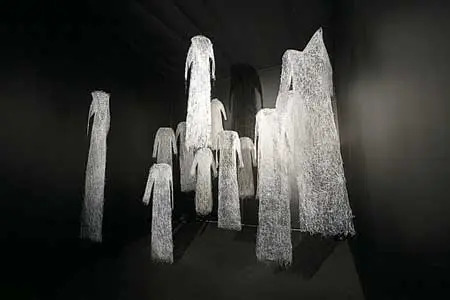
The concatenation, very obvious in this piece, is repeated as part of the process to create the work. Wolski links different organic materials together—pumpkin seeds, colorings, fish bones—until he produces the weaves for surviving costumes of imaginary ancient settlers that are exhibited as clothes from a very distant future. Likewise, Wolski appeals to figures of speech that reveal past and future in order to create a personal space within the asepsis of the exhibition space. Wolski turns it into a stage that evokes—perhaps in culturally inclined terms—those used by Stanley Kubrick in his futuristic films from the beginning of the Seventies. His revisiting of certain themes and forms; the initial weaves in the form of seashells, the clothes weaved with organic materials—a product of the appropriation of visited folklores, but also the imagined result of post-apocalyptic survival—the concentric patterns carved into granite disks; the fragility, almost ethereal, of his terracotta pieces, build up an experience that at the same time remits us to the exhibition halls of an anthropology museum, a museum of natural history and a museum of contemporary art. Intentionally or not, Wolski—from among the formal reaches of the organic and the extremes that validate cultural pillage—creates futurology in the same parodist sense used by his contemporary, writer Stanislaw Lem in his The Futurological Congress.
Curated by Santiago Espinosa de Los Monteros, the exhibition groups the works created during the last twenty years. According to the curator “Wolski’s ever-inquisitive gaze has been able to strip everyday objects of everything he regards as superficial and, at the same time, as he sheds light on the things that surround us. This is the reason he magnifies and enlarges them.” In this magnification or enlargement, Wolski plays—with lyrical parsimony—with the imaginary times of a futuristic past with Olmec astronauts. It is difficult not to do it, when exposed to the reproductions of the rings from the ball game placed on the walls of the exhibition room, one in front of the other, as references to the millenary game.
RICARDO POHLENZ