
For his first exhibition at the Galería Xippas in Montevideo, Uruguayan artist Yamandú Canosa (Montevideo, 1954), based in Barcelona since 1975, presents a series of nearly 30 drawings, paintings, and collages that have been organized in the space to create multiple superimposing narratives. Mostly small and medium-sized images are arranged along a single horizontal line (165 cm from the floor) on the six walls that form the two adjoining spaces in the gallery, to form series that punctuate musical rhythms or literary chapters. The horizon line is an element that has been present for many years in Canosa’s work and that is the result of his intrinsic relationship with the vast landscapes and endless horizons of the southern Atlantic coast that is part of the artist’s homeland.
In fact, in 2001 Canosa began to establish this horizon line in site-specific interventions that usually consisted of color planes in geometric compositions directly painted on the walls that permitted the artist to introduce his own spatiality into the exhibition space. These fields of color and form acquire the function of an environmental background for the independent works, while at the same time they establish an optical perspective for the viewer’s gaze. They also connect the external space with an imaginary one, and the memory and the unconscious with the eye-body experience before the landscape. Nonetheless, this plane-background, interior-exterior dimension is absent in this exhibition. Here the walls remain flat and the white cube prevails. The fact that on this occasion the works are introduced in the space in a more timid fashion makes one wonder why have the walls not been intervened. On the other hand, the neutral environment of the exhibition allows the works to breathe in a more autonomous manner—although those who know Canosa’s work will be surprised by his decision—while the silence and an invitation to be contemplative are stressed. It is also easier to detect the graphic-poetic subtleties proposed by the artists between each work.
In the 2011 retrospective exhibition entitled The Tree of the Different Fruits that Canosa presented at the Fundació Suñol, in Barcelona, he already emphasizes the importance of the independence between each image, notwithstanding the fundamental role that, like words in a text, the dialogue between them plays. Inspired by the work of Uruguayan poet, Amanda Berenguer (1921-2010), a member of the fervent literary generation of 1945 in Montevideo, Canosa fully explores experimentation within language itself and its relationship with perception, always trying to avoid the cracks that gradually mark specific artistic styles. As each work by Berenguer is different from the previous one, her efforts are centered on the study of language beyond the meaning of the words. The poet delves into the universe of vocalization, phonetics, and the written word as the signs and images that characterize concrete poetry. The first drawings by Canosa were studies of poems by Berenguer from the 1960s. Forty years later, in 2005 Berenguer and Canosa collaborated in an exhibition at the Centro Cultural España in Montevideo that centered on the different manifestations of the landscape—in between image, text, and sign.
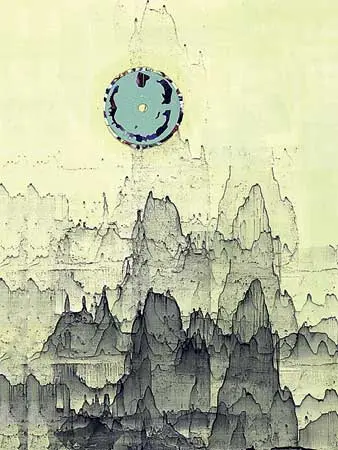
The artwork as the autonomous narrative center, the exploration of the limits of language, the poem-landscape, the equation, the metalanguage: there is a close connection between art and the literary universe in Canosa’s work; so much so that some of the paintings included in this exhibition awaken calligraphic and sign reminiscences, as his drawing is closer to illustration and his installations to graphic design. This exhibition at Xippas underscores the constellation strategy employed by Canosa in his montages, where small forms and independent images, each containing its own meaning, acquire new readings as they incorporate into a larger construction. The works from the series of five oil paintings entitled Viento Sur I-V (South Wind 1-5, 2012) respectively, are not grouped in the same space, but are rather scattered in such a way that, when moving as they gaze upon the horizontal line—the same horizon is kept by the works on all the walls—viewers can detect the various “south winds” among the other equally abstract works created with oil ink on paper, like Fronteras y Horizontes Heridos (Injured Borders and Horizons). There are among these abstract constellations figurative compositions created with gouache on paper that break with the logic of concrete compositions, like the figure of a man falling three times in Tres Caídas (Three Falls, 2006), the tail of an airplane in En el Viento (In the Wind, 2007); and Solo (Alone 2008), an image consisting of three silhouettes of a woman who sings on a floor with roots springing from underneath. Placed among these diverse series there are singular works that are radically different from the rest. This is the case of the drawing of an iceberg rendered in a mechanical-surrealist style created with charcoal (1999), or of the work Terraforming (2012), a piece created with gouache, oleo, synthetic varnish and a CD on paper, in which the foreground and background are indistinguishable; alpine-like outlines reverberate like musical scores and the CD object humorously evokes a sun setting behind the mountains.
Canosa plays with the works and the ways of looking at and perceiving our surroundings. Within each frame the optical planes cannot be distinguished, provoking the gaze to continually readjust between vertical and horizontal perspectives, between depth of field and flat planes. This play is repeated in the way the works are arranged in the space—not like pieces from a puzzle but rather like musical notes that produce narrative/compositional sounds—that completely vary according to the place they occupy in the proposed sequence. This compositional strategy arouses fundamental questions about perception, particularly in connection to the universe of the visual arts and the exhibition language itself. What does it mean to present a show in an exhibition space beyond the mere display of works of art? How can the exhibition experience confer new meanings to the works?
Yamandú Canosa was born in Montevideo, Uruguay, in 1954. He lives and works in Barcelona. His work has participated in retrospective exhibitions of Spanish art at the Centro de Arte Reina Sofía in Madrid, the Sprengel Museum in Hannover, the Albuquerque Museum in New Mexico, the Dalí Museum in St Petersburg, FL and the Bass Museum in Miami Beach. In 2011, the Fundació Suñol, in Barcelona, presents a retrospective entitled The Three of the Different Fruits that reviews the last twenty years of his artistic career. Some of the recognitions Canosa has received include: the 2010 Pollock-Krasner Grant in New York, the Jennifer Howard Coleman Distinguished Lectureship and Residency from the Otis College of Art and Design in Los Angeles; the 2007 Pedro Figari Award, in recognition of a trajectory, granted by the Banco Central and the Asociación de Críticos de Uruguay; and the 2011 Endesa Grant given by the Museo de Teruel. Canosa’s work is part of several public and prívate collections: Collecció d´ Art Contemporani La Caixa in Barcelona, Colección DA2-Domus Artium in Salamanca, Colección de Arte Contemporáneo Fundación Coca- Cola de España, Colección Josep Suñol in Barcelona, Colección Rafael Tous in Barcelona, and Museu de l’Empordà in Figueres, are among the most prominent.
NOTE
Canosa’s exhibition titled Three Spots at the Otis College Ben Matz Gallery in Los Angeles in 2006, consisted of an intense dialogue between in-situ painted wall interventions and autonomous works arranged on top of them: aquamarine planes that dissect the walls in the middle, a brick wall painted blue-green, and white forest.
VERÓNICA CORDEIRO