
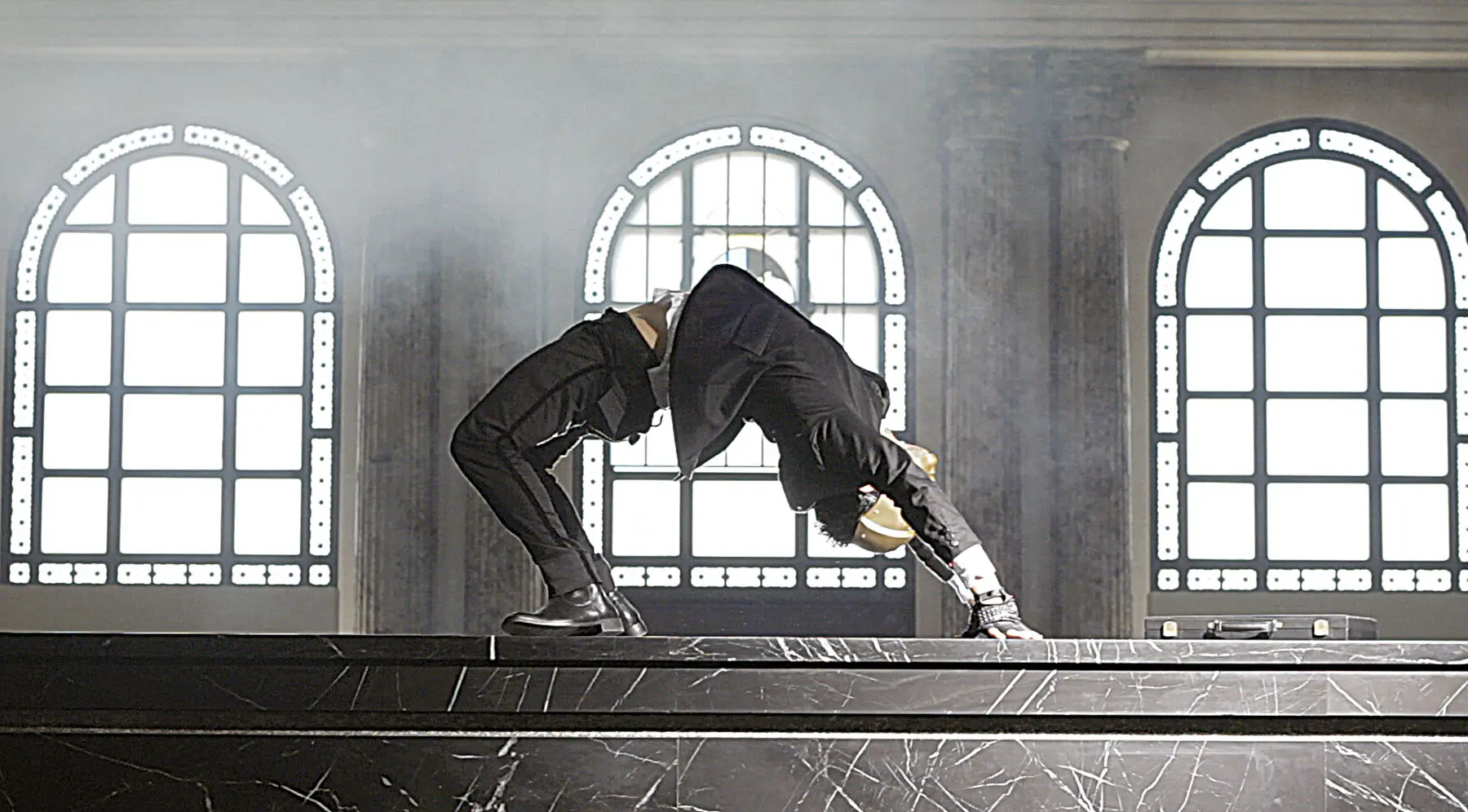
Pepe’s Perfume
With its accessible and agreeable course, the first edition of the Montevideo Biennial stimulates our curiosity and generates admiration with the sensibility of the works on display, the intelligence of its concept, and its subtle exhibition design. The works included in El Gran Sur, under the general curatorship of Alfons Hug (Germany) and co-curators Paz Guevara (Chile) and Patricia Betancur (Uruguay), exhibit their relation to the context and the possibility of its transformation, bringing forth the concurrence of objective conditions and the capacity for artistic invention.
‘Our North is the South… For us, there should not be a North but in opposition to our South. This is why we now stand the map on its head,” said Constructivist master Joaquín Torres-García as he inverted the map of Latin America in a now-legendary drawing. In the same vein, another celebrated Uruguayan, writer Mario Benedetti, asserted that “the South also exists.” Indeed, the curator points out that in this show “the issue in the South and its relationship to the world. According to the artists’ origin—Northern or Southern Hemisphere, West or East—the works will offer different readings of the South. Some will be guided by geographical categories, such as the South’s astounding landscapes, while others still incorporates political and social aspects. Some will explore the South as a real territory, others as an allegory and metaphorical projection.”
U for Uruguay
Montevideo, Uruguay’s capital, is a charming and at times melancholic city that has retained its pedestrian scale, populated by almost half of the country’s 3.5 million people. The city’s old section was not overwhelmed by real state speculation (as happened in neighboring Buenos Aires), and it still boasts magnificent preserved and salvaged buildings. It is precisely in the Ciudad Vieja neighborhood, near the docks, where both the Biennial’s four sites and most of the great buildings are located.
The international contemporary art show gathers over 50 artists from all over the world and is sponsored by the Montevideo Biennial Foundation. As the curator says, it “brings Uruguay once again center stage. This is a country that was a lighthouse for modernism in the early Twentieth Century…” Uruguay, these days, is also a fairly predictable country, with a stable legal framework and almost full employment (6% unemployment), led by a personally frugal president whose behavior towers when compared with some of his luxury-loving, graft-prone colleagues in the region—as highlighted by talented artist Martín Sastre (Uruguay, 1976) in the touching work he presented here.
Sastre, who lives and works in Madrid, was in Montevideo for the Biennial’s opening, which featured the projection of U from Uruguay, a video of “the essence” of José Mujica, a perfume based on Uruguay’s president, popularly known as Pepe. ‘I started working with concepts of luxury and poverty. It is said that our president is the poorest president, but in fact, he donates 90% of his salary; he is a man who gives, and a man who gives is a rich man. Giving is a luxury, and it is a luxury to have such a president,” the artist said. His project, like an impeccably executed advertising short in the noir genre, promotes a fragrance—a luxury product if there ever was one—consists of the manufacture of perfume using the natural essences of flowers cultivated by President Mujica, to create a fund for artistic creation in the country. Powerful and playful, this work presenting ‘Pepe’ in his small homestead outside Montevideo went quickly viral across social networks, seconds after its premiere (http://cor.toKMDO).
An unusual stage
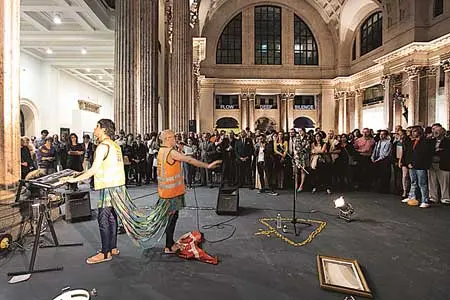
The friction of a president who is at once poor and rich is not the only one posited by this exhibition. The Biennial’s main site is the imposing Banco República Oriental del Uruguay (BROU) building, which archives a good swath of the country’s history. With its marble and granite columns and its spectacular 40-meter vaulted ceiling, the BROU’s Casa Central’s Grand Hall is host to at least half of the artists in the Biennial. The unaccustomed expressive freedom of contemporary art makes it possible to create art out of almost anything and exhibit it almost anywhere, and this Biennial does this with great efficacy.
Thus, the unorthodox site of this now-unused bank institution was brilliantly used by some of the artists. In U from Uruguay, for instance, Sastre films views of the bank’s treasure, enigmatic hallways, counters. Against the grain of spectacle that has enveloped contemporary art in recent years—and which is also the note struck by this Biennial—Olmo Blanco (Spain, 1982) presented Dibujo Sobre Polvo, an installation using dust gathered locally that the artist turned over a superb marble countertop, tracing on it delicate abstractions that refer to ancient cultures and setting them with water spray: simple and elegant. The Uruguayan collective Traspuesto de un Estudio para un Retrato Común often engage in expeditions in order to bring about their art. For this, their sixth such exploration, they researched Tambores, an Uruguayan town with a population of 1,700 people. The result is Tambores, an audio, video, and print installation deployed as leaves on the verge of flying (arranged thus inside the “cages” of the historic bank vaults), alongside an old TV monitor and headphones. These are drawings of the flora, fauna, and people of Tambores as well as local sounds, with the wind making the same noise as the musical instruments alluded to in the town’s name (Tambores is Spanish for “Drums”).
Another artist who was not oblivious to the significance of the site is Luca Vitone (Italy, 1964). Taking into account the centrality of a financial enterprise or the local community, Vitone intervened ten series of Uruguayan banknotes in different denominations and from different historical periods, incorporating to them new images and utopian texts. In his Il sole dell’avenire, the public can pick up the bills—placed next to a vine that grows around and hugs the old teller windows—and take them home. Dollar green? No, says the artist, green is the color of hope: “the vine, like utopian thinking, is non-conformist and in constant search.” For his part, Jorge Satorre (Mexico, 1979) dusted off portraits of the bank’s 42 Presidents and created paintings that feature fragments of their faces, torsos, and hands, prompting new readings and recreating micro-histories with the help of a psychoanalyst and a semiotician (both from Uruguay), who collaborated in the analysis. The resulting 42 Retratos Parciales de los Presidentes de un Banco also incorporates the functionaries’ sayings.
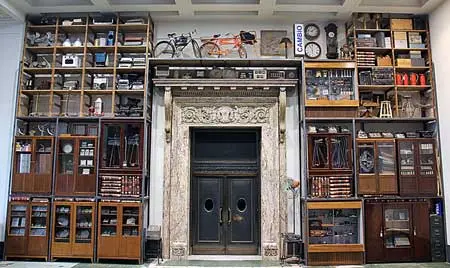
Like an archaeologist, Mark Dion (the USA, 1961) entered the institution’s warehouses (by law, the bank cannot discard anything) in search of old traces, salvaging dozens of furniture items and objects for his magnificent installation El Gabinete de las Máquinas del Capital; he even added a piece of personal history by an anonymous bank employee, through a stone found in an elevator shaft that contained the inscription “José X. worked here, 1930”.
There are many more works of art in the Grand Hall; some standouts among them are the marvelous photographs exhibited by Guy Tillim (South Africa, 1962), which debate the very nature of photography as a witness, as a picturesque postcard, as an instant that is no longer; an outsize collage by Juan Burgos (Uruguay, 1963); Tiled Flower Garden (2012), a garden by El Anatsui (Ghana, 1944), created using aluminum bottle tops and copper wire; and Arte con una Carga Simbólica en Sí Misma (2012), the precise dancing lines drawn in freehand on the bank’s walls by Ricardo Lanzarini (Uruguay, 1963).
Offered prayers
More than user-friendly, the Biennial is distributed around four neighboring locations. At only 100 meters of the main site, the Atarazana building, the old naval station, hosts works that tell beautiful, terrible, and contradictory stories of pirates and the lion-colored river. The River Plate, which seems like an ocean from the Eastern banks and is rather muddy on the other side, is a common cultural space filled with significance for both Uruguayans and Argentineans.
The enthusiasm for the poetry of the artworks extends to the BROU’s Zabala Annex (across the street), where the curators placed most of the Biennial’s videos. Alfons Hug is partial to videos, an easily portable technology. This time they came from China, Germany, England, and Italy, but also from Peru, Cuba, Brazil, and more. The walls of the Annex were covered in videos, and the videos sat next to one another more comfortably than you would think. Important to note are works by Darren Almond (England, 1971), with a solitary protagonist facing the wind, snow, and night in the Arctic in order to go where no one had gone before, and those by the Chilean collective Niles Atallah, Cristóbal León & Joaquín Cociña, with their experimental video animation Lucía. Lidia Abdul (Afghanistan, 1973) returns to her almost surrealistic poetic with an edition of Vendedores de Ladrillos de Kabul, 2006, depicting children who sell cinder blocks and rocks salvaged from the ruins and spotlighting the country’s cycle of destruction, triggered by the Soviet invasion of the 1970s and yet to stop; an unsettlingly atmospheric work that offers tangible images and explores concrete problems.
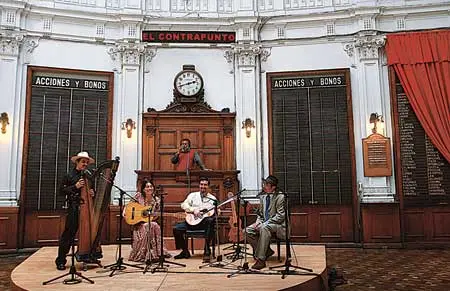
Among the Annex architectural curlicues, there is a series of well-outlined spaces where videos requiring total silence—as texts are in them an essential element—were on exhibit. El Contrapunto (del Arte), 2010, is the recording of a payada, a traditional song duel, between Chilean singers in Valparaiso; it was conceived by Humberto Vélez (Panama, 1965) as a performance for the V International Spanish Language Congress, and the texts were changed on the fly as a consequence of the recent earthquake in Chile. In Luna con Dormilones, 2012, Pablo Uribe (Uruguay, 1962) works in an intelligent way with art-history materials: A well-known Uruguayan meteorologist recites for the camera what appears to be the weather report, but soon we realize he is actually offering a detailed description of a painting by José Cúneo titled, precisely, Luna con Dormilones. On the underground level, two installations dazzle us with their apparent simplicity and their conceptual depth. While the object with mirrors and lights presented by Kitty Krauss (Germany, 1976) generates an infinite number of reflections that somehow refer to Jorge Luis Borges’ universe, the installation Salón Fumador, by Eduardo Basualdo (Argentina, 1977), with a glass wall and a light bulb in motion, threatens to blow up, yet never does.
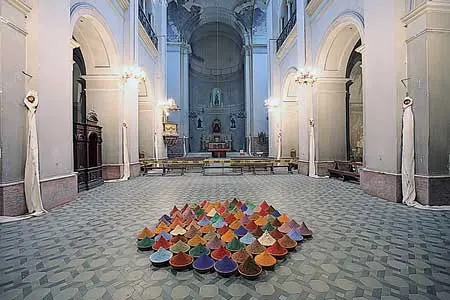
Across from BROU, in a diagonal, the San Francisco de Asís church has on display two unique, well-rounded, and poignant works of art that come across as an emotive and unforgettable lay prayer. In the central aisle, Sonia Falcone (Bolivia, 1965) presents Campo de Color, an installation of bowls with spices that resemble religious offerings of some kind; they are enveloped in the murmuring sounds of an audio installation by Paulo Vivacqua (Brazil, 1971), which emanates from the church building’s columns, now in the process of being restored.
As in any biennial, beyond the inaugural date with its roster of performances such as Marina de Caro’s (Argentina, 1961), who used newsprint, water, and blender-processed pigments to manufacture paper with random textures and color, this one also has a program of conferences, like Mark Dion’s, and street performances such as Christian Jankowski’s (Germany, 1968). The charismatic artist and musician Dani Umpi (Uruguay, 1974) was once again among the highlights with his convincing spectacle Dani Umpi Piano, 2012, where he recites with the accompaniment of Uruguayan pianist Álvaro Sánchez.
VICTORIA VERLICHAK