
In his paintings, Alexis Iglesias (Cuba, 1968) confronts us with the issue of painting’s aptness for the contemporary world, or, better yet, the issue of figuration in painting. From the standpoint of representation, the platform has been lost for more than a century, and more so in our era, when so many images represent the world in art, especially with photography and video, but also with digital devices. Painting, thus, would have to situate itself in a position of discarding all new technological media in order to say something new, something still filled with meaning.
In the first place, the painting comes to us as a technique that, today more than ever, is understood as an otherness to the widespread habit of biting and running, the habit of speed and improvisation through which dual realities are created, beyond the realm of art and into common practice. And indeed painting requires long times, pauses for reflection, and it lives in separation from the world: it is created in an atelier and outside any mimesis with reality and its immediate communicative and advertising-centered imagination. It harks back to the kind of manual labor and attachment to objects that art has since the beginning sought to utilize, recomposing with an ancient gesture the will not sever the links between body and object. It is proposed, then, as a site for the reformulation of an unmediated relationship with the world, which the new status media break to appear as mechanical mediators in human affairs. Yet the new technologies, along with installations, speak of the reality in which we live with considerable immediacy.
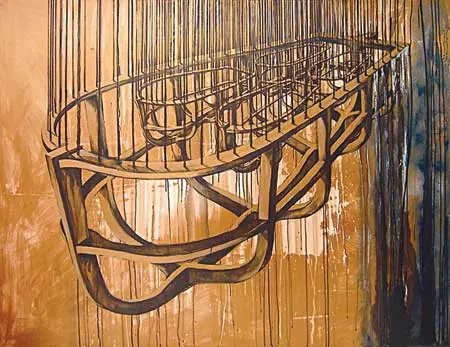
What place, then, for painting? It could be, as Iglesias seems to assume, the place of a tradition that despite everything returns for a reckoning, to find a way to transform our view of things and say something new. The dream-like objects in his paintings are situated in evident perspective, seemingly recalling, for instance, the experiments—analog, at any rate—of a master or the Italian Quattrocento like Paolo Ucello; perhaps Iglesias remembered the famous Mazzochio set in hilarious perspective as it has to do with his painting The Golden Age. But this iconic presentation is denied in its integrity and presented like a residue, like rubbish, since the materials are fleshless, given to their bone-raw structure, and then it is as if they had been put through an X-ray machine and reinterpreted through their elemental structure. It is as if he wanted to penetrate the essence of the object, in its generative model, in ways that are invisible to the distracted eye. But this secret and generative hangs from some threads that deny it vitality and autonomy. What it is, then, is a small theater operated by an unknown, invisible sovereign. Could this be a mirror of our existential condition, where we are reduced to pieces of a system that is as well-known (seemingly free) as it is oppressive?
This may be sci-fi, somewhat cyberpunk interpretation, but Iglesias’ elegant and irrational shapes can very well take us there. Schematic as they are, these shapes can evoke the grids that govern the formation of objects in three-dimensional graphic art, but rather they are dense, rich paint splotches, which contradict that origin. And then we are back to painting and its suggestions, perhaps thinking of the drips of abstract expressionism, but also the voluptuous and matteric American neo-Dada, which is what courses through the almost-flat backgrounds of these paintings enriched with blue brushstrokes that resemble waterfalls and at times overflow onto the objects. They erase all borders and suggest in that way the idea of some depth to the scene or at any rate a dialectic between figure and field, a dialog even if minimal between the two entities. The dominant hues are the browns of earth, trees, and precious metals, which seem also to want to return to the concreteness of brute matter, where human products are born and become differentiated. And to myth, to religion, to human technique, to great narratives, and perhaps to the contemporary ones of videogames, as once again do the titles of the works: La Edad de Oro, Caridad del Cobre, Narciso, Ábaco.
References are high and speak of a new humanism that resituates humanity and its history at the center of things. And then what comes to mind is Alejo Carpentier’s “magical realism” in the introduction to his novel The Kingdom of This World, a concept that was then revisited in Cuban film (think of Tomás Gutiérrez Alea’s La última cena) and later became part of the dominant and preferred code of Latin American literature in general. But neither can we forget Eliseo Diego’s Divertimentos and perhaps many more, to speak only of Cuban literature. True, in such filigrees we can read an entertaining call to surrealism and the code of the strange, the extravagant, the mysterious, the enigmatic. In general, then, to the investigation of a possible narrative that viewers are called to follow, interpret, or simply imagine. Iglesias’ world is presented a profound, unsettling, and, why not, ironic in the way it brings forth ways of inventive and suggestive shapes that are celibate machines, where nomination and meaning are ultimately inexplicable. It is in the end for the audience to find interior resonances and to discover whether this has constructed a new possibility of seeing the world that can, in the end, change it.
CARMEN LORENZETTI