
In 1972, Álvaro Barrios (Cartagena, Colombia, 1945) signed the pages of several newspapers that showed an ad created by him and declared it to be original work. With this act, he began the series Popular Engravings that eventually became Dreams About Marcel Duchamp. Scathing and timely, within its context, the exhibition Dreams that Money can Buy is added to the body of work that Barrios has been creating about the mystified figure of the French artist, as he constructs a new phase based on that series.
Everything began in the 1980s when Barrios distributed flyers with a photograph of Duchamp’s face and several lines left blank so the public could write their fantasies about his person. The answers by the public were not very stimulating and Barrios decided to write the texts himself to complete the project. It is a group of aphorisms that reveals the fetishization of the artistic object and the cult to the persona, as well as other complex mechanisms and perversions of the art world. In 1983, the artist created a series of watercolors in which he appropriated works by Canaletto in order to stage some of the situations proposed by the texts that were part of the Dreams About Marcel Duchamp. From that moment on, Barrios has illustrated the collection of onirisms through several techniques and formats. The exhibition in question includes six acrylic on canvas paintings—created between 2012 and 2013—of those drawn dreams, developed with a pop language, sprinkled with the humor and irony of the comic aesthetic whose characteristic frivolity contrasts with the conceptual reach of the “dreams” enunciated on the upper boxes of the vignettes.
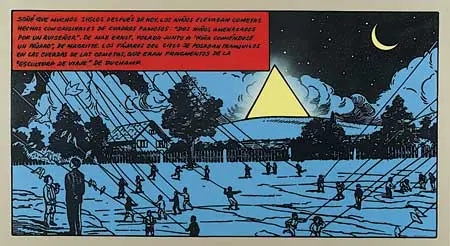
For those new to Barrios’ work, this is a good opportunity to learn about the visual resources that characterize his approach. Among these: appropriation, quotes, irony, la mise en abyme, and a strong conceptual anchor—despite the handcrafted style of his images, he does confer great importance to language and poetic meaning. While Duchamp’s presence/impact in all post-Duchamp art is nothing new, the manner in which his influence is used by artists like Barrios is indeed innovative. In Barrios’ work, Duchamp is not phantasmagorical like in many other treatments; instead, he has become rather explicit in order to admit that which none of us dare to say: we have turned a man who hated theism into a God we mistakenly worship.
Following this line of thought, and like a prophetic beginning, the show opens with a landscape that alludes to a biblical passage about creation to illustrate the first dream: “Marcel Duchamp had declared that everything is art, and yet, that the only thing that does not exist is art.” In front of him, yet another biblical wink, La Multiplicación de los Cuadros (The Multiplication of Paintings, 2012), dreams: “…that some apostles collected famous paintings from the rough sea. Bicycle Wheel, by Marcel Duchamp, was used as the rudder of the fishing vessel. On that day fishing was so abundant that five museums around the world were completely stocked.”
The piece that gives the exhibition its title and that shares its name with Hans Richter’s 1945 movie, shows one of the pages from the first set of Dreams About Marcel Duchamp, with a portrait of the artist and lines on which one can barely read the manuscript “I dreamt that nobody could dream and that Marcel Duchamp created the dreams for every person according to our personal needs;” this is the same Álvaro Barrios who affirms this dream. As is well known, Richter’s surrealist film is an experimental search that included the participation of Alexander Calder, Max Ernst, Fernand Léger, Man Ray, and Duchamp himself. It is about Joe/Narcissus, a man who, in order to be able to pay the rent of his room, opens a shop that offers custom-designed dreams for a large variety of frustrated and neurotic clients. How many people in Spain today would not like to be able to have their dreams custom-designed to avoid eviction!
Intelligent and cunning, the “meta” dream of the piece that gives the exhibition its title is that Richter’s film… “was created with the goal of ensuring that the public would buy my Dreams About Marcel Duchamp. Probably nothing more and could happen for an exhibition at a gallery presented concurrently with ARCO. Nonetheless, the best piece in the exhibition is the one that dreams “that many centuries from today, children would elevate kites made from famous original paintings….”
DIANA CUÉLLAR LEDESMA