
“(…) The conception of an exhibition always poses a challenge in terms of the space to be occupied. (…) Painting is always a renewal of experience and of the feelings aroused by color.” Amelia Toledo
The plan for Amelia Toledo’s exhibition Mirada Actual was conceived as a space for dialog between temporal frameworks anchored in works from different periods in the artist’s career, and it proposed the updating of creations from past decades as they shared their space with works executed specifically for the occasion.
Because of the show’s temporal span and its extensive exploration of almost five decades of artistic activity, Amelia Toledo’s visual poetics had an important place in the gallery’s year-end program. With the inclusion of “new works”—paintings and installation—created especially for this exhibition space, the initiative signaled a new cycle of form and color avenues.
The show, built on the materiality of each one of the compositional elements—mirrored stainless-steel sheets, acrylic resin, polished quartz—that are recursive presences in the artist’s aesthetics, proposed a renewed contact with her poetics. Toledo’s recourse to reinvention, or the re-elaboration of her own creations, reveals the synchronic nature of her art, her interest in an attentive reading of interconnected, incessant, permanent flows in the structuring of forms and colors.
At the entrance to the gallery, still outside the exhibition area, an invitation to explore the project of the show was extended by Tajadas de Horizonte, a 1996 work in mirrored stainless-steel sheet, partially oxidized with iron filings. With Tajadas de Horizonte, Amelia Toledo revised the persistence of the reflection of her production through the materiality of the steel sheet, set on the floor, in the reflection of the viewer’s gaze and its relationship to the work’s sensorial environment.
This emblematic aspect of Toledo’s visual production—its relationship with the surrounding environment—took place in her symbolic appropriation of materials, and it was, undoubtedly, in direct contact with the work that the audience was able to understand the strength of each part of her creation.
The artist’s entire trajectory, almost five decades of a constant quest, reveals her commitment to an investigation of the properties of matter—minerals, iron, glass, resins—which, reinvented in her works, compose a kind of physics condensed into a new sensible grid, a different aesthetic key.
Color, the protagonist and highlight of this sensible grid, in an atmosphere of linen and jute, synthesized the register invented for new works of art, in a universe of two-dimensional events as in the series of Horizontes.
Present in the Mirada Actual exhibition, Horizonte, 2012, in acrylic resin and pigments on linen, confirmed the vitality of pigmentation layers in conversation with three-dimensional shapes of various periods of her production.
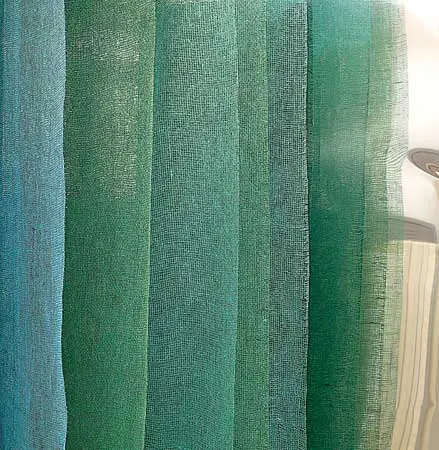
Among the three-dimensional works on exhibit, the installation Abanico de Colores Fríos, 2012, created for the occasion, composed with sheets of mirrored stainless-steel sheets and pigmented jute, filled the room with a hybrid atmosphere of the intense material presence of its steel in coexistence with the partial visibility of the pigmented grid of the fabric.
Be it because of its experimentalism, the diversity of its supports. Its sensorial ideas, its creativity committed to the inclusion of viewers in the works of art, Amelia Toledo’s oeuvre stands out for its intimate understanding of materiality that is essential to life. And her inquisitive creation always prompts a “spiritual exercise” activated by the atmospheric that envelop the viewer. Once again, invaded by this “spiritual exercise” in its incursion into Amelia Toledo’s sensible world, the exhibition space was filled with the multisensorial dimension of the work, in an intense dialog with the rhythm of life.
Be it because of their sensibility, their experimentation, and/or their commitment to the senses, to the body and its surroundings, Toledo’s works are active guidelines for a tireless explorer who continues, today, to follow a path of lucid invention.
CLAUDIA FAZZOLARI