
The fragmentation of compositional elements as the discursive value in the work of art became one of the fundamental principles of contemporary movements. Immersed in that very exploration is the work by Aureliano Parra (Caracas, Venezuela, 1980). In his most recent exhibition entitled Urban Incisions, presented at the Galería D’Museo from September 2 through September 30 of 2012, Parra achieves suggestive visual impacts with the use of the aforementioned resource that he has been exploring and developing in his production of recent years. Seven medium to large-sized pieces interact with the walls that serve as support for these creations displayed like a rainbow that illuminates the exhibition space.
The use of collage allows Parra to assemble small cutouts that are reproduced until they form a sort of hive that expands irregularly across the plane. The artist meticulously extracts squares and rectangles of mylar, a malleable acetate that he uses to create reticles placed on undulating reliefs to animate the static walls. The group is discerned in subtle tides that are precipitated, swirled, mixed, or superimposed in various sizes and models, with the prismatic and surprising radiance that characterizes the auroras borealis.
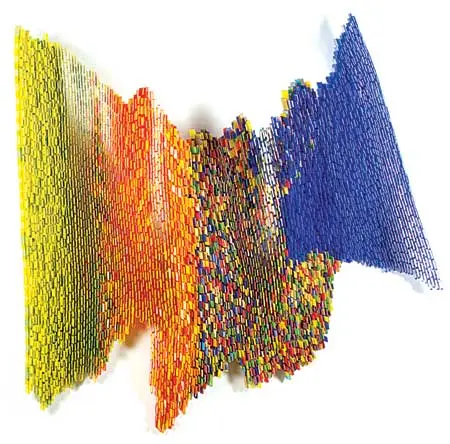
This perception can be appreciated in Cuerpos Ausentes (Absent Bodies, 2011), Descolgados del Tiempo (Unhooked from Time, 2012) or Cromatismo en el Tiempo (Chromatism in Time, 2012), a kaleidoscope impregnated of subtleties and polarities agglutinated in successive wakes that carve into the fabric, weaves and warps to intertwine matter and void, form and pigment, line and fragment; it is painting created with dispersed corpuscles that seduce and trap viewers. Parra’s works reveal that antagonism that elicits aesthetic intentions, the purposeful and the random, the geometric, and the asymmetric; they are pictorial “architectures” that grow like ecosystems stealthily gravitating. From a formal point of view, in these works, Parra relies on the chromatic component, frees it from the conventional support, and allows it to flow freely in search of its place. This project by the Venezuelan artist unavoidably reminds us of the crucial moments in Western painting, as his endeavor communicates the vibrations of impressionism, the segmentation of pointillism, the harmonies of Kandinsky, and the systematization of De Stijl. According to Parra “It is about a form of research that relies on the utilization of the medium of paint. In the instance of chromatic networks, painting strives to find its way out of the perimeter of the canvas. In a manner of speaking, it is about leaving the canvas and tradition behind. It is a proposal in which color expands into the space to produce movement; colors that hold a poetic relationship with the city….”
And it is precisely the atmosphere of the metropolis that motivates Parra to convey the impressions that he absorbs from its surrounding environment. Nowadays, Parra lives in a centric area of the noisy city of Caracas. There he delves into the obsessive construction of repetitive figures and tonal combinations; this way, he synthesizes, abstracts, classifies, and recomposes until he has organized a sort of cartography constituted by numerous rectangles, in a process that reduces the complex reality to a primary entity: the atomized image; one that is reminiscent of the famous Broadway Boogie-Woogie by Mondrian, paintings with which the Dutch painter celebrated the modern city, its road traces, designs, squares, minute inhabitants, voices and innumerable noises. Order and chaos conform to this notion of the urban; the artist’s gaze transcends the external to access the internal. Parra affirms that “There are specific elements of the city that I am interested in as structural phenomenon born from a real or zenithal view; pedestrians, peddler stalls, neighborhoods and political rallies in which I can only observe continuity and a series of points that are multiplied and generate a sensibility between the space and time and the configuration of painting as the epicenter of my artistic proposal…”
Like Mondrian, Parra senses that behind any appearance there is a scheme, a pattern. Thus the sequences, the contrasts, and degradations this artist uses as the foundation for his work emerge from the intimacy of his studio: in the movement of a curtain, the incidence of light, the reflection of shadows over surfaces, in the echo of sounds; the diversity of situations is captured in a video and in a series of ten drawings created with Indian ink on paper, both exhibited to the public for the very first time under the title of Frágiles Luces Alineadas (Fragile Aligned Lights). According to researcher Alberto Espino “The surrounding social dynamic that he turns into sensible imaginary…” has now turned into an imaginary that opens new visual paths for the fine arts.
GLADYS YUNES YUNES