
In the image used to promote En el Abismo, Carlos Salas’ exhibition at Alonso Garcés Gallery, 1 the artist appears with his back to the camera, a small figure in relation to his large-format paintings and to the high ceilings and wide spaces of the gallery in which they are arranged. Salas’ contemplative attitude put me in mind of a similar image of Rothko in his study. Like the Russian’s, Carlos Salas’ art prompts us into such contemplative states, as if an unfathomable depth lurked behind those two-dimensional surfaces, an accumulation of time that can only be perceived when our gaze pauses and tries to penetrate a world of layers upon layers of color.
Inside a smaller gallery, carefully displayed on a sober worktable, we found the correspondence between the artist and his daughter Ana María during the process of production of his paintings. These emails, arranged in such a way that they suggested a sculpture, revealed some of the many layers that give Salas’ paintings their profundity.
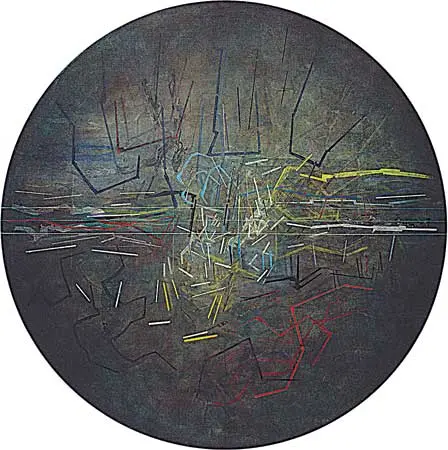
“I just gave the first circle a fundamental turn. A very tenuous blue installed itself there, feeling at home. There no longer was a struggle for control. I like how paint tries to emerge into the surface. Like with Pärt’s music, so propitious for this moment”, writes Salas to his daughter, a filmmaker, and philosopher who lives in France and is working on a documentary about her father’s workshop. The blue hues occupied several large-format canvases and peer through certain brown round shapes on which lines of great precision float.
As the words, sometimes resembling a private journal, come and go, three creative processes evolve, intertwine, and enrich each other: the construction of a home in La Calera where Salas exercises his education in architecture; a series of paintings titled En el Abismo; and the documentary about Salas’ workshop. Reading this correspondence is a pleasurable literary experience. Mentions of the books that swim through the lives of the painter and the filmmaker, the music they listen to, the films they share, as well as Salas’ concerns, his routine, the daylight, or raindrops that hit his windows, mark the pace of Salas’ painting.
In these carefully dated emails that reveal intimate experiences, Salas’ impeccable paintings are referred to as windows that look at the sky to make visible cosmic mysteries. Ana María, who has begun to see an abysm in her father’s paintings, tells him about an experience she had:
“Once I went to the Tatacoa desert with a friend and we laid down to look at the sky in the dark, moon-lit darkness. After gazing up for a while, I had an impressive vision. I saw the stars with depth of field, in three dimensions: instead of a fat firmament with larger and smaller stars, I felt some stars closer and some farther away. Suddenly, I saw myself laying on the Earth, which was projected into the universe and was part of its immensity. I saw the infinite universe and myself in it. (…) We live in an immense abysm, but we keep forgetting that. Art reminds us by evoking it.
These words, which define the title of the show, bring me back to the act of contemplation I mentioned at the beginning of my note; it implies vision, image, and temporality. Painting condenses the painter’s time, the time that passes inside the workshop, which according to him differs from common time. His words define with precision this relationship between time and the act of painting: “Now I have received an image, the image of a time that acquires presence, that occupies a space. It is like a cold atmosphere. As if time occupied a place”. Evidently, time does occupy a place in Carlos Salas’ powerful paintings, it becomes a surface and filters through the various veiling’s that at times dim the colors and at times make them brilliant and luminous.
Contemplating these circular paintings that so unsettled the artist, I begin to see that, while being as absolutely flat as demanded by American critic Clement Greenberg, they easily transcend their two-dimensionality. At times, the lines float over brown hues projected backward; at other times, as some of Kapoor’s works, they bulge out and the canvas comes forward. Suspended high on the wall, they remind me of the eye of God looking at us from on high.
More than windows, Salas’ blue canvases reminded me of the ocean’s depth; their color achieved the artist’s purpose and I immersed myself in them. Blue, Kandinsky said, has depth. These intense blues also evoked Monet, his water lilies, his ethereal, and liquid art, from where modern painting emerged.
Yes, Carlos Salas’ paintings can give presence to the infinitude of the cosmos, the profound, mysterious abysses of existence, of time and space, but they also evoke the field to which they belong: the pictorial tradition. And they bring forth the history of their author: the time of his own existence.
NOTE
1. A book on Carlos Salas’ work with texts by José Hernández was launched at the exhibition’s closing.
MARTA RODRÍGUEZ