
Clemencia Labin is an artist from Maracaibo, one of the two most Caribbean cities of South America: a modern port with quaint architectural vestiges of a Spanish colony. These facts are germane to White Gold, Labin’s last exhibit at the New World Museum, for Houston is also a port city, although in the Gulf of Mexico. White Gold alludes to cotton, a product that has marked the city’s history from the times of slave plantations to the modern industrial era. It also alludes to the synthetic fiber that fills many of Labin’s plush padded works. On the opening night of her exhibit, Labin wore a thoroughly golden outfit from head to toe, put on a golden mask, and enacted a performance in which she swept with a gilded broom the white synthetic filling throughout the exhibition space into a pile. One assumes the performance was a metaphor for the material value of cotton, and by extension, of art.
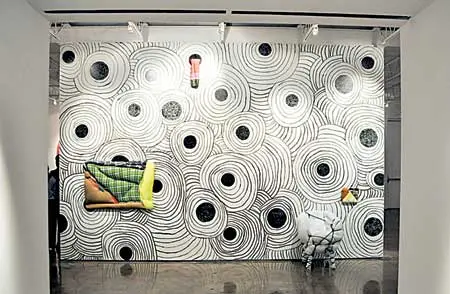
Labin was trained in New York and Germany. For over two decades she has been living in Hamburg. During the period she was looking to find herself as an artist, she confesses she was doing works using many grey and dark colors. One day she asked herself, “What am I doing? This is not who I am!” Last year when she represented Venezuela at the Venice Biennale, Labin explained in an interview how rediscovering her home city of Maracaibo transformed her art practice. On a casual visit of the Santa Lucia neighborhood, she found a new palette in the bright colors of the houses’ facades and interior decor. Against the advice of friends and relatives who warned her that it was a dangerous neighborhood, she bought a house there and since 2001 has been hosting an annual art festival called Velada Santa Lucía. The color palette in her current exhibit reflects the influence of that neighborhood on her art.
Labin’s works were once described as Bolero Pulpa Chic, for its evocation of a fifties aesthetic that still survives in working-class neighborhoods throughout Latin America. Pulpa Chic is the name Labin herself gave to the works she has been producing since 2001. The huge “drops” hanging from the New World Museum’s ceiling are covered with fabrics one might find in the dresses, upholstery, or curtains in the Santa Lucía neighborhood. Although they are abstract, they represent by sampling. One could say that they are cultural stalactites. As such, they somewhat resemble Ernesto Neto’s drop-like works like Bicho! (2001); but the Brazilian’s works are monochromatic and filled with spices like pepper and clove. On the other hand, Labin’s lycra-covered assemblages that hang from the walls have the amorphousness of the improvised, while at the same time showing the inviting coziness of piled pillows. The touchy-feely materiality of Labin’s works is a far cry from anything Bauhaus—except for its abstractness. In fact, the poetic license for many of her works may have been issued by Arte Povera and signed by Neo-concrete Brazilian artists like Helio Oiticica.
The most admired piece in the exhibit was without a doubt the one cleverly featured in the menu of Labin’s website (http://www.clemencialabin.com/): Pulpa Nueva Mega Lucrecia (2009). This is a work that puts the viewer at odds as to whether he/she should find shapes—as if looking at a cloud (a bone, a fist, a mouth...)—or simply lie on it. Labin has produced works like Pulpa Pla de Piso that create a living space that seems to invite the viewer to sit, lie, and squeeze the work. However, we do not know that she has turned viewers of her works into participants yet.
FERNANDO CASTRO R.