
David Zink Yi, a conceptual artist with a long record of exhibitions in Germany, Spain, Switzerland, the US, Austria, and Italy, presents his second exhibition in Lima. It is titled Ángel, ¿eres tú?, also the title of the show’s smallest work, comprised of two photographs. “Given that these are the smallest works, as well as narrative and/or suggestive photographic registers, I found it convenient to title the show with them.” 1 In this exhibition, Zink presents twelve photographs, a 12-minute video, and an installation.
The first photograph in Ángel, ¿eres tú? features a white-skinned man, his back to the camera; all we see are his legs, down to the bare feet, clad in red pants that reach only to his knees. Behind him we see, floating, the equally bare feet of a dark-skinned man. One of them is standing on an even, shiny floor (at Zink’s studio as a fellowship student in Rome). The men are with their backs to each other. In the second photograph, they have switched positions. The one who was on the ground now floats, and the one on the ground wears blue pants, somewhat longer.
The man who floats is the angel, who is a man. Zink likes to send hybrid messages with the body and has made several bodies using his body as a medium.
In the photograph titled Cuatro caminos (Four Paths), shot in Havana, we see an environment of hallways and doors. We notice it is from a humble home, without actual doors at either entryway, just curtains. Behind the main entryway we see the threshold to a room, covered by a white curtain with pink decorations. The threshold to the room to the left sports a red curtain that enlivens the photograph. Here, Zink’s intention is to find art in a humble home and elevate it to the world of art.
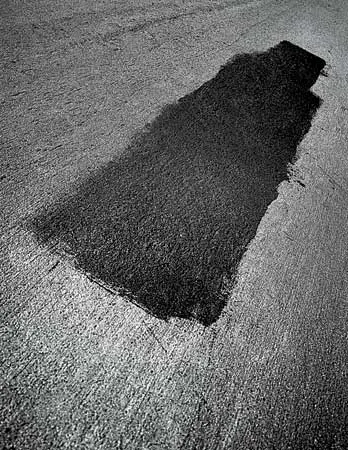
Most of the photographs are shots of a highway to the city of Huancayo, one of the main urban centers in the Peruvian highlands. The photographs are of the winding road as it crosses small villages and reaches the city. As the road was being repaired and patched up with tar at different stretches, Zink also captured images of the roadwork at various points. In these photographs, Sin título, the patched-up areas of the road look like abstract geometric shapes in grays and blacks, generating a sense of mystery.
The installation features geometric shapes in the walls, made in cement, with relief and texture. “This work was conceived during my stay in Lima, a city marked by the presence of cement and by this kind of relieves and ornaments. The work begins as a reflection of this reality”. 2 The works are minimalistic: two diamond shapes with their corners almost touching or two almost-connected diamonds forming an X. On the other wall are four triangles in different directions, with one placed on two intersecting walls to generate the sensation of movement. These cement shapes were in a dimly lit room, illuminated by lights that give it a magical and enigmatic aspect, like almost everything in Zink’s work.
In this exhibition, this artist, who generally works in sculpture, presented few three-dimensional works, focusing on photography, video, and installation. His work is featured in important collections in museums around the world.
NOTES
1. Interview with the artist, February 2012.
2. Ibid.
AUGUSTO CHIMPEN