
Located in Polanco’s new cultural zone—also the new site for Museo Soumaya and the Jumex Collection—Galería Luis Adelantado seeks to promote emerging artists and connect them to widely recognized international contemporary art manifestations. On exhibit for this occasion is the work of two artists whose youth is belied by their professionalism with an irreverent, yet maturely reflexive discourse with regards to their material supports.
We begin our visit to this 1500 m2, radically proposal-making space through an entrance that greets us with numerous leaflets, a staircase that invites us to its generous contemporary-art library, and galleries 1 and 2, which present La isla de los links, by Diego Bianchi (Buenos Aires, Argentina, 1969). Bianchi uses provocation in order to nudge us to reflect on consumerism; from its first aesthetic impression, his work makes us question currently dominant economic processes on the basis of the—perhaps holistic, perhaps cybernetic—idea of generalized connectedness. This recalls Even-Zohar’s and Tôtosy de Zepetnek’s polysystems theory, but is actualized through Sloterdijk’s bubbles, in the semiotic sense that converging signifieds rhyme and rhythm together even when unshared; the only question is how deeply do media influences determine our plugging-in on a socket (or sucker) that makes us prone to homogenizing, and I quote the author, “taxonomies in the hands of artists.” But, indeed, even before the TAZ, Rushkoff’s Cyberia heralded the canonization of otherness, because, in the midst of our identitocracy and the current cognitocracy, who claims to be me and who has an idea of his or her own? The defense of insularity, without reaching the silo-ing in which unintelligible proposals are often stranded, makes it possible for Bianchi to communicate, in my view, the fact that we do not find ourselves inside a black hole where everyone is in the same place, performing the same cultural practices, having the same thoughts, being identical.
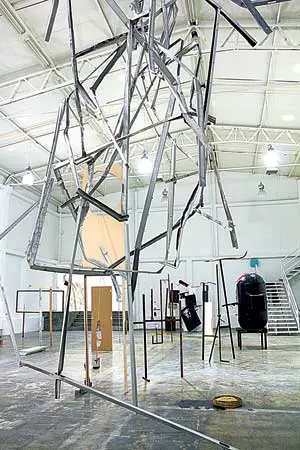
Appealing more to the sovereignty of individual thought, a little in the manner of Attali as he observed good and bad aspects in nomadic devices, Bianchi reconnects. His premise is not new, although it is notable for its visual ingenuity in terms of its unique use and configuration of materials such as wood, egg, and ping pong balls next to epoxy clay and toilet paper.
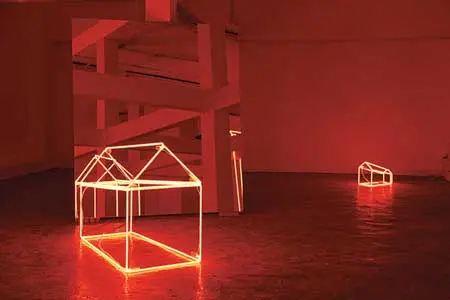
Going down to the basement, we find a cavern where blinding neon lights refer not only to Bruce Nauman but to the entire history of advertising. This is the work of Luis Rodrigo (Guadalajara, Mexico, 1973), who uses photo shots sometimes printed on paper, sometimes exposed with a nostalgia that chooses not to accomplish its goal: to reflect the past. Projections of happiness, the appeal of Rodrigo’s work is perhaps his discovery of a less literary exploration of every day and its reinterpretation, revealing images of life as it happened. Satisfying empiricism in a certain sense, his neons are—or seem—simple graphics of the pseudo-architecture of lived experience. Or reconstructions of its visual history, by means of tungsten.
Drawing as a bridge, a natural window that connects us with the outside (whatever the outside is) and with an equally unknown interior. The line possesses an almost audible quality and the composition of the painting resembles the sounds produced as a musical instrument is tuned.
Neon is later incorporated as a gestural element inside a kind of painting that evolved organically to finds its autonomy and become a drawing or a sentence. We constantly play or attempt to play with the foundations of personal walls, reinventing ourselves, and for that we make use of an imaginary eye belonging to others, moving the point of perception of our own selves; one of the main problems here is that, in seeing ourselves from outside, we value ourselves in perspective, as the point of view is external.
In Deconstrucción, neon, the light line, becomes embodied and acquires a sculptural character that recreates interpretations of spaces, architecture, the home as a symbol of personal perception and construction.
MAYRA INZUNZA