
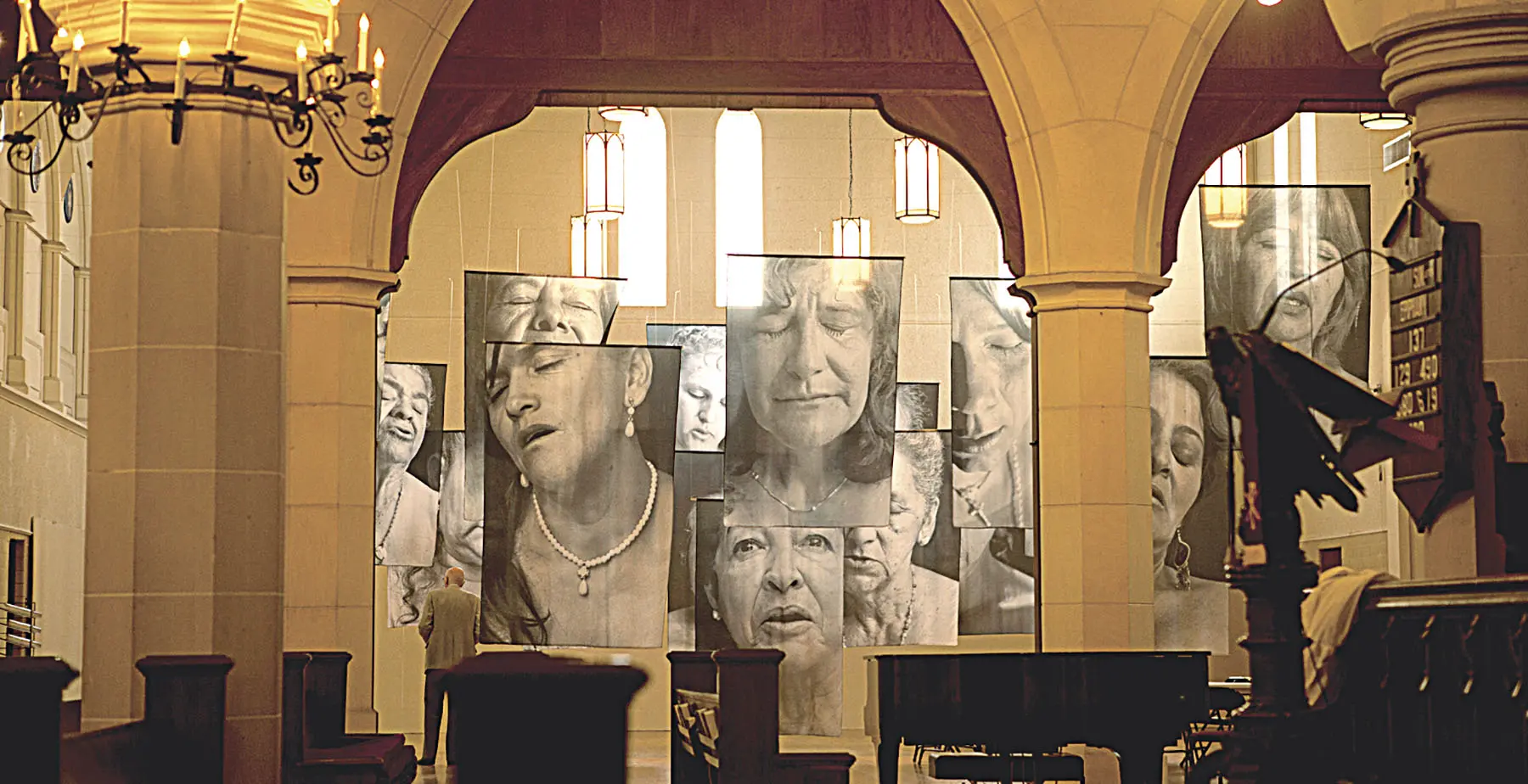
Some artists seem to have the vocation of undertakers. Across the continent, art has imagined strategies to shape their gazes and questions, their obsessions, their position-taking, and the accumulation of immense suffering that can no longer be silenced. I see the work of Colombian artist and photographer Erika Diettes as the weaving of a large, painfully poignant shroud in which she wants to lay down, consecrate, see off and bury bodies that have no repose.
Although the number of artists who develop their practices and produce their works around the topic of suffering and the catastrophes of our time is indeed significant, I will focus here on two works by Diettes: Río Abajo (2007-2008) and Sudarios (2011). The creative process in both instances generated an archive of the pain and suffering endured by the most afflicted victims of violence.
French theorist Georges Didi-Huberman has developed a notion that contributes greatly to any reading of contemporary art. Taken from the Warburgian corpus, the concept of survival, Nachlebem, living-after, (2009, 29) 1 is brought into a more contemporary stage in order to shed light on what, to me, is a fundamental urgency for the art of our times: the demand of returning to the dead via their material traces. Applied to images, the notion of survival can be read in several ways. It points toward that which is sedimented or crystallized in them, to the various trajectories—historical, anthropological, psychological—that traverse and make it impossible for them to be reduced to “one thing”. Hence the proposal to “think of the image as an energetic or dynamic moment,”, (35), as that which “survives from a ghost town”. (36) What survives in images, the different experiential charges that accumulate in them, is what shapes their memories. If, as Didi-Huberman indicates, survival designates a reality of fracture and also a spectral reality, (52) the quality of those two realities—fracture and spectrality—can be understood as qualities of the memories that accumulate in many practices or works of contemporary art. Qualities that imply topoi but also temporalities. As a trace of past life, of what was but no longer is, survival speaks of material and phantasmatic accumulation, of the many events of the past, of the “virtual remains” that are condensed in the works of art and speak from them. According to the Warburgian hypothesis reformulated by Huberman, such survivals become images. This relationship between vestige/survival and image allows us to think of the idea of an image-in-mourning through which the sediments of loss “speak”. This idea was explored by Didi-Huberman in his reflections on Winckelmann’s notion of history in Greek art as an “object of mourning”. (2009, 21)
What survives is not only the image as memory’s aesthetic form. The image is determined by the shape of a pathos through which we gain access to certain events and narratives. In particular, the emotional register suggested by images connected to situations of suffering prods us to delve further and explore the sum of experiences that traverse them, the traces of events inevitably linked to a human loss that cannot be buried; so, those images become images-in-mourning.
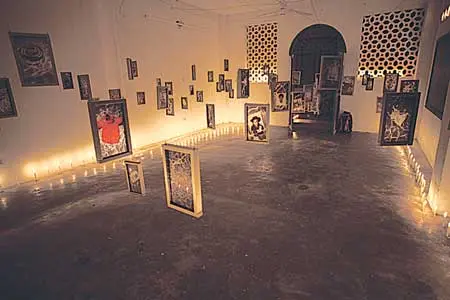
Image as Testimony / Ghostly Bodies
Diettes’ works involve a careful effort to perceive and archive each of the objects entrusted to the artist, a delicate process of recognition undergirding the emotional placement of the items under her care through the moment of their artistic processing. The journey of these objects is registered in photographs, and these are included along with the artist’s recollections of her own travels in the field notebooks she has produced. My reference to an instrument common in anthropological, archaeological, paleontological, and ethnographic research is fully intended. Fieldwork as a research method in the manner of the social sciences is used by some contemporary artists working with traumatic memories in contexts of conflict, who use first-hand information and generate documentation that can produce a narrative against the grain of the official story.
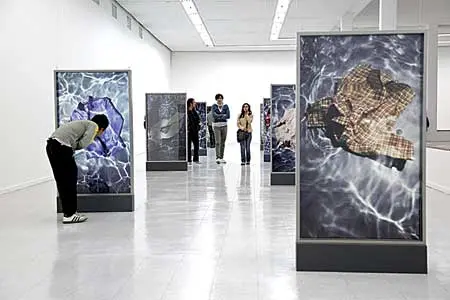
These two series, Río Abajo (2007-2008) and Sudario (2011), share the photographic mechanism, yet they explore very different discursive supports and anthropological experiences. Río Abajo is comprised of 26 digital prints on glass, framed by a wooden structure that holds them from the ground. The Sudarios are twenty prints on silk, unframed, supported by a thin aluminum structure.
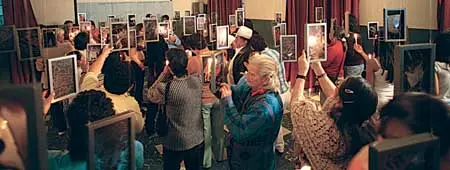
Río Abajo was created using clothes and items loaned by the victims’ relatives. As Miguel González has noted, creating this work involved “a real journey through the geography of rural and urban violence in Colombia, seeking out and finding the victims of the war and exploring their memories”. (2010, 2) 2 The objects received by Diettes for temporary safekeeping belonged to people who were disappeared or killed in Colombia’s armed conflict and had been preserved by relatives who are otherwise unable to bid farewell or bury the bodies. It has become commonplace to hear or read descriptions of Colombian rivers as funereal locations where bodies disappear or are discovered only by the circling of vultures overhead. In many cases, what accounts for those bodies are their clothes, their sole remaining trace. Diettes’ installation of twenty-six digital images printed on translucent glass is a powerful allegory for Colombia’s watery tombs. In their fragile materiality and the hopelessness suggested by the clothes left behind, these images become ghostly bodies.
Sudarios: Suspended Suffering
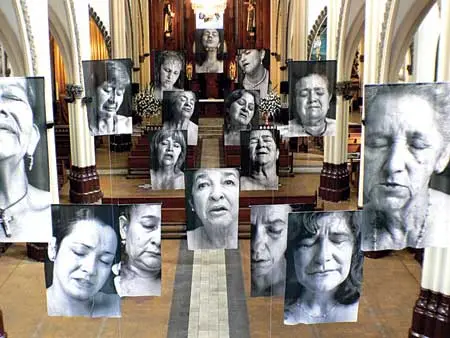
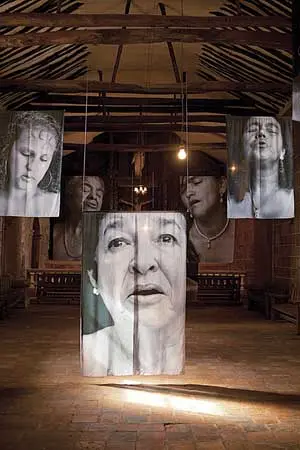
The Sudarios series comprises twenty portraits of women from the Department of Antioquia who were forced to witness the torture and killing of their loved ones. The back story behind each one of the images is truly horrendous. The photographic sessions were held as the women, set against the very landscape where the tragic events took place, agonizingly recounted their experiences.
Photography is the art of capturing the instant, or, as Didi-Huberman puts it, “an ecstasy of time in its access to the visible”. (2007, 131) 3 But, while Río Abajo was created in a time and a space “controlled” by the artist, the images in Sudarios were attained in very different conditions: the tension between listening to such painful narratives and at the same time focusing on getting the right, unique shot, the shot that reveals in the deepest furrows of pain in the subject’s face.
How to capture human suffering, the suffering that took over the body, and still overwhelms it? How to represent the traces left by the experience of pain? In the field of the study of violence as inscribed on the body, Wolfgang Sofsky believes that any attempt to represent suffering will always refer us to a later scene and that the unutterable nature of the event cancels the possibility of its expression in any registers save the image: “Verbal lamentation, the language of the psalms, begins after Man overcomes the state of howling in pain and regains the ability to use words. Pain cannot be communicated or represented, only displayed. The medium for its display is not a language, but images”. (Sofsky, 65) 4.
In general, discourses on the sublimation of the body have prioritized eroticism, ecstasy, or sainthood. A special treatment was reserved for representations of the body in martyrdom, where suffering appears in the transcendent, ecstatic facial expression of the sufferer who loses part of his or her body and offers it as a sacrifice to God’s love. The distinction between body and face pervades the iconographic tradition of Christian martyrdom, “with its astonishing split between what is inscribed on the face and what happens to the body”, (Sontag, 62) 5 as if keeping the face outside the atrocities inflicted on the body safeguard the person’s dignity. The body is the site of pathos and pain, the place for the production of martyrdom, and the preferred material for sacrificial offerings. A face in pain would conflict with aesthetic codes that extol serenity and beauty, because it anchors the subject of representation on an earthbound terrain, letting it fall from the heights of the aesthetic transcendence promoted by a certain understanding of beauty.
Erika Diettes acts against the grain of such legitimizations. The series of faces in her Sudarios leave no doubt about the painful experiences that molded them. Seemingly close to the ecstasy—and eroticism—of the mystical experience (as in Saint Teresa’s ecstasy, for example), these faces consummate a sublimation of pain, presenting a transcendental snapshot of the waves of suffering. Unlike the mystical transubstantiation of Christian martyrdom, the experience behind those images is that of having witnessed the horror, the violent, torturous loss of loved ones sentenced to death by the will and practice of others.
A sudario is a shroud, the canvas used to cover a corpse, but also a piece of cloth contaminated by its contact with the face and turned into a ghostly impregnation of the body in retreat, a trace acting as a photographic beginning.
Erika Diettes’ Sudarios are a testament of time, bearing witness to the extreme degradation that pervades a time when killing is no longer enough: now the body and the gaze must also be punished and the memory of the other must be made unendurable. Such testimonial intensity is sculpted in the form of pathos, the creases on faces almost always tilted, congealed in their agonizing motion, as if lifted by a sigh or pushed down by memory. The eyelids are drawn over the eyes like windows closed to bar us from a frightening interior, like veils intent on covering pain.
I want to highlight the forms of pathos that are in the image itself, the energies and experiences that traverse them to reveal a lyrical seismography. It is grace wounded by suffering: “It was clear to us that the resulting images would not respond to an idealization of their faces, but to the transcendence of their pain” (Diettes, 2012). 6
Yet, that very grace of the images takes us back to Boticelli’s Venus. Is it truly a matter of Pathosformel, of the way in which we are still shocked by the bodily shapes of the time of survival (Didi-Huberman, 2009, 1973), of the debt our imaginations and cultural references owe to figurative archaeology? If we mention Pathosformel in connection with Diettes’ photographs, it is because we recognize the agonistic motion that courses through them. Erika Diettes’ Sudarios bring to mind those Venuses in their disquieting intensity, where Eros and Thanatos converge. As if transported to other regions, the faces suggest an unsettling ecstasy, a kind of state of delirium and possession, much closer to the Bacchic pain observed by Nietzsche (and described by Plato as a state of mania where remembrance is paralyzed) than to the ecstasy of Christian marriage described by Saint Teresa of Ávila, which is just a motif in Bernini’s sensuous Saint Teresa. Formally, they are perhaps related to those Venuses in their nudity as well. The visual impact of bare skin at shoulder level, without any clothing to distract our gaze, in the close-up portraits, becomes a kind of frame for the face.
Images in Mourning
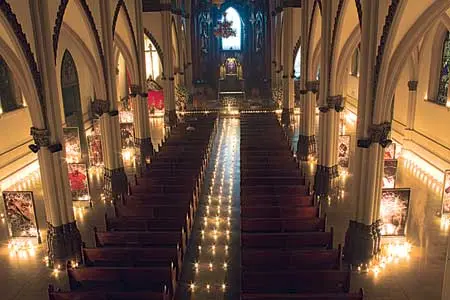
The Sudarios are exhibited in any space. The artist has clearly made a decision to present these silks in sacred locations charged with a certain aura; particularly in churches, always established around relics and vestiges of suffering, spaces of sacrifice and pain par excellence but also spaces where many come seeking a silent consolation for the pain in their lives 7. Confronted with these works, with the agony that fills them and condenses on the images, we wish for some peace to reach those bodies, for the pious contemplation that occurs in such spaces to accompany and bring back from oblivion the suffering of the victims.
Additionally, Río Abajo, besides being exhibited in art galleries and museums, has traveled through several regions of west Antioquia, 8 the territory where the objects photographed originated and where the victim’s relatives continue to grieve, denied the consolation of a burial. When the relatives, gathered in a public ceremony, illuminate the photographs with candles, we witness a ritual that continues to take place due to a large number of deaths in these lands. When artistic contemplation is transcended in a funerary rite, we acknowledge that art perhaps makes it possible to effect, in a symbolic and ephemeral way, that which we cannot effect in real life.
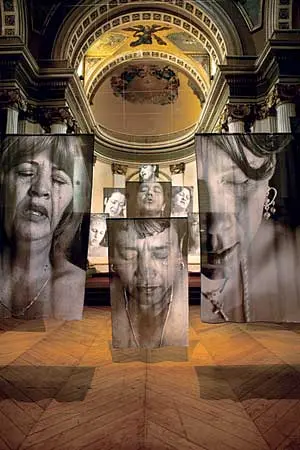
Installed inside the exhibition spaces, the Sudarios are literally an agglomeration of suspended suffering. In physical terms, the twenty silks where the faces are printed hung in such a way that they are free to move, exposed to contact and involuntary touch, or to our desire to touch and even embrace them. Our moving between them generates a tactile dimension, which we cannot but connect to the accumulation of survivals that courses through these works, to the memories of which they are testimony and which take us to a different place, as if telling us, in a whisper, that real pain and true tragedy happen in scenes that precede art. Rather than to the order of interpretation, I appeal here to my own memory, to the agonic exhalation that breaks the sacred silence generated by the Sudarios. It is an “almost imperceptible” register, Erika Diettes has said, “when the viewer is in the exhibition, it is as if they were exhaling,” 9 A different reading of the suspended suffering these Sudarios condense thus emerges. Something suspended is still pending, latent, nor canceled but postponed, prolonged in unending agony. We are in the territory of mourning, of the infinite suspended mournings that haunt these lands.
The work of Erika Diettes generates a dimension that becomes an allegorical space for mourning. I am in no way claiming that art provides a real space for mourning. The possibility of mourning passes through the debts still owed by the justice system, against indifference, impunity, and the absolute absence of symbolic spaces and rituals to accept and process death. But to foster the creation of a space where the vestiges and remainders treasured by grieving relatives are rendered visible, to gather them together in a public ceremony where much more than just a work of art is on display—a ceremony that becomes, even beyond the artist’s own design, a funerary ritual—is perhaps to foster a different space for our sorrow after death. When the survival of the protagonists themselves is compromised, as Didi-Huberman has reflected, (2012, 116)10 the images become a collection of survivals: images in mourning.
NOTES
1. Didi-Huberman, Georges. L’image survivante. Histoire de l’Art et temps de fantômes selon Aby Warburg. Paris: Les Éditions de Minuit, 2002.
2. González, Miguel, “Río Abajo”. Río Abajo, by Erika Diettes. Bogotá: Cámara de Comercio, 2010.
3. Didi-Huberman, Georges. Invention of Hysteria. Charcot and the Photographic Iconography of the Salpêtièrre. Cambridge: MIT Press, 2003.
4. Sofsky, Wolfgang. Traktat über die Gewalt. Frankfurt: Fischer Taschenbuch Verlag, 2005.
5. Sontag, Susan. Illness as Metaphor and AIDS and its Metaphors. New York: Picador, 2001.
6. Diettes, Erika. “Sudarios”. Conference, Museo Universitario del Chopo, UNAM. As part of the exhibition Sudarios at Ex Teresa Arte Actual and the Des/montar la re/presentación cycle at the Universidad Autónoma Metropolitana, Mexico City, 2012.
7. Sudarios has been presented in active churches and in former churches now functioning as museums, such as Museo Iglesia de Santa Clara Bogotá; Trinity Episcopal Church, Houston; Ex teresa Arte Actual, Mexico City; Capilla de Jesús Resucitado, Barichara; Monasterio de Santa Catalina, Buenos Aires; Capilla de Los Remedios, Santo Domingo; Templo El Señor de las Misericordias, Medellín.
8. Besides Granada, La Unión, Nariño, Sonsón, El Peñol, Guatape, Guarne, Cocorná, Carmen del Viboral, and the Templo del Señor de las Misericordias (Manrique, Medellín), Río Abajo has also been seen in Barrancabermeja, Montería, Cartagena, and Bogotá, as well as in galleries and museums in Buenos Aires, Houston and Newark, NJ.
9. Private communication from the artist, August 2012.
10. Didi-Huberman, Georges. Survivance des lucioles. Paris: Les Éditions de Minuit, 2009.
ILEANA DIÉGUEZ
Research Professor in Contemporary Art, UAM-Cuajimalpa, Mexico. Independent curator.