
In the first gallery of Meteor, Frances Gallardo seduces the viewer with her elaborate cutting skills. Her colorful cut paper vortexes, a whirling cosmos of intricate patterns, are based on satellite images of Caribbean hurricanes. As a child growing up in San Juan, Puerto Rico, Gallardo remembers seeing and hearing the force of Hurricane Hugo (1989) from her ocean-view window. After moving to New York City in 2009, she began to study the subject of hurricanes visually, through satellite imagery, and historically, by investigating their links to the cultural, economic, and political dynamics of Puerto Rico. Fernando Ortiz’s book El Huracán, su Mitología y Símbolos provided her with further layers of significance and her residency last year at New York’s Center for Book Arts, expanded her knowledge about paper and paper cutting techniques.
The artist’s cut paper works, layered and graced by soft traces of pencil and pastel, are equal to the beauty of aerial images of tropical cyclones. Gallardo’s use of a delicate, controlled technique to address the immensity and power of nature is akin to Ellen Gallagher’s Watery Ecstatic series. Gallagher likened the old art of scrimshaw (carving into bone) to her cut paperwork featuring sea creatures. Likewise, Gallardo’s cut-paper portraits of hurricanes were partly inspired by the centuries-old tradition of bobbin lace weaving in Puerto Rico.
Gallardo took the circular motion of the satellite view of a hurricane several steps further in the sound installation Hurricane. Working with two collaborators she created an instrument that plays “the ‘classical music’ of the Caribbean”—sounds triggered by the visual imagery of hurricanes. Based on the nineteenth-century Ariston Organette that played paper discs, Gallardo’s elegant contraption features a wooden music box and three painted, perforated paper discs that look like skill saw blades. As the disks move counter-clockwise on the player, light filters through their openings. This light is read by six photo-sensors located along a groove in the box and each one is programmed to emit a different sound. One of the discs sounded like church bells and a traditional Chinese plucked string instrument. Gallardo is extremely careful about the execution and presentation of her work—nothing seems out-of-place—but she always leaves room for playfulness, which enhances the work.
Gallardo’s passion for drawing and the line permeates her art. Falling, a video of a performance in New York, and Untitled (landscape), a row of painted square tissue boxes, highlight the artist’s superb ability to punctuate an intensely focused act with an expression of letting go. In Falling, Gallardo connected a line of string to various nails on a wall weaving a kind of web. Once the string was used up, the artist sewed the front of her simple white dress with vertical lines to the web. She then fell down and out of the dress, detaching freely and unemotionally from her work. In Untitled, the subtle watercolor of a Caribbean landscape recalls the refined work of Camille Pissarro. The emotion implied by the tissues and the depiction of a single wind-battered palm tree along a beach heightens a feeling of nostalgia. However, the billowing tissues also suggest the ever-optimistic white fluffy clouds in Francisco Oller’s painted Puerto Rican skies.
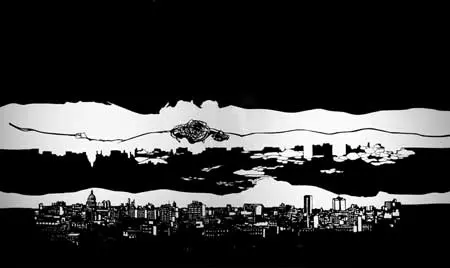
Meteor is the first one-person exhibition in Gallardo’s hometown, San Juan, and it features thirty works from 2008 to 2012, although most were made in 2012. The earliest work in the exhibit, Progress I, consists of static, uniform, straight black lines the artist adhered to the exterior of a building in Puerto Rico to outline its various planes. She then photographed the façade of the structure. The staccato lines imply the possibility of its easy disappearance. It’s as if one could take a pair of scissors and remove the structure from its environment. Like the best conceptual artists, Gallardo’s simple gesture points to the illusionary nature of what we hold true. She continues to contrast an image of stability and monumentality with ephemerality in three cut paper skylines of San Juan, New York, and Havana. Thick black tempests, full of surprises and furious agitation, hover above and strike the geometric order of the cities, thus suggesting an end to a fragile climactic balance.
The most poetic cut paper series in the exhibition is Untitled (Pentagrams). Here Gallardo reinterprets he written music scores of Bayoán Ríos, a young composer from San Juan. She uses power lines as the staff, electrical posts as the bar lines, and a mix of improvised connections and debris as the notes. Could this image of mundane chaos and visual pollution be another form of “the ‘classical music’ of the Caribbean?” Once again, Gallardo makes her dexterous juxtapositions electrifying and alluring.
CHERYL HARTUP