
It has been a long understood fact in the history of activist art that whoever controls images controls a great deal of power. This belief compelled the Egyptian pharaohs to destroy all imagery related to an enemy predecessor, drove Napoleon to cultivate the best artists of his time into a PR machine that put a positive spin on his conquests and campaigns, and with Dada led to such practices as photomontage. Drawing from Dadaist strategies and adding a more sophisticated media savvy, the artists of the 1960s, particularly those labeled “Pop,” made art that not only used various forms of media to convey their works but that also commented upon the very medium itself.
This legacy continues in a recent exhibition by Francis Alÿs entitled Reel-Unreel. Alÿs, who was born in 1959 in Antwerp, Belgium, originally trained as an architect. He then moved to Mexico City in 1986, where he continues to live and work. Apparently, the confrontation with issues of urbanization and social unrest in his adopted country inspired his decision to become a visual artist. Reel-Unreel comes from a project that was originally shown at Documenta 13, and it is comprised of two distinct yet interrelated parts, both drawn from the artist’s experiences of working for over two years in Afghanistan. One section of the exhibition consists of carefully grouped clusters of what appear to be intimately scaled geometric abstract compositions. As it turns out, color bar patterns such as Alÿs has painted are electronically produced and used by video engineers as test patterns in between televised programming to correct chrominance and luminance on TV screens. Therefore as the title implies, these images appear to be “unreal” abstractions but actually represent “real” video imagery. This oxymoronic duality can, of course, allude to the manipulation of reality during wartime and who gets to tell the story. It also suggests the impossibility of knowing the truth after some time in such conditions of irrationality, and the artist has indicated that they represent his inability to represent his Afghanistan experiences in images.
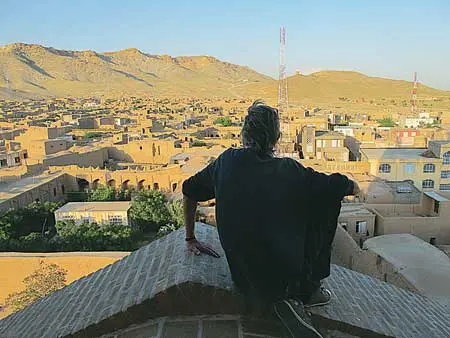
Alÿs became familiar with these color bars by working on a video for two years that make up the second component of the exhibition. Produced for Documenta 13, the video Reel-Unreel (made in collaboration with Ajmal Maiwandi and Julien Devaux) focuses on children playing in the hills above Kabul. The game appears to be the familiar one of rolling a wheel, hoop, or tire along the road with a stick while running alongside it. Rather than the conventional wheels or hoops, in this video we see the children using a reel of film, with one principal child dressed in black running along in the lead and another, white-clad child, taking up the slack. As the reel rolls, the film unspools, only to be apparently respooled by the child who follows. As the video progresses it becomes more troubling. The playful innocence of the game is increasingly marred as the children move from the hillside to the city and run along with destruction and impoverishment. As they continue the “game” grows increasingly relentless and uncomfortable, and the children seem to be more driven than happy. One has time to question who these children are, why they are allowed to run the gamut of the city unsupervised, why it is not a problem that the film is clearly being destroyed, and is it even possible for the second child to re-spool the role as he appears to be doing. At the close of the video, one learns that the Taliban had seized all copies of Western films and destroyed them. The negatives of these films, however, have survived.
Reel-Unreel makes one think of the nature of war and its various fictions and the role of various media in shaping those fictions, as well as who is controlling that media. The idea of reducing an epic struggle into a children’s game is poignant, as is the duality of seeing children trying to be children in a shattered world. Rather than merely angry or abject, there is a pervasive note of hope in this exhibition whether it be in the form of a saved body of film work that waits for the day that it can once again be viewed and enjoyed, or a group of children still finding ways in which they can be children, or even in the intimate colorful beauty of Alÿs’ abstract non-abstractions.
JOHN ANGELINE