
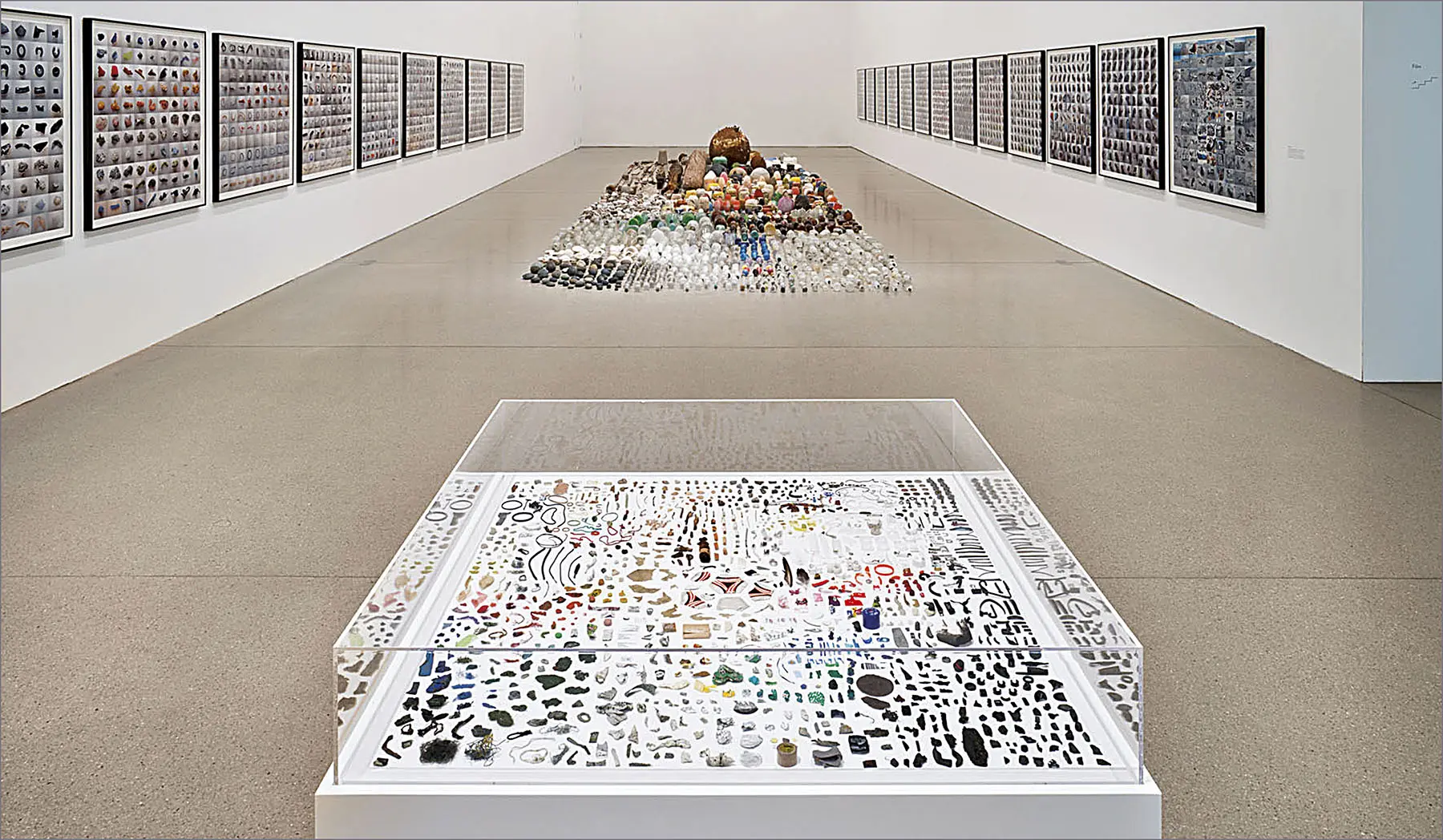
Detritus is what the Guggenheim press release calls the over two-thousand objects found in the world, collected and assembled by Gabriel Orozco for display, i.e., (from the dictionary), loose material, fragments, or particles, that result directly from disintegration, destruction, or wearing away. This raises the question of what has worn away? We speak easily of the “detritus of past civilizations,” so is it fair to ask what has passed, even as we are instructed by the institution and the artist to marvel at what is present? Two of Orozco’s favorite words are “constellations” for his collections, and “connections” for what is expected from us. In doing so I think he’s identified more—and perhaps less—than he or the Guggenheim realize.
Each one of the two-part installation of objects and related photographs has its own subtitle and source, but the entire installation is called Asterisms, from the Latin word for “star.” Orozco uses it to mean the constellations we create by drawing stick figures between stars that appear to us in the sky as if located on the same flat plane. Today we know them to be separated by vast distances in time and space, a description that fits Orozco’s process of finding isolated objects on a playing field in New York and a deserted beach in the Baja for display in the same plane of time and space of the museum.
Technically, asterism means those stars that are not part of the 88 officially recognized constellations. In a sense they are leftovers and although this line of thought fits very nicely here with “detritus,” the express intention is for us to connect the dots between Orozco’s objects through and within our own subjective space. James Clifford, the influential cultural historian, argues this process as one that recovers the “adult-child” play—the return of a bit of the old savage mind—that is lost by collecting and separating objects from cultures for taxonomic display in museums.
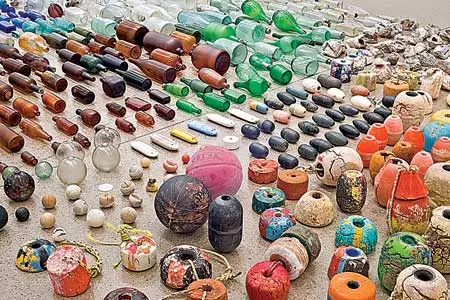
The Sandstars are objects found washed ashore on the otherwise lifeless white sand beach of Isla Arena, the same location as his earlier discovery and recovery of the California Grey Whale skeleton (Mobile Matrix now hanging in the Biblioteca de México José Vasconcelos in Mexico City), who mate and calve behind this barrier island. The wandering artist’s subjective decisions are then encoded into a taxonomic arrangement spaced evenly on the gallery floor, one made using shared characteristics such as form and color. In other words, their missing context as found fragments is now replaced with formal aspects, the aesthetic properties become the universal leveler. However, the viewer is more likely taken with the mental images and historical associations of light bulbs and bottles (some with messages) or of the many construction workers’ helmets bobbing across seas from as far away as Japan, to judge by some of the writing.

On the wall are 12 large frames of photographs, one photo for each object with all objects arranged in equal grids and typologically according to physical properties of shape, color, material, etc. Here the reductionism of context to formal characteristics is reinforced by the reduction in scale: all objects are now uniform in size, quiet scientism inherent in the entire project, and one that begs us to ask the question of conscious intention.
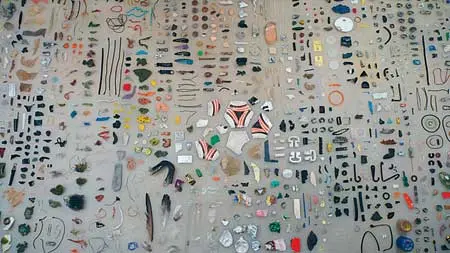
Astroturf Constellation is of the same format and system but due to the small size of the fragments left behind by athletes and spectators in the Astroturf on a playing field on one of the New York City west-side river piers—pieces of sneakers and soccer balls, gum, paper wrappers, coins, etc.—they are displayed on a raised horizontal panel and protectively covered, a vitrine in the tradition of the display of specimens. The accompanying grid of photographs on the wall repeats the plan of Sandstars. But here the fragmentary quality and the reduction to formal characteristics, enhanced by Orozco’s typological arrangements by color, is greater. These urban archaeologies are therefore as removed from the human context as the “stars” we have been asked to re-connect.
By framing his and our experiences within taxonomic and quasi-archeological systems, Orozco creates what we assume is a purposeful tension to call attention to the relations between objectivity and subjectivity, between the rationality of the finite and its projected colonization of the chaotic normalcy’s in the world inherent in older methods and rationales of collecting; ways we have come to reject and reformulate. This is a well-established critical awareness, one by now firmly chronicled in the museum, art, and cultural studies. And the reductionism here to aesthetic properties seems a disturbing counter-note to the strength of his admirable materialist aesthetic that privileges the object for its conceptual and ideational parallels in the everyday world. So how does this work?
One answer comes through Theodore Adorno’s argument that “art” objects are different from mere objects; they somehow combine both objectivity and the subjectivity of the aesthetic into a “cognitive” moment, which discloses some form of truth content. Then, too, Adorno’s use of the word “constellation”— borrowed from Walter Benjamin—can clarify Orozco’s use: these can be seen as juxtapositions rather than a reduction to an “integrated cluster,” one that resists the ossification of classification. However, by isolating his own more holistic process and emphasizing the aesthetic and fragmentary as possible means to a promissory end, it also signals the danger in Orozco’s balancing act; its collapse here into a flight from the world rather than his desired and vitalizing conceptual reawakening within it.
RICHARD LESLIE
Contributing Editor and professor of art history and criticism at the School of Visual Arts, New York.