
The rapid process of Miami’s gentrification has consequentially increased the need for specific types of constructions to support it, especially road infrastructure. The outcome is visually stern sceneries that in a way unify the country with the same kind of neutral architecture. The same type of highways, bridges, and parking lots populate cities all over the United States, sometimes making it difficult to find out where it is located exactly. These highly functional spaces have become almost invisible because of their seemingly repetitive and unattractive nature.
Miami’s process of urban renewal inspired Colombian-born Miami-based artist Hester to pick up her camera and capture it. She received her Bachelor of Fine Arts in Environmental Design from Parsons School of Design in 1989. In 2001 she moved to Miami, and in 2003 received her Associates' degree in Photography from the Art Institute of Fort Lauderdale. Her last solo exhibition, Concrete Perspective, is a result of her reaction to the city and shows photographs from three of her most recent series: Highway Overpasses, University of Florida Stadium, and Herzog & de Meuron’s 1111 Lincoln parking building.
The highway overpasses series show images of the archetypal connecting bridges that usually join highways and streets in the United States. The views were taken from different perspectives against a dark sky, creating a high contrast between the white or lighter bridges and their dusky background. It reminds us of projects or building models, in which all the elements are flawless and the grass is given an appearance of artificial uniformity. This series contrasts with the other two, visually for the darker color spectrum, and conceptually because it is portraying open-air spaces while the others concentrate in specific building sites.
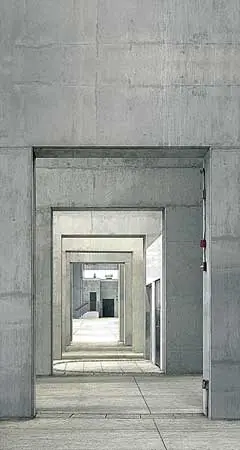
The University of Florida Stadium is represented extensively on the second series, in which several shots dissect the space. Again, playing with the angles, Hester creates compositions that refer us to constructivist paintings. Good examples are UF_0219_079 and UF_02192_226, in which the effect of chiaroscuro is obtained by clever manipulation of the light. Yet, one of the most attractive pieces of this series is UF_021912_253, in which space is multiplied almost to the infinite in a mirror effect. The doors are echoed in the repetition of the image in a rhythmical cadence. The sobriety of the color contributes to accentuate the space distribution and the sensation of a visual duplication.
The third series concentrates on Herzog & de Meuron’s 1111 Lincoln parking building, which has become a distinctive landmark in Miami Beach. The famous architects solved the need for parking in a very ingenious way, with a building that is at the same time stunning and functional. Hester depicted several views of the edifice, always accentuating its high ceiling and the use of space. Some of the images, such as 1111LR_012110_85, are taken right from above, provoking a vertigo sensation.
Despite being in the heart of Miami Beach, the city is almost invisible in these images, barely emerging like a ghost from the back of 1111 LR_030812_204. There is a visual uniformity in the colors used: all the pieces are monochromatic in a range of greys, except in 1111 LR_030612_078 and 1111 LR_030812_161, in which particular elements are highlighted in vibrating fuchsia color.
The type of photography that this artist makes requires a tranquil and solitary moment, since she is focusing on the structure and not in the presence of human beings or its interaction with the place. Hester is reinforcing the idea of architecture as a protagonist of urban life, a parameter to determine the level of civilization of any city. Nevertheless, her lifeless images are evocative of silence and isolation, instead of the usual noise that prevails in a city where heavy traffic would justify the need for these structures. The dialogue here is established between the artist and the place.
Her working system initially involves a photographic camera and later the computer. She would take her images and later re-work them in her studio until she is satisfied, resulting in these immaculate but apparently cold images. The artist is concentrating on something that is usually overlooked, such as the attractive qualities of exposed concrete, tubes, and bulbs. These elements become the protagonists of the compositions and their aesthetic values are highlighted.
The pieces are printed in big formats, giving the impression of open windows. The views are not static despite the fact that they might look like geometric compositions. By selecting different angles, Hester achieves movement and dynamism.
Hester’s pristine images are the results of her technical “manipulations”. By “tweaking” reality, and selecting usually-ignored fragments of it, she presents us with a peculiar vision of contemporary urbanism. Concrete Perspective is just an attention call towards these often forgotten parts of the cities, an aesthetic survey of them, stressing their functionality and beauty.
IRINA LEVYA