
Jorge Pineda held his first solo show in New York City at the stunning new galleries of Hunter College of the City University of New York, located on Third Avenue at 119th Street in the Lois V. and Samuel Silberman School of Social Work Building. This is only the third exhibition to take place in the Hunter College East Harlem Art Gallery, which opened in Fall 2011 and showcases exhibitions relevant to the local community, including work by Latin American and Caribbean artists. The Pineda presentation titled Shadows and Other Fairy Tales was curated by Mariluz Hoyos, associate curator of the gallery, and partially funded by the Colección Patricia Phelps de Cisneros.
The exhibition featured two major pieces The Forest: Lies (Version III), 2006, an installation of drawing and sculpture from the Cisneros collection, and a series of 93 drawings and 93 paintings titled Oh Taschen, Taschen, Taschen! Wild Girls Without Masks 2, 2012, conceived specifically for this show. Pineda installed The Forest himself, with the help of assistants. The piece consists of an abstract mural in graphite and chalk that spans a long wall facing the street. Meticulously drawn in graphite, the principal form evokes a vortex or a cloud of smoke that progresses through space, enticing the viewer to follow around a corner. Though this shape is amorphous, the lines that make it up are rigorously controlled, resembling individual strands of hair. Above them, however, is a looser, freer line—recalling Surrealist automatic drawings—rendered in chalk and contrasting with the structure of the drawing underneath. The combination of the two signals a theme in Pineda’s work that is underscored by the curator, the relation between the conscious and the unconscious. The drawing has the effect of moving spectators forward through space but also keeping them fixated on the finely executed line. When they do eventually turn the corner, they encounter both the continuation of the drawing and a representation of a young girl wearing a red hooded jacket and leaning against the wall, her face invisible but her head placed where the drawing ends (or begins). Here, there is only one layer of drawing, with a much looser line. The effect of the child is so unsettling, however, introducing the element of surprise and suggesting an enigmatic narrative, that the drawing becomes almost secondary. The principal theme here seems to relate to the meanings ascribed to abstraction and representation. In the catalog, the curator also points to Pineda’s interest in Jungian psychology, specifically the shadow archetype.
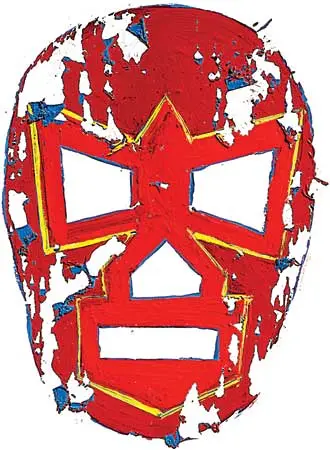
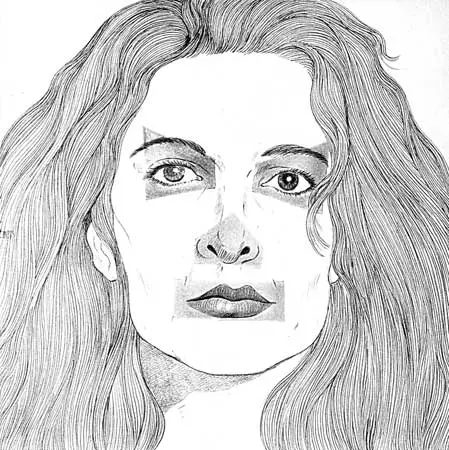
The Taschen drawings occupy the same gallery as the girl. Installed in a grid-like configuration, they consist of drawn portraits of women artists—from Marina Abramovic to Andrea Zittel and including Frida Kahlo, Adriana Varejão, and Lygia Clark—derived from the book Women Artists in the 20th and 21st Centuries published by Taschen in 2001. Corresponding to each drawing is a painted lucha libre mask that follows the form of each face. In the volume, the photographic portraits of the artists featured are positioned in a grid that is clearly being referenced by Pineda. He alters the ostensibly straightforward nature of the portrait photograph by including remnants of the mask on each of the physiognomies. For example, the drawing of Frida Kahlo, based on the iconic photographs of the artist, includes her most recognizable attributes—her thick eyebrows that connect in the middle and a braided updo—along with long earrings and a shawl. Pineda also depicts the eyes, nose, and mouth of the mask atop Frida’s features. This and the other works in the series appear to imply the unknowability of the human subject. They relate to prior drawings and installations featuring the lucha libre mask, including Mambrú (2005) and Wild Girls: Sandra and Juana (2007), as indicated in the catalog.
In her illuminating essay, Hoyos answers the question of what may lay behind Pineda’s sudden interest in women artists. She posits that the Taschen compendium purports to provide an authoritative overview that in the end may serve to constrain the work of the artists included, just as Latin American or Caribbean artists may be limited by the projections and stereotypes placed on them. Pineda’s critique of the classificatory survey as a means to knowledge is relevant, but the role of gender in his work remains intriguing. The girl in the installation appears to be the source of the line, just as the women artists he represents created many fine works of art. Through these references, Pineda begins a conversation on gender and Latin American art that merits further attention.
TATIANA FLORES