
Conceptual artist Karen Macher (1979) presents her fourth solo exhibition, titled Naturaleza de la deriva. Macher explains: “My work is based on Guy Debord’s ‘Theory of the derivé’, where, to create in freedom, one must adopt a state of constructive playfulness and go with the flow of whatever is found along the way, building according to how things come about. Although I work with a sketch and a prior idea, once on the site, the idea always shifts and I adapt to my surroundings. It is important for the work to be flexible to change.” 1
Macher’s work interacts with nature through different media, such as photography, sculpture, video, installation, and drawing. She has created several works using rice and vegetation, as well as Land Art constructions on lakes, on the sand, using beach rocks, and on forests, which she photographs to document her interaction with nature.
Her photograph Línea de vida depicts a hand and tallow, wilted leaves on its palm. This is easy to read: nature is in our hands. With her work, Macher intends to send out a message for the protection of nature. In another photograph, Contacto, we see a hand closed into a fist against a tree, which represents Man’s struggle with nature.
Macher’s work is, to a degree, ephemeral, as can be seen in works that use objects such as a book, a pair of women’s shoes, a handkerchief, and a shirt completely covered in rice, which in a few months will be nothing but a pile of black dust. A portion of the work will have disappeared. Such art-in-process works are not new in the field, but Macher’s subconscious emphasizes the concept by communicating that the man-made will endure while nature will perish. The artist also highlights her interest in seeing and documenting that process as part of her work. 2
Macher’s sculptures feature painstaking carvings in the shape of fossils. One of them, made in stone, measures 50 cm in depth and is particularly impressive with its sections of uncarved stone, which creates an interplay that tacitly contrasts the man-made and the nature-made.
Macher wants her viewers to be captured by the work “be it for its concept, technique, or execution. I like to abstract viewers from the everyday, like when one takes a walk on some natural landscape and begins to discover things one had never seen before. I am interested in creating an awareness of the beauty of ephemeral things, for each one of my works to generate emotions and sensations.” 3
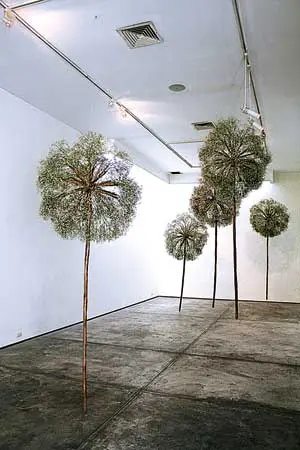
Macher intervenes all her photographs. Some feature ropes in different colors with the shape of trees or cobwebs. In the show’s main installation, Deseos, we find five constructions using dandelion flowers, often used to ask for a wish (in Spanish, “deseo”) as they are blown. The work is based on this “disappearance” of the dandelion and it also uses fresh flowers that will degrade over time, leaving only their recycled and painted cardboard stems. The outsize proportions of these stems (3 meters tall) and flowers (1.20 meters in diameter) reinforce the concept. Referring to this installation in process, Macher says: “I did this to create a magical environment and generate the sensation of them floating as if it were a fantasy.” 4 The flowers do not touch the ground; they hang from the ceiling, some higher than others, thus creating an almost oneiric, illusory perception.
With this exhibition, Macher challenges the idea that art must remain untouched and last forever. She transforms her works into ephemeral art, focusing on the residue after a natural process. Her goal is to also develop a visual language capable of raising awareness of environmental issues among her viewers.
NOTES
1. Interview with the artist, January 2013.
2. Ibid.
3. Ibid.
4. Ibid.
AUGUSTO CHIMPEN