
We live in an age of growing imbalance between humanity and its habitat. We constantly abuse the environment, and nature has responded violently by way of storms, hurricanes, and earthquakes. In the exhibition entitled Terraforma, the artist Luis Cruz Azaceta who, throughout his career has shown a particular sensitivity toward social ills and human tragedies, turns his gaze to those natural disasters that affect not just man’s wellbeing but also the stability of the planet.
The paintings in this series have titles that make specific references to natural catastrophes and the consequences of climate change. Cruz Azaceta paints tsunamis and tornadoes, but also the damages more directly caused by men such as oil spills and acid rain. Nevertheless, he also reminds us of the goodness of nature in other works where he paints a planet Earth that is alive and full of color. Among them are paintings with titles such as Green Cube, with its triangles in a variety of greens—that reminds us of a faceted precious stone—and Bay View in which we imagine a blue sea that contrasts with the brightness of the sun on the earth.
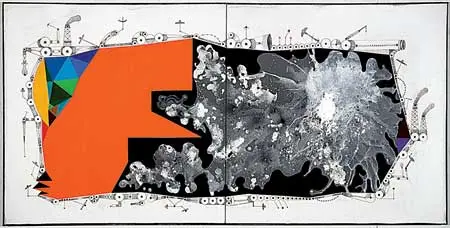
The paintings in this series have predominantly white backgrounds, which the artist frames with hand-drawn, somewhat blurry, black lines. Almost all the compositions are based on a large semi-geometric central shape, into which Cruz Azaceta inserts the main characters of the series, such as spilled oil, black clouds, rains, floods, or whirlwinds. He also incorporates thin lines, dots, and multiple polymorphic elements, but above all, areas of small repetitive triangles which he later fills in and makes dynamic by way of parallel lines, shadows, chiaroscuro effects or vibrant colors. In spite of the serious warning the subject conveys, the effect is lively, even humorous, and the colors, cheerful.
In Tsunami III, for example, more than half of the central area is covered by a gray watery mass, converted into a visually dynamic space by the hundreds of black and white dots that are all over it. Within that space, we see shapes that float, as if adrift. In spite of the fact that they are abstract, they remind us of bits of clothing, of human bodies, or destroyed houses. A curvy diagonal line crosses the canvas, the right part of which has an area covered with the repetitive triangles common to all the works in this series. Finally, along the upper edge of the central form, the artist has a pencil drawing of a group of lines, gears, and pulleys that make up some sort of man-made machine. It’s an ironic commentary because with its disproportionate smallness, and from the outside, the machine clearly fails to control the natural disaster.
Cruz Azaceta transmits a message about the meaninglessness and futility of human endeavor as opposed to the enormity of the effects of pollution. The contrast is particularly marked in a work such as Rainy Cloud in which a huge cloud in shades of white, gray, and black floats over a landscape of colorful triangles that suggest farm plots, green fields, and mountains. Rain, like white tears, falls from the cloud onto the earth. One lonely machine sits above the scene, looking useless, almost humorous. By contrast, in Terra Carbon, the complete perimeter around the central “disaster” is covered with the delicate design of tubes, cogwheels, pendulums, and even oil rigs. The black line drawing looks neat and precise but a closer look reveals that there, as well as in the black border around the composition, the artist has left smudges and imperfections as evidence of the artistic process and the work of a human hand.
Although all the works in this series make reference to human activity, only one of them includes a human being. In The Artist, a small man dressed in coat and tie appears in the middle of a large white rectangle, standing on a thin horizontal line. Behind him, there is another line, like a horizon or a symbol of the past. On his head, is a three-dimensional geometric shape in the primary colors of red, blue, and yellow, which looks as if he were carrying part of his house in place of a hat. Above him floats a strange shape, like a dark nimbus with the form of an electronic component or a glass container for a chemistry experiment. Multiple associations come to mind. We are facing a man who is isolated from the rest of humanity, on empty land, who carries on his head what little is left of his home. There are no greens or browns, and in the sky, there is no blue, just a black cloud.
Cruz Azaceta is a committed artist, with a sense of responsibility, who is critical of the problems of our time, whether social, political, or environmental. At the same time, he displays a sense of humor and artistic skills that invite and seduce the viewer. Throughout his career, he has shown continuous renovation, from the time of his early expressionist style to his current more abstract and geometric language, but he has never ceased to deliver messages, including warning signs, that the world should heed.
MÓNICA E. KUPFER