
The exhibition presented at the Instituto Cultural de México in Paris, titled Tepalcates (a Nahuatl term meaning “pieces or fragments of a clay receptacle”), perfectly captures the words of curator Gicela Arias, from the Mariana Yampolsky Cultural Foundation, and the photographer’s own spirit focused on art and a love of detail. The show, occupying the Institute’s five galleries with more than a hundred photographs in the same format (medium), is comprised of thematic sets that reflect rural Mexico’s creative ingenuity. Since the 1970s the photographer undertook a systematic investigation of agricultural activities, functional objects, ceremonies, and clothes. Yampolsky traveled around Mexico, crisscrossing cities and villages in response to the foundational axis of her production logic, which consisted of generating a series of photographic cycles. These resulted in several important books, such as Lo efímero y lo eterno del arte popular en el arte mexicano (1971), La casa en la tierra (1981), and La casa que canta (1982). Later, she traveled in search of haciendas or their remains, from the New Spain era to the Nineteenth Century, which crystallized into Estancias del olvido (1987) and Haciendas poblanas (1992).
Mariana Yampolsky (Chicago, 1925 – Mexico City, 2002) arrived in Mexico in 1944, at the age of 19, to study printmaking at the Taller de la Gráfica Popular (TGP). Soon, she fell in passionate, fascinated love with the country, and made use of her relentless energy and perseverance to traverse it time and again. She chose photography, a direct and manageable medium, in response to the desire for discovery that emerged from this new existential experience. Yampolsky’s unending curiosity enabled her to catalog a centuries-long reservoir of knowledge, thus contributing to the revaluation of artisanal practices that had remained alive and to the archiving of an immemorial culture that the country’s modernization has not erased.
Yampolsky is, perhaps, the artist most systematically interested in the diversified wealth of indigenous knowledge. The body of work presented at the Mexican Cultural Institute bears witness to an aesthetic gaze combined with evident ethnographic interest. In the catalog for a previous exhibition at the Centro de la Imagen, in Mexico City (1999), Francisco Reyes Palma spoke, accurately, of an “emotional anthropology” in Yampolsky’s photographic oeuvre.
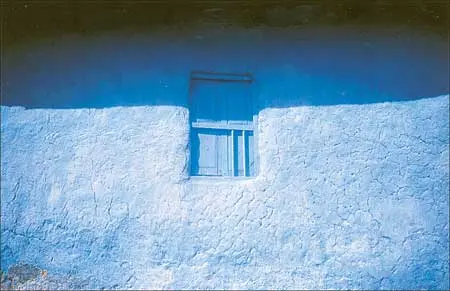
In this exhibition, the artist’s gaze invites to share in the “active present” of indigenous Mexico. Be it through details of roofs, textures of adobe or dry rock walls, functional architecture such as fences for horses, a stone chicken coop or a coscomate (corn granary), braided ropes, an assemblage of wood stumps for roofing, or cirio cactus curtains, the photographer shows us, with elegant simplicity, that form is inseparable from function and that, even if unaware, workers and artisans also manufacture beauty. A functional aesthetics can be invoked through these photographs, which do not aspire to a fabricated aestheticism. The human presence is scant; there, life is somewhere else, in that ancestral savoir-faire that attests to the human hand and the naturalness of the artisanal and vital gesture. Yet, a few living outlines (child, woman, dog) appear around a corner, inside a home, in the sober framing devices that capture and concentrate, in one gesture, the infinite character of time.
Another notable aspect as we contemplate these photographs is, without a doubt, Yampolsky’s sense of geometry as she captured architectural details (walls, roofs, eaves) and textures (adobe trellises, ropes, rocks, maguey stalks), a path to the beauty of details inaugurated by Manuel Álvarez Bravo in his earliest photographs. Several of the images on exhibit here refer to the inspirations of architect Luis Barragán’s “emotional” geometry and his spaces whose limpidness is never altered by the force of color, an interest shared by Yampolsky in the nine color photographs—more recent, but undated—included in the show. The polychrome beauty of these simple walls and doors underscores the photographs’ pictorial dimension and the dialog they propose, in the violence of their chromatic contrasts.
This thought-provoking exhibition enables us to understand the essence of Yampolsky’s conceptual, aesthetic, and emotional project. The one thing to lament is that here, the French public that finally discovers her is denied other parts of her oeuvre, open to different themes and spaces.
CHRISTINE FRÉROT