
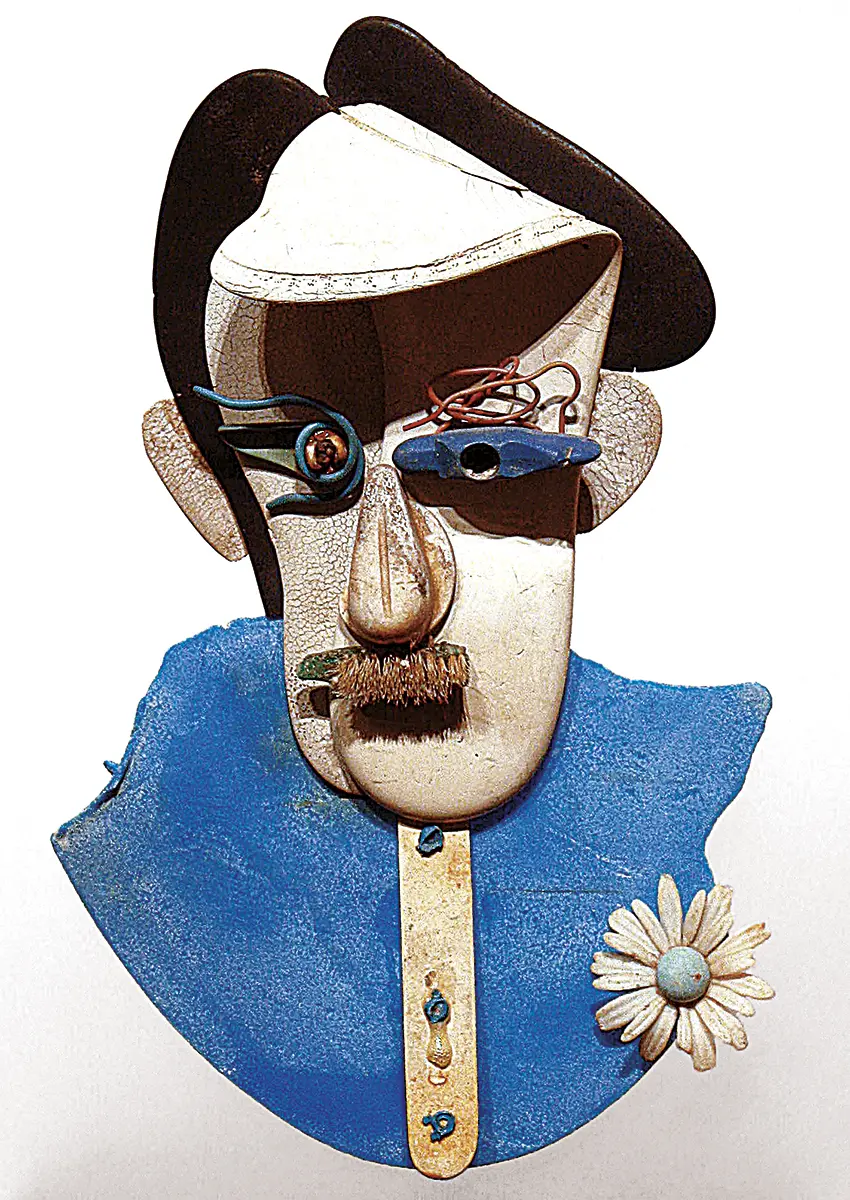
Nick Quijano’s most recent exhibition at Museo de Las Américas, located in the Cuartel de Ballajá in Old San Juan, is a precise example of trash as art. The exhibition includes 140 artworks created using fragments of objects, historical remainders of merchandise transformed into rubbish. Shoe soles, bottle caps, pieces of cardboard that were at some point parts of a box, plug now without their cord, and so much flotsam and jetsam become the ready-mades dictating to the artist in a creative trance, as he has described the process, the mysterious connections that exist between them. Nick Quijano may be telling us, like Bertolt Brecht, that among all the objects, the ones he loves are those that have been used. Impregnated with use and the imprint of time, they are brought ashore by the sea to the beaches of La Perla, the neighborhood where the artist has been gleaning them since the 1980s. Such detritus collected at first in Quijano’s rooftop and later in his Old San Juan studio is a treasure trove awaiting its artistic transfiguration into collages of figures, masks, portraits, still-lifes, cabinets of curiosities, and maps, among many other things.
In his effort to dislodge the notion of progress associated with social Darwinism and Nineteenth-Century technology, Walter Benjamin described the spectacle of Paris, the City of Light, as a phantasmagoria, with its tree-lined boulevards, cafés, and well-lit store windows filled with luxury objects. The city as a magical mirror reflected the image of the multitude that flowed through it more as consumers than as producers, veiling the relationships of production that existed behind the glass. The objects’ exchange value concealed the value of productive work. For Benjamin, contrary to what Marx thought, the problem of the phantasmagoria resided not as much on the merchandise-in-the-market, but on the merchandise-on-display. 1 Susan Buck-Mors explains that, for Benjamin, both exchange value and use-value lose all practical meaning within that realm and are substituted by a representational value. The merchandise, appealing to potential buyers in its pristine virgin state behind a contemporary city’s store windows, sheds not only the appearance of its use-value as it’s consumed but also its enchantment. At the end of its useful life, discarded into the urban center’s trash bins and hide from the citizen’s gaze, the merchandise reveals the material nature behind its use-value. Discarded objects are like abandoned children who, thrown next to others equally dirty and dusty, are an ironic commentary on themselves. They present us with their worn out, marked, or scratched surfaces, their dents, their mutilations. Their meaning seems to be that of what has been lost, while its metamorphosis into art, through recycling, restitutes its exchange value and imbues them, also, with aesthetic and artistic value.
The subversiveness of Nick Quijano’s collages and installations derives from his recycling of all that is discarded by an affluent capitalist society. Quijano’s works reveal what is lost from the object as well as what is associated with its presentation, the packaging that emphasizes its usefulness, integrity, and status as a new thing. Like Benjamin’s, Quijano’s critique, in his trash art, disarticulates the pretensions of manufactured desire. The material qualities of the discarded objects and fragments are clearly on display, as is the arbitrariness of brand designs that impose a unity between the merchandise content and its form. Quijano’s use of the trash, for instance in La Nube, is a reflection about the speed of production, massive consumption, and obsolescence of the merchandise, ultimately discarded by society after taking up large quantities of raw material and human labor. Trash appears in the social imagination as an element of guilt, much more patent when we see marginalized or homeless people using it for their shelter or dress. Yet, Quijano’s imagination, like that of a child using trash as a toy, the former merchandise is a means for the formation of new intuitive relationships and the establishment of a connection to objects that are not pre-determined by the utility and takes place in the fullness of freedom. Art opens up that possibility, denied in the world of merchandise.
NOTE
1. Susan Buck-Morss. The Dialectic of Seeing. Walter Benjamin and the Arcades Project. Cambiridge: The MIT Press, 1991.
INGRID MARÍA JIMÉNEZ MARTÍNEZ