
In 2005 Paul Parrella presented his first annotations about nature to the public. Even back then his works were compelling because of the perceptive duality that they presented. Indeed those images—like the current ones—appear to be abstract in their rendering, and sometimes they even look explosively spontaneous and expressive. The informal trace leads one to associate these works with a return to an informalism charged with gestures. On the other hand, his work is a clear reminder that appearances can be deceptive. His adherence to reality is such that more than abstract representations, the work is about the presentation of certain natural forms just as they are in certain moments and specific states. Parrella is an observer of reality and his work is the result of the annotations he takes after carefully observing it.
As we were saying, in 2005 Parrella created his Annotations about Water; in 2007, he presented Annotations about Light, and the result of those two projects led to the current series Annotations about the Sky (2012). While all three series share formal similarities among them—in terms of trace and apparent spontaneity—they also have in common that each is the result of a very different process for capturing the images that the artists take directly from nature. What varies among them are the discursive intentions of the Parrella.
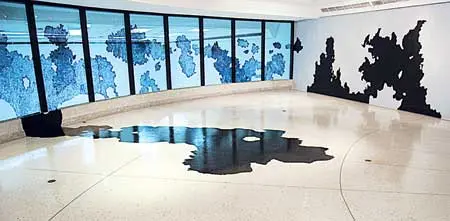
The most recent Annotations About the Sky were exhibited simultaneously in November of 2012 at two separate venues. At the Galería Viloria Blanco in Maracaibo, Parrella showed a group of paintings and drawings on glass; at the Sala 6 of the Museo Alejandro Otero in Caracas, he created a large installation that he entitled Materia Flotante (Floating Matter). For the latter, Parrella consolidated at a grand scale the distinctive elements of this visual and perceptual research. To do so, it became imperative that the artist took into consideration the architectural characteristics of the Sala 6 in the aforementioned museum: a triangular space whose façade is a thick glass wall (which enables visitors to observe the enormous height of the main hall of this museum. Parrella intervened floors, walls, and those large windows shaped like clouds whose existence he has “annotated” earlier from his studio window. It is noteworthy to mention that it is through his studio window that this artist observes the movement and permanent transformation of the clouds in the sky and renders such instants eternal. Through this process, he alters the criteria for painting still landscapes, as his objective is to paint that which is eternally transforming. Thus the informal appearance of his paintings and the great gestural nature of his brush. Nonetheless, he operates under analytical procedures that are very rational. His point of departure is the window of León Battista Alberti, the author who proposed visualizing the surrounding space through a matrix or grid set over the frame of a window or veil. Parrella’s studio window was also reticulated. This allowed for the forms of clouds to be analyzed and their points of reference are defined to then transfer them to the canvas. On other occasions, the artist draws the clouds directly on the glass or photographs them.
To intervene in the huge window of the exhibition hall in MAO became an extraordinary opportunity to develop this research at a grand scale. It was also a way to work the drawing without losing its gestural and intimate condition when working on a large scale. The clouds were rendered with agile and small traces—made with permanent marker—that, when added up, resulted in very large forms. These clouds were able to maintain their translucent quality, allowing viewers to see through the window and also through the cloud forms.
As far as the intervention of the other areas of the space, the work differs from the one done in the large windows in the materials used to create it. While the windows were intervened with “drawing in patches,” the walls and floors are pictorial representations of the shapes generated by the clouds created with dense and thick materials. The procedure is as follows: after rendering the clouds on graph paper or capturing them through photographs, Parrella extrapolates the forms (or patches) to the canvas or, like in this case, to the walls and floor of the exhibition space. Paradoxically, despite being dense forms painted with opaque or subterraneous-looking pigments—like asphalt—the clouds appear to be levitating. It is a contradiction in technical and formal terms. Nonetheless, the clouds penetrate the hall like solid and invasive forms just as it occurs with asphalt.
Without having to leave his studio, Paul Parrella creates images that are the result of a dynamic perception and of circumstance. After all, clouds endlessly alter the landscape. The sky is one and yet, it is also limitless and diverse.
SUSANA BENKO