
Divided into three venues in Santiago, the exhibition entitled The Geometrical Route centered on the work by the group Forma y Espacio, as special attention was paid to the work of its founder, Ramón Vergara-Grez (1923-1012). Vergara-Grez became a significant presence in the Latin American art scene of the 1950s, during the height of the constructivist currents. Nonetheless, his work was under-appreciated by the local artistic system. Last year, the death of this great master was reported a couple of months after it occurred. He spent his last days hospitalized where he was declared incapacitated by his family.
At Espacio Arte Abierto and at the Corporación Cultural de Las Condes, the paintings by artists from the group—formed in 1962 by members of another group, Rectángulo, formed in 1955—allowed viewers to understand the contributions of a current that in Chile appeared not to transcend before the prevalence of manchismo painting, the work with objects and the push for installation that marked the last decades of local art in Chile. Carmen Piemonte, Gustavo Poblete, Kurt Herdan, Aixa Vicuña, Miguel Cosgrove, Uwe Grumann, Robinson Mora, and even renowned Matilde Pérez and legendary Mario Carreño, among others, were at one point or another part of the group that remained active until the late 1990s. The works in this exhibition propose personal languages based on working with form and pure color, subjected to geometric naturalism, the preponderance of design, Op-Art, or specific matteric inquiries. The relevance of these codes is revealed in their relationship with minimalism or with certain types of retro-futuristic exercises that restore modernism’s inquisitive power.
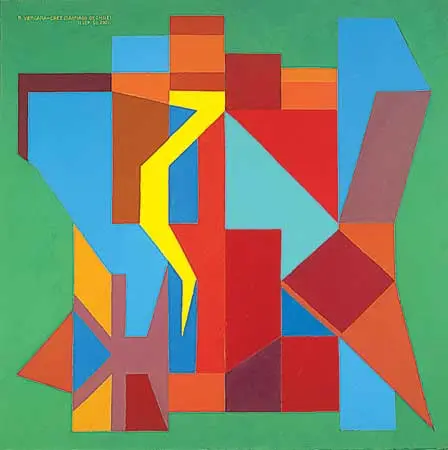
The third exhibition at the Casa Museo Santa Rosa de Apoquindo was thus an homage to Vergara-Grez. It included works that expanded from the 1940s to 2001; from the period in which he practiced certain rigorous compositions through representation and gesture, to the walkthrough five decades dedicated to a single obsession: the search for an absolute abstract plane to express more than reality as an idea, the idea as a reality.
Vergara-Grez was an atypical and misunderstood artist in the local context who questioned the currents of the market, the tendencies applauded by curators and galleries, and even the boom experienced by Matilde Pérez—an artist of his generation more connected to kinetic art—during the decade of the 2000s. He lived confrontation immersed in his studio, extremely concentrated in finding, until the last minute, the perfect form and color from the experience of landscape as internal landscape, within the boundaries of the frame.
It is possible to discover in the paintings by Vergara-Grez the desert in which he was born, the Andean mountain range, the visions of those clear skies from the north of Chile, and also pre-Columbian motifs or even certain mystical spaces. Every form-color is both concept and symbol. It stems from an exercise in which the artist is able to conjugate concept and feeling, using painting as a meditative act to establish a connection with a supra-conscience. He named this highly cosmogonic land metaphysical language “Andean geometry.” If we take our time observing Vergara-Grez’s paintings, we can see more than what we thought we were looking at. Its structures meet, color causes emotion, and the manner in which pigment is applied—flat, pasty, or smooth—intensifies such communication: the tones either vibrate or are muted; they are either depths or glowing areas. The group becomes a multidimensional space where that which appeared a mountain, sky, moon, architecture, or border suddenly becomes a portal or purely contained energy.
Some have accused Vergara-Grez’s art of being apolitical, uncommitted to history, and social causes. But, is it not a political gesture to discard any ornamentation in search of the essential? His painting is not afraid of solitude, silence, or emptiness; it is solemn like a cathedral erected over the mortals, or like an ancient temple that glows under the sun. He is also criticized for being incapable of leaving the frame and becoming part of the contemporary, in terms of the movement and expansion of the languages. His landscape is invariable, immutable and eternal: the frame becomes rather a “cosmic object” searching for some degree of the absolute.
“I am attracted to the images that persist in my memory. Schematically constructed, of appealing colors, magical for the associations that they unleash. Archetypes?” writes Vergara-Grez in the catalog of the exhibition Andean Geometry (1997, Museo Nacional de Bellas Artes). Ramón Vergara-Grez sketched a sort of “metapainting,” an “open window between here and beyond” that in the experience of the work looked for a necessary order in the materialist context. This is perhaps the reason his paintings from the last decade accumulated in the small studio he kept in Downtown Santiago, vehemently resisting, more than ever, succumbing to the speculative nature of the art market.
CAROLINA LARA B.