
Creatures that projected an emblematic animality dominated the space. Upon entering the gallery, viewers were placed at the mercy of the gaze of one of them. From that position, Sapingo (Know-it-all) headed the exhibition. It anticipated the nature of the portraits to come. With the contemptuous—almost brutal—name of that character of imposing figure and enormous, protruding, eyes, the proposal alluded, among other things, to the act of prying, as it questioned that disturbing shadow that hangs over the lives of those living under constant observation. Such is the first image we found at the opening of the exhibition at the Galería Habana entitled We Are Not Animals, a personal project by Roberto Fabelo, in which the absurd, the farce and the grotesque that inhabits his recent works, appear like pillars of critical focus in connection to life in the island of Cuba.
The ludic irony used to name the exhibition reproduced a phrase taken from the streets: the irate response that individuals used against mistreatment in the middle of the struggle with the circumstances. The enunciate We Are Not Animals, beyond the series it was based on and developed by the artist in 2011, is now a colophon of the concept Roberto Fabelo has been working on during this last decade in connection to the surroundings—approached from a global perspective—as he questions human beings’ roles as predators of the planet. There, another notion of the surrounding was activated as the center of Fabelo’s preoccupations; a notion whose coordinates are defined by the reality this artist lives in. A concept that through creatures reflects a specific world and that serves as a social interpretation of his time.
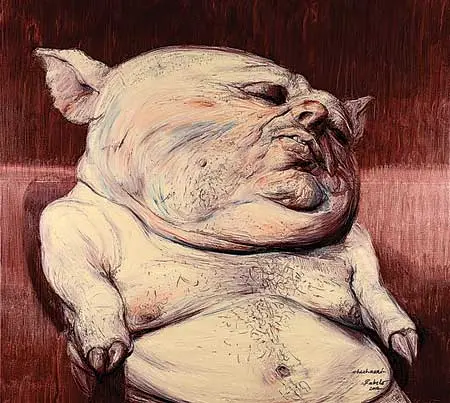
Fabelo, who admittedly feels trapped by the expressiveness of the human figure, on this occasion, brings to the foreground their unusual hybrid faces. Metaphors of the present, these new elements were arranged on five large canvases that dominated the gallery with their expressionism and large figures. The paintings reflected the fundamentals that drawing contributes to his work. Likewise, the exhibition as a whole showed the dialogue between the several mediums that efficiently complemented each other to render just the right dramatic projection of this project—as it also included a meaningful group of small drawings.
The presence of the animal has been a fixture of Fabelo’s work throughout his career and the artist has used it with varying intentions. In his earlier work, it was expressed through his proximity to naturalism. But as drawing gained ground, his bestiary began to be defined. First, during the 1980s, it accompanied the visceral expressionism of his installation series Fragmentos vitales (Vital Fragments) made with torn Kraft paper. Then, in the baroque watercolor fantasies that would also expand to painting. And, in the last ten years, this animal presence has acquired a new symbolic status by denouncing the environmental tensions that threaten life on the planet. Among the most relevant works from this period are a group of sculptural installations that include Mundo K (with 17 thousand cockroaches) and Sobrevivientes (Survivors).
That satirical vocation at the beginning of Fabelo’s career manifested in the mordacity of series like Pequeño Teatro (Small Theatre) from the 1990s, is renewed today with this symbolic animalia first announced in Obsessions—at Bötzow, in Berlin—with the work No soy un Animal (I Am Not an Animal) and El Rap de Las Moscas (Rap of the Flies). At the Galería Habana we encountered beings committed to the enjoyment of sexuality and the exaltation of the instinctive, as part of the major and silent carnival shown in the drawings. Nonetheless, Fabelo’s emphasis resided in that grotesque body —according to Mijaíl Bajtín’s definition—that translates into his paintings the lesions of the local social body.
Sobriety and tidiness accompany this aesthetic vision of reality, whether in his fountain pen notes or the drawings where the crayon is recreated. The same thing occurs with his paintings of strong traces similar to stabs on the canvas; or that other painting that reveals the sleek accommodation of the brush. Fabelo’s varying approaches to art are surprising, the disegno of his figuration, among other elements. Thus the impact of a visual projection never stops challenging itself.
The portraits in the exhibition We Are Not Animals are revealed through the symbiosis of humans and animals' current ethics and spiritual affections. They refer to values that have been shaken and attacked. Sapingo (Know-it-all), Destino de los Carneros (Destiny of the Rams), Mejor Amigo (Best Friend), Persistencia del Animal (Persistence of the Animal), and Chicharrón denounce stupidity, unresponsiveness, and abjection. They calibrate treason and docility, as they also neglect opportunists and servile people. Heads and figures traced by Roberto Fabelo as types that range from the stubbornness of rhinoceros to the indulgence of pigs. Through these cartoons are hyperboles the artist uses to convey the corruption that societies must eradicate in order to remain healthy.
CARIDAD BLANCO DE LA CRUZ