
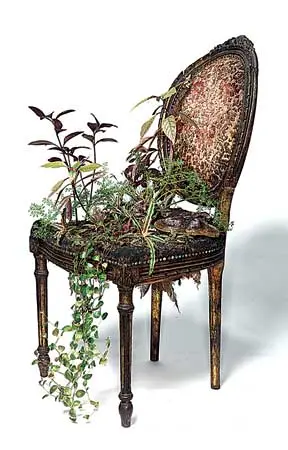
For the past several months I have witnessed the growth of a number of chairs from Rodrigo Bueno’s series Mobilia Tomada, part of his exhibition Matuto ao Cubo, now at EstúdioBuck gallery in São Paulo. The chair in question is a typical aunt chair, in the French style, with small arched legs that narrow as they reach the floor, as though it were tip-toeing to minimize contact with the world; a flowery upholstery in greens, fuchsias, and violets gives it a distinctive character.
At some point, the chair ended up in the trash, and from there it came to Bueno’s studio. In between the embroidered flowers, the artist sowed some real plants whose main characteristic is that they copy, repeat, or reproduce the upholstery’s hues, creating a sense of chromatic fusion and thus proposing a game of time and representation. In this work of art, real plants copy the print design; design does not copy reality.
Among the other furniture items included in the installation is a fiery-red armchair with a green Bromelia flower right on the headrest, which establishes a new chromatic dialog, this time based on contrast rather than similitude. Opposite one another, red and green attract and reject, love and hate each other; how much red one needs to add to green for it to gain consistency, and vice-versa? A brown couch functions as the receptacle for some plants whose thin stems extend upwardly, while pushing the furniture down with the weight of the dirt on which they sit, almost turning it over on the floor. This object, then, deserves a dual description: heavy as a mammoth, light as a firefly.
Mobilia Tomada—and Rodrigo Bueno’s work in general—brings to mind a connection to the still life, the humble genre at the bottom of the Renaissance hierarchy, which followed the tree of Porphyry, a pyramid that posited an order of value for representational works. In it, historical themes and state acts occupied the upper rung, followed by portraits, and then landscapes. The last level was that of the still life, paintings of inanimate objects that, besides lacking a soul, remained immobile (dead) during the execution of the work.
Yet, this lowly status made it possible for the still life to introduce a degree of everyday spontaneity, a disorder unknown in historical paintings: while the latter dealt with the uppermost echelons of history, the former presented only what was ordinary and ephemeral. A kind of worldly time that, in the Seventeenth Century, became a warning, the still life unveiled the vanities of the world and, moreover, the fatuousness of art, of those colorful deceptions that often pass for perennial images. From a wilted leaf to the skull, the still life is presented as a course and a process. Mobilia Tomada connects with this genre, then, more than as a matter of theme—leaves, flowers, receptacles—because it makes tangible the condition of mutability.
In a different section of the show, Bueno’s compositions in wood establish a relationship with the past. These assemblages hark back to Brazilian concrete art of the 1950s, but instead of standardizing the different parts as concrete artists did, Bueno’s work seeks to emphasize their singularities. Each articulated fragment shows the path followed by the wood, revealing both the fact that it was part of a furniture item and that it comes from a tree. From there a spontaneous concretism, or an anti-concrete concretism, evolves, in which memory overtakes the future.
This relationship with memory is explored by the artist in other works and by other means as well. In an August 2012 exhibition at the São Paulo MAM, Bueno projected an intervention based on African deities, or orixas. There, a circle of objects—food, plates, fruits, metals, plants—placed directly on the floor, were arranged in segments corresponding to a specific orixá, which implied a chromatic disposition, because, as Bueno explains, each of these deities has his or her specific hue: while Oxún tends towards gold tones, Iemanjá is partial to whites. Interestingly, Greek still lifes originated from offerings to the gods; thus we return to the genre, not via the old Baroque warning but through a ritual time that is capable of nullifying succession and condensing it in the fullness of the present.
Rodrigo Bueno’s work, then, opens itself up as the possibility of a different time, a different course of things, which in particular in Mobilia Tomada is summarized in the chair’s reverse march, be it because real plants copy their own portraits as they repeat their colors, or because the chair’s wood, having been part of a piece of furniture, now wants to become a tree.
JULIA BUENAVENTURA