
One of Us Can Be Wrong and Other Essays is the title of Rubén Torres-Llorca’s most recent solo show, open to the public at Juan Ruiz Gallery.
As the title indicates, rather than from the field of art, this exhibition must be approached as a compilation of complex essays on encyclopedic culture and its crisis in the global era.
Supported by a revision of literature and history, these unique essays grab our attention, first, for their emphasis on process as an inherent quality of the creative act. Connected through the impeccable artisanal execution that characterizes the work of this artist, the resulting body of work is a sword of Damocles where icons are subjected to careful scrutiny. In this way, the attractive appearance that seduces the viewer acts as a self-destructive snare.
The stories revisited by the artist, derived mostly from that reservoir of models for personality and social roles that are fables and children’s tales, brings to us related characters such as Hansel and Gretel, Dorothy, Red Riding Hood, who is subverted and negated through the device of irony. We are witnesses then of a fairy world devoid of happy endings, whose protagonists hesitate in the face of an uncertain future.
One of Us Can Be Wrong… continues with the post-structuralist social and aesthetic investigation that has defined Torres-Llorca’s work since the beginning of his career. To that effect, a dominant characteristic here is the inclusion of variegated objects that create a fundamental relationship of tension, generative of meaning.
In the specific case of One of Us Can Be Wrong…, the exhibition is a kind of tribute to the book as an emblem of a kind of culture and education of individuals. Torres-Llorca uses Rayuela, Julio Cortázar’s novel, and its nonlinear structure, as his map and avatar.
In that sense, Casa tomada is symptomatic. This colossal installation that takes its title from a Cortázar short story, expands like a vine on the largest wall of the gallery. Comprised of more than 300 individual parts, each one encompasses drawings taken from encyclopedia pages. Sometimes, up to three pages are superimposed, inevitably hidden to the viewer’s gaze in a univocal relationship forever out of our reach.
A complicated numeric code that uses algorithmic formulas, on top of the drawings, immerses us in a culture of the hyper-text, where the cascade of indiscriminate information takes us—often in a haphazard manner—by unsuspected paths and dissimilar points of view.
Aren’t You Tired Yet (2012) is comprised of two blocks of 77 individual parts articulated by the directions chart of Rayuela, one of the first nonlinear novels, animated by a multi-course topology where game and avatars open different horizons. The same is the case with Torres-Llorca’s work, where each block is comprised of the same drawings, but placed in a different sequence.
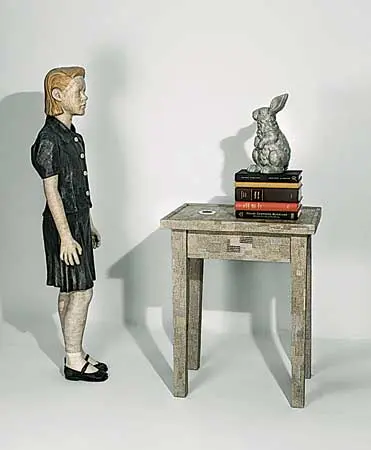
One of Us Can Be Wrong (2012), the installation that gives the exhibition its title, presents us Alice, now an adolescent, in an open confrontation with the rabbit. The character is devoted to the disjunctive between the worlds of fantasy and reality. Both paths, equally dangerous and equivocal, intertwine and overlap. The books used as pedestals for the white rabbit that in other times enabled Alice to escape the tedious book with no illustrations or dialogs, signify the return of a traditional kind of education which predetermined narrow social roles. The thorny disjunctive dominates this work.
Untitled (2012) presents us with the sculpture of a pubescent boy holding the gaze of a small pig atop a pedestal of books. Among the references, we notice Dickens’s Hard Times and a 1957 issue of Life magazine (1957 is the year of Torres-Llorca’s birth, which may give the work an autobiographical character). For his part, the little pig, associated at once with clashing meanings such as abundance and pettiness, is a felicitous clind’œil to American Notes, also by Dickens, more specifically to the books Chapter 6, devoted to New York City, where Dickens uses the figure of a pig for his biting characterization of American society at the time.
From the formal point of view, it is important to note the abandonment of color and the preponderance of hieratic poses that do not reveal the character's emotional state. This visual binding contributes to the sensation of ambiguity that, like a mirror, interpellates the viewer, who becomes the protagonist of the show, prompted to explore within and arrive at their own conclusions in the midst of the great conundrum in which we find ourselves in the global era.
JANET BATET