
The exhibition that currently showcases the most recent work by Tania Candiani (1974) at the Laboratorio Arte Alameda, in Mexico City, offers a series of points of departure and possible future platforms between her work to date and what we can expect from her in the future. As her first solo show in Mexico City and though not actually a retrospective exhibition, it is nonetheless possible to read the results of her intense work of the last few years. The exhibition shows the consolidation of strategies, interests, and working processes that characterize, already with enough solidity, her ways of interrelating languages and aesthetically configured conditions.
Five Sound Variations and a Pause presents six sound installations that alternate the participation of audio, graphics, and video in a display of the various levels of understanding and interactions that the artist weaves between sound, words, listening, and writing.
Each of the six installations presented is displayed in one of the architectural areas or spaces, as they set to interact within a certain independent topography. Two of the works stand out for the compelling manner in which the artist successfully conceptualized and materialized them.
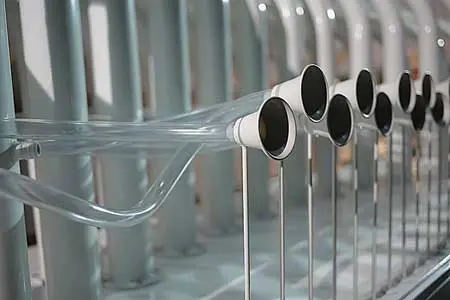
The first one—clearly the most spectacular of the two in terms of appeal and seductive sculptural appearance—is Órgano (Organ). Created in the place that it would historically hold in the chorus of the main nave of the former temple/convent of San Diego, the work is presented as a sort of decaying mannerist symbol of the imposing verticality that would confer these instruments a central place in liturgical participation. But instead of having the notes of its praying ascend to the sky, the tubes-trumpets designed by Candiani hang over the soto-chorus forming a sort of white tubular and static cascade.
The intervened instrument that is at the zenith when viewers enter space is turned on by a moving sensor that projects a sequence of sound words blended with the tonal range and note sequences that the organ is able to play. This occurs because of the development of a complex translation program that, combined with letters from the alphabet, forms 1,201 syllables that in turn are converted to musical notations—it is a program Candiani created in collaboration with two codifiers and one programmer. The phrases that the organ emits when it is activated by the sensor narrate in robotic voice fragments from texts by several authors associated with robotics texts.
Nonetheless, this is not the only—or the most interesting—way to activate this work. When accessing the chorus through the winding wooden stairs, spectators find themselves in front (or giving their backs) to the organ where, if they want, they can type a story of their own in an old typewriter—which will, in turn, be translated into cascading syllabic tones each time the viewer/writer pulls the lever that changes to the next line. Viewers can also just play the music they remember or improvise something on the keyboard of a conventional organ—whose notes will also be translated into words, meaningless ones quite possibly.
The second work from this exhibition that I want to talk about is the one entitled Pausa (Pause); a piece Candiani blends among five sound variations. In one of the lateral exhibition halls (a chapel) a sequence of discrete frames, each containing a letter-size paper with a story typed on it with an old typewriter. The stories—each very different from the other—are signed by writers like Mario Bellatín, Guillermo Fadanelli, and Alberto Chimal. At the back of this space, there is a video projected onto a wall in which the authors—appearing from the waist up with very serious faces—are set before a black backdrop that rotates slowly as the songs unfold with the written narrations superimposed like subtitles.
Leaving one with the feeling of only having been given a couple of clues to guess the story, the work is completed in the adjacent exhibition room where two large videos explain the creative process behind Pausa. The face of an old scribe appears on the left side attentively looking at his interlocutor while taking notes that, in the adjacent projection, the writer narrates so the scribe can type it on the third moment. The scribe was selected from a group of professionals who, like in the old days, still populate Santo Domingo Square in Mexico City to offer their services. The process of translating the spoken word after it has been processed by a listener, and its eventual conversion by another imagination/memory into constructed sentences, is revealed among the various devices that (de)construct the piece. The complicity that these works incorporate across several forms and technologies that allow for the transmission of personal, intimate, remembered, appropriated, or invented stories among—biological, mechanical, or digital—bodies, foreign or unknown, underscores and strengthens the essential creative center that Candiani’s work has been searching for.
MARCELA QUIROZ LUNA