
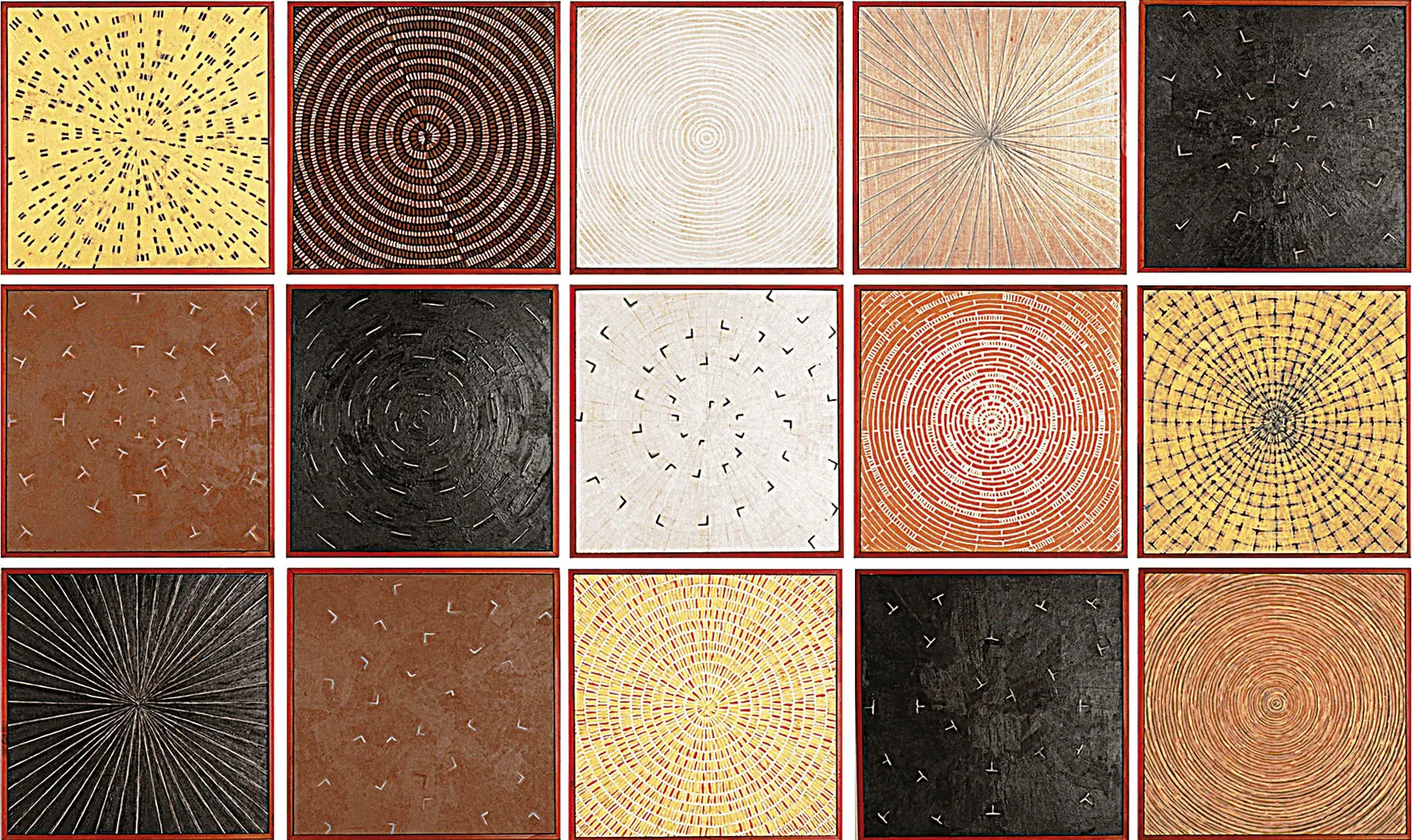
Under the impeccable curatorship of Susana Benko, Centro de Artes Integradas presented Traspasando Fronteras, an exhibition featuring the work of Venezuela artists Marylee Coll, Consuelo Guinnari, Ana María Olalde, and Patricia Van Dalen.
Benko’s thesis sought to find common points for the works of these four artists to engage in a dialogue; they are essentially connected by the persistence of abstract language, which nevertheless is expressed in different styles and for different motivations. As the curator puts it in the text accompanying the show’s catalog: “They are united by abstraction, of course, but their reasoning differs.”
Since the beginning of her career, Marylee Coll (Caracas, 1957) has carried out an investigation that combines the reach of the material medium used and the visual language proper. These explorations brought from the integration of words, fabrics, and decals into her paintings to the intention of giving them volume through the addition of pieces of foam rubber. Coll has been characterized from the start by the sharp intuition she displays in her use of diverse materials and forcing them to unfold into the pictorial support, giving them new meanings and engaging also some playful aspects of our contemporary, urbanized perception.
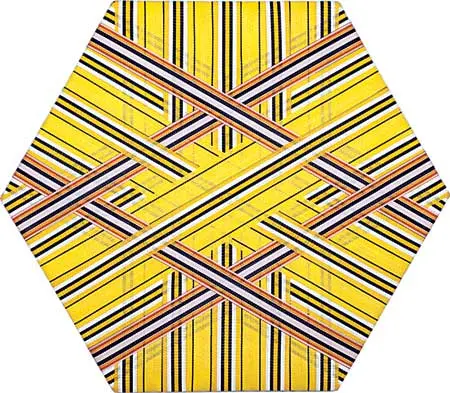
In Traspasando Fronteras, Coll presents a selection of works with an abstract-geometric appearance, created using nylon bands and foam rubber. The artist takes advantage of the linear, vividly colored design of those industrial bands (used in the manufacture of beach chairs) to compose works in geometric formats—hexagons, octagons, squares—on which she “paints” without the need for pigments or brushes, as can be seen in Azul Rojo Amarillo Negro Verde and Yellow. Coll’s grasp of geometry and of the dynamics activated by the crossing of straight lines in vibrant colors, added to her bold use of her materials, make these works an outstanding example of the contemporary syntax.
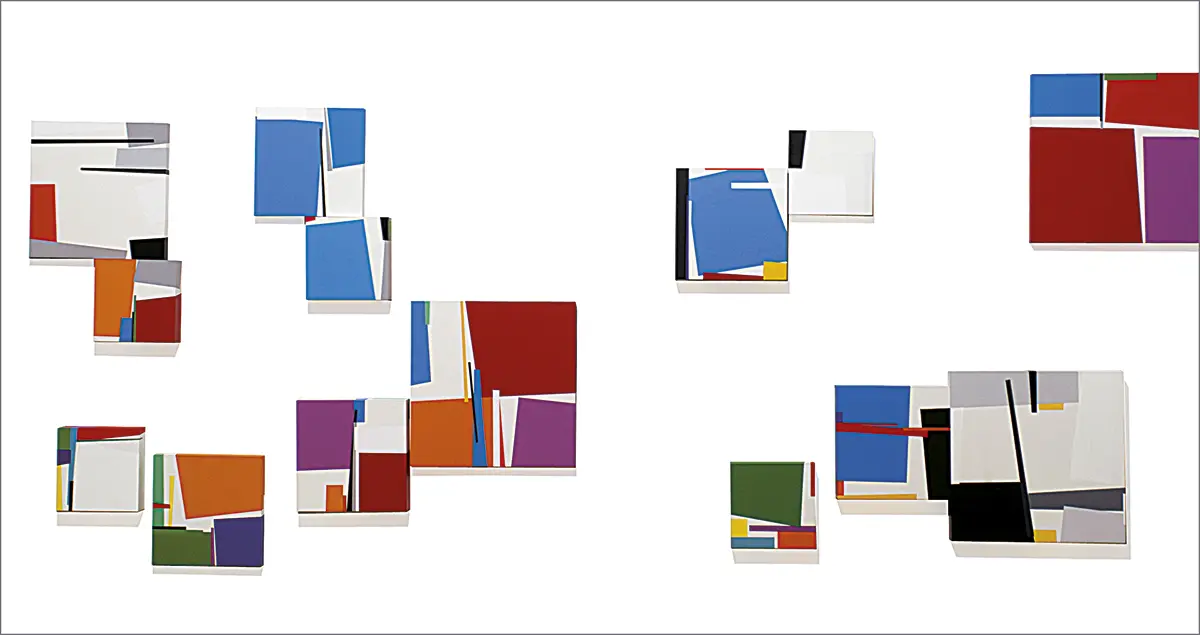
Color as an expressive element is the grand theme in the work of Patricia van Dalen (Maracaibo, 1955). The artist has been distilling her language, freeing it from the gesture-like, from expressionistic brushstrokes. Her most recent works feature a deliberate abstraction based on geometric shapes, yet they leave aside all strictly constructive elements and move into a kind of poetics of form, or rather, of color-made form, in what the artist had called “structure of color.” In that sense, her current work relates to Mercedes Pardo’s great paintings and silkscreens. In the exhibition we are reviewing, van Dalen presented a selection of paintings—Arquitectónica 134, Arquitectónica 130, among others—made in small formats of varying density. Composing on the wall two or more items that, together, form a single work of art, van Dalen seeks to intensify the dynamic produced by the interaction of colors on the plane, and of these planes on the wall. Balance, rhythm, direction, vibration, and movement are set in tension and result in luminous and vibrant works of art.
Unlike Coll and van Dalen, Consuelo Ginnari (Caracas, 1950) moves again from the orthogonal and from vibrant colors. As a consequence of her early figurative works, Ginnari’s vocabulary was polished and opened itself to what would become the basis of her language: the circle. At the same time, her Buddhist convictions make her approach painting as a metaphysical expression. In that sense, the circle also becomes a symbol of spirituality and science. Benko notes that in Ginnari’s work “the circle establishes an analogy with the universe, but the multiplicity of circles and bubbles express the existence of parallel universes.”
In Traspasando Fronteras Ginnari presented Flotantes, an installation comprised of paintings in a circular format in which overlapping circles floated to give shape to a recursive dynamic space. The neutral colors and the use of transparency connect to the artist’s religious practice. Ginnari’s work is able to combine aesthetic and spiritual reflections.
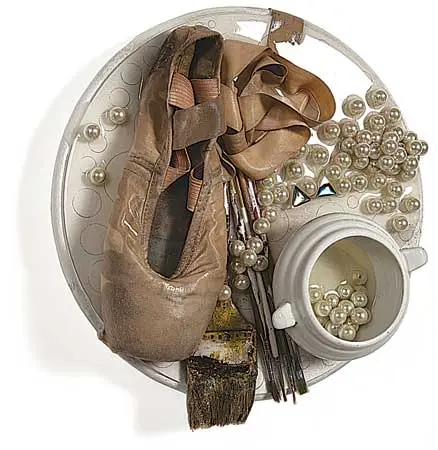
Ginnari also exhibited two works from her Recuerdos series, assemblages in a circular format where memory-laden objects converge.
Perhaps due to his background as a mathematician, the work of Ana María Olalde (San Sebastian, Spain, 1954) is particularly complex. Interested also in pre-Columbian art and in quantum physics, Olalde connects geometry in her work with a worldview in which form is ascribed to the macrocosm and the macrocosm acquires a special symbolic meaning.
In this show, Olalde presented paintings and sculptures. The sculptures are from the 1990s and the paintings are part of the series Entrelíneas, dated between 2005 and 2011, and Little Bing Bangs, dated 2009-2012.
Space as a theme pervades Olalde’s work. In her sculptures, square formats refer to pre-Columbian architectural modules.
The ferment of her paintings is found in Olalde’s reading in Chaos Theory, and the notion of fractals is prominently present in them.
In her more recent works, those from Entrelíneas, the artist composes her planes through a succession of lines in parallel. Painted in freehand, their “cold” kinetic effect confronts a somewhat primitive, warm quality that distances them from mere formalism.
Traspasando Fronteras gave us an opportunity to enjoy the work of four artists for whom geometry is reconfigured as a theme that transcends itself and accesses a universe of preoccupations that encompass the urban, the spiritual, the architectural, the poetic, and the symbolic.
KATHERINE CHACÓN