
Migration, migrating, migrant… these words have definitely left a mark on the twenty- and twenty-first centuries. Although the migratory phenomenon has been concomitant to the evolution of large human groups and the development of societies since time immemorial, in recent decades it has also been marked by the emergence of new technologies that shorten distances and establish virtual bridges. These technologies impact contemporary society in dramatic ways, and their consequences are visible in vast sectors of the population, and in countries that are “producers and receivers of migrants.”
There is a long tradition in Cuba of artists who have focused on the topic of migration and reflected on one of the most crucial issues in Cuban society in the last 55 years. Unlike many of his contemporaries, who explores the issue on the basis of the circumstance of insularity and create a system of representation rooted in the use of visual paradigms that are specifically connected to the case of Cuba, Abel Barroso makes universal references to the act of emigration, which allows his work to bring forth elements that are common to many cultures.
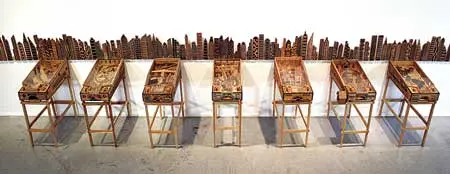
Barroso’s show at Pan American Art Projects, Un país, una ilusión, curated by Irina Leyva-Pérez and Alejandro Machado, uses an entire imagination that is built on elements that seem to simplify the act of traveling (visas, passports, bridges, airplanes…), but which, in an evident contradiction, also symbolize the restrictions to mobility imposed upon millions of migrants in today’s world.
Working with natural wood, which leaves in a state of bareness—the distinctive mark of his creative trajectory since his beginnings at the Instituto Superior de Arte, in Cuba—Barroso builds objects with profound semantic connotations. Casa-Mochila alludes to the symbolic load carried by individuals who, as they move from one location to another, are forced to bring their home, their memories, their past experiences wherever they go. A home devoid of roots, held by the ribbons that tie it to its owner’s back. The individual’s freedom of communication is symbolized in Llamando a casa by a telephone that becomes a home, refuge, an instrument to keep the distance at bay.
Entradas y salidas múltiples brings to mind the hand-made constructions that are often placed in gardens and other open-air public spaces with the intent of sheltering birds. Piled up like a condominium for migratory birds, these homes remind us of the fragile line that separates the act of traveling with laying down roots. The title also alludes to the permits that are required in Cuba to enter and leave the country. Although in recent months these restrictions have been modified, other documents, such as passports, are the sieve through which the decision is made whether to grant or deny permission to any given citizen. This is, perhaps, one of the works in this exhibition most closely connected to current Cuban reality, where the process of migrating is tightly connected to the nature of the State.
The installation Pinball del inmigrante is the most elaborate at the formal and conceptual levels in the entire exhibition. The highly distinctive New York City skyline is the horizon for seven machines in which players compete for the right to enter a city that is at once desired and forbidden. The work compares the process of migrating with a game of chance that demands from its participants, to make it to the end line, skill, intelligence, planning, experience, and cunning. Traditionally found in bars and playful spaces, these machines are relocated by Barroso to the space of real life, where the fate of millions who, following their dreams, gamble in favor of a better life beyond the borders of the Third World, is at stake. Without any glamour or color, the machines become symbols of an often harsh journey that is not made for pleasure, where fear-induced adrenaline is a constant companion.
Some of the works included in Un país, una ilusión were on exhibit in Cuando caen las fronteras, a show at the Museo Nacional de Bellas Artes during the recent 11th Havana Biennial. The current show at Pan American Art Projects brings to North America works that provoke reflection and give new life to debates on topics that belong not only to the academic analysis of critical issues of our time but to the international art scene as well.
VALIA GARZÓN