In November 2012, Venezuelan artists Amalia Caputo and Esperanza Mayobre, both living in the United States, shared two exhibition spaces with recent and not-so-recent works that dealt with topics such as the relationship between space and identity, personal memory and objects, female stereotypes, and collapse as the leitmotif of the contemporary.
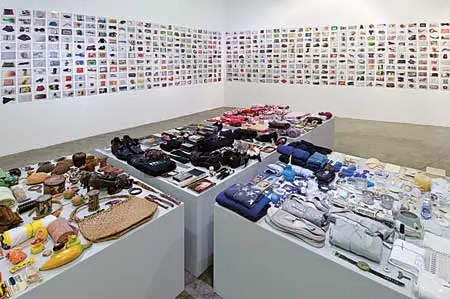
At La Caja, of the Chacao Cultural Center, Caputo presented Transferencias, an installation comprised of three walls covered with 1800 small (6 x 4”) photographs in which the artist had systematically recorded personal objects against a white backdrop, from concert tickets to clothes and shoes, encased in transparent plastic packages. At the same time, a monitor displayed the same images in succession, and at the center of the gallery, there were three tables with the objects themselves which could be switched for any object that viewers wanted to leave there. The installation centered on the contrast between the invitation to an intimate exchange via the objects (to emphasize their emotional weight and their role as the vehicles for personal stories) and the even-keeled photographic record of the same objects arranged in an impersonal way in the shape of a monumental-scale mural. But in dismantling the personal history of the objects and subjecting them to the camera’s automaton archive, the artist’s position with respect to photographic discourse as a memory medium is left ambiguous: a doubt emphasized by the presence of the monitor, which instead of adding a new element to the installation’s discourse repeated the same photographs.
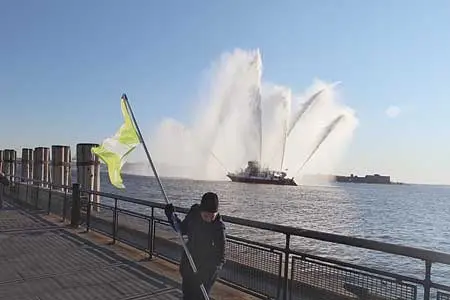
In this same institution, Mayobre’s installation Tierra a la vista (2012) included a video performance projected by six monitors set on the floor, where the artist sweeps the floor from the Statue of Liberty to the United Nations headquarters in New York City, using a broom adorned with the flag of the immigrant. The story of the Spanish immigrant Rodrigo de Triana, who arrived with Christopher Columbus in the Fifteenth Century, summarized in labels in the wall, expanded the performance with an eloquent analogy that outlined a more complex historical framework for the topic of immigration. In turn, a printed photograph records Mayobre’s performance, constructing an ironic monumentality based on the contrast between her manual labor “under the flag” and an effusive “fountain” of water jets from a ship that passed behind her. A rather less forceful element in the exhibition was the installation Museos Viales (De Caracas a Golindano), 2012, with 102 small photographs of several blank advertising billboards shot along 450 kilometers of highways between Caracas and the Gulf of Cariaco, where the repetition of the emptying-out of content did not reach the connotative density that is usual in Mayobre’s work.
Caputo and Mayobre also exhibited their work in Galería Artepuy. The exhibition Dibujos included a series of careful, tidy recent drawings by Mayobre. These were printed digitally with laser on paper in faint hues and their central leitmotif was the reiteration of rectangular structures crowded together in chaotic ways. In this way, the drawings posited scenes after a deconstruction that suggested the generalized crumbling down of a past order and, instead of presenting the city as a living organism, reconstructed it through clear allusions to the urban space as a cemetery of failed structures.
Caputo’s Obras recientes presented eight series of photographic works covering the period 2002-2012, conforming—more than a sampling of recent works—a mini-panoramic of her explorations over the past decade concerning the body as a stereotyped territory where gender discourses are generated. In Masculine feminine (2002), Caputo explores the topic through the nude body, headless and anonymous, contrasted with mannequin molds or a matador’s shoulder pads. Heroines (2007-2012) plays with the coupling of the inhibition and liberation of the female body; in one image, the body is caged and the woman holds outside a bird, while in another the body is intervened in an ironic fashion by showing the profile of a nude woman whose breasts are covered by an exaggerated plastic object—between rocket and phallus—that, by analogy, brings to mind a symbol of virility and masculinity. The series of keys contrasted with the nude body in the recent series Entrance (2011-2012) follows the same line and demonstrates the coherence of Caputo’s photographic discourse as a medium for the creation of images that question consensus-enforced social roles.
Although both exhibitions were organized under a single curatorship, they did not foster the establishment of connections between the works, since any dialogue between them was limited to their simultaneous presence in the exhibition space. In that sense, the curatorial concept lacked a synergistic grid to guide the viewer, so the uncertainty remains about the reason to combine the work of these artists rather than separate them into solo exhibitions.
LISA BLACKMORE