
We enter an enormous industrial space and listen to an unnerving neutral noise. The place is only illuminated by five large videos projected on the walls. Animal skulls, alone or in pairs, lie on a desert surface. The skulls explode without altering a bit the unsettling noise. The images slow down and it is possible to observe jawbone fragments flying all over the place. Although the technical execution is perfect, one cannot help but feel unsettled and disturbed in the middle of this audiovisual layout.
We return to the point of departure with the buzzing noise still in our brain (in our skull). To some, the experience is complete, but others feel that things have been left unanswered and need to be explained. More than offering any clues, the title generated fruitful and suggestive reflections: Del Cuerpo No Podemos Caer (From the Body We Cannot Fall) is inspired by a phrase by philosopher Willy Thayer that expands the field of interpretations for this audiovisual work. As I mentioned before, this is impeccable work. Film equipment was used to capture the crisp images and to attain excellent results. The same care also went to editing the piece, establishing the rhythm in the explosions, and generating a loop where no two explosions occurred at the same time. One cannot but wonder how a young artist like Aymara Zegers has been able to complete a project like this in a space that does not specialize in contemporary art but can be rented for all types of events. The answer is crowdfunding. Zegers launched a Website to collect donations that would help her complete her work. In exchange for these donations, and depending on the amount raised, the “producers” would receive a publication or even a work by the artist. This approach to financing has been successful in other fields like filmmaking, and it is a great example for other artists, particularly in Chile. Why? First of all, never before had an artist tried this approach in the field of art. Secondly, the Chilean art scene is heavily dependent on Fondart, a public fund for the arts. I will not even mention private support since, as paradoxical as it may seem, such support is almost non-existent in Chile.
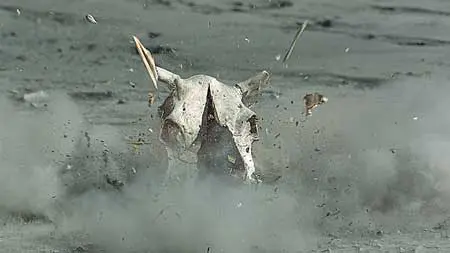
Returning to the exhibition, it is possible to dig even deeper (to get to the bone) by addressing the genesis of the idea. Two references, one personal and the other from the movies can help us understand the intention behind this work. Nine years ago Zegers visited a crematorium in India and witnessed the incineration of a girl’s body. At some point during the ritual, the cranium exploded as a natural reaction to the fire. That instant really impacted Zegers, who was not able to recover the image or the sound until two years later, with the achievement of Del Cuerpo No Podemos Caer. The other referent is the documentary La Nostalgia de La Luz (Nostalgia for the Light, 2010) directed by Chilean Patricio Guzmán. This film collects the experience of astronomers and scientists who work in the Atacama Desert, one of the best places in the world to observe the stars. Because there is almost no humidity in the place, the desert is also a place that is able to maintain bone remnants intact. A group of women surveys the area, removing every grain of sand, to find the remnants of family members supposedly buried there during the military dictatorship in Chile. While the astronomers gaze upon the space, the women endeavor in another kind of exploration to find the bones of their loved ones. The parallelism is completed when an astronomer comments that the stars contain “calcium,” and that, when they explode, the dust from their “bones” fall to Earth. I think of that affirmation and I associate it again to the piece by Zegers. The exploding skulls are not but faithful representations of the stars that also die and explode in the sky. As we know, that which we observe in the sky are not stars but the light that they have left after their deaths. The poetic behind this scientific fact “illuminates” or sheds new light on this artistic work. The link between the political and the anatomical, the local past and something as global as the universe, generate a new interpretation. Rather tangentially, we have touched on the theme of the murders perpetrated during the Pinochet era. Many artists have alluded to the disappearances without naming them through the use of bones (Arturo Duclos comes to mind). Even earlier works by Aymara Zegers also have reflected on these events in a subtle and metaphoric manner. Nonetheless, in this instance the allusion is indirect. It is perhaps that the overproduction of the audiovisual piece has exhausted the semantic ability for interpretation. Del Cuerpo no Podemos Caer has two sides. One, when we visit the exhibition without any previous or later knowledge about it, the sensation that remains in us is anguish. The other is, having the benefit of the background information, the experience adds other fields of study that range from the political to the scientific. It is possible that Zegers’ intention contemplated a two-way street: one way for the unsuspecting visitor and the other for the well-informed one. Whatever direction one takes, the ultimate goal of this work is to transfer the impact suffered by the animals’ skulls to our own heads.
JUAN JOSÉ SANTOS