Autorretrato para Mi Muerte (Self-Portrait for My Death) is the title of the work with which Carlos Herrera won the 2011 ArteBA-Petrobras prize—its eighth edition—in the category of unpublished projects by young artists that are held in the framework of the Feria de Arte de Buenos Aires. So far, the proposals by the artists—although each curator intervenes by establishing his/her own standards—have been large installations in the space and sometimes performances.
The work presented by Herrera represented a departure from the models thus far submitted and expected. The smallest work ever to be presented in this area, it consisted of a very thin white polyethylene bag that was translucent enough to barely hint at its contents: a basic set of folded clothes that belonged to Herrera and a pair of shoes for everyday use. The element that defined both the potency of the work and the commentary in response to it, was the nauseating smell that came from it. It was generated by the inclusion of a dead squid that over time increased its pestilence. It was nothing short of the smell of death and, as one can imagine, a metaphor for Herrera’s own death. That is to say, Herrera took a long-standing theme in the history of art—death as an extreme mode of representation—that in this instance was intensified by the gesture of referring to his own death through the use of a compelling metaphor; namely, a subjective attitude that is objectified at the same time.
Trabajo Nocturno (Night Work) at the Ruth Benzacar Galería de Arte, is inevitably preceded by Autorretrato para Mi Muerte (Self-Portrait for My Death) and becomes its mirror reflection. The first connection between that earlier installation and the current one is the high referentiality to the person behind the artist. In the former, his death; in the latter, something suggested as an extended, symbolic, and self-staged scene of the artist’s life. It is almost like writing an autobiography. Just like the awarded piece, the entire series of works continues with the concept of the self-portrait, as the material absence of the body becomes evident. Is it possible that the squid was the metamorphosis of his body? Another silent protagonist in both works is the space, as counterbalance turned into an allegorical element.
On the cover of the catalog of Trabajo Nocturno the artist announces with images the kinship between both works: the polyethylene bag, just like the one of 2011, but this time empty, limpid, volatile, and unique on the floor of the gallery. The opposite image is that of a squid supported by a fragile rig—like those used by puppeteers—supported by the artist’s hand. Thus, the squid appears to have gone through the cycle of life-death life.
This is what precedes the entrance to the spacious gallery space with its low ceiling and an atmosphere that appears to be intimate, populated by seventeen different objects that one must not forget are “self-portraits.” Herrera has organized the space biographically but also as a possible place for a theatrical action. This time, it is not about a dead body but of an austere, sober, temperate, installation where the absence of the body is evident. However, everything alludes to it and, possibly, only to one body: that of Herrera. It is likely that the entire installation describes a state of life that is poetically essential.
The support of a bed where his body rests, enigmatic platforms that function as gym benches where he would temporarily rest; once again the polythene bags, hidden items that are nevertheless semi-revealed through the translucent plastic, and the presence of sex on supports of phallic elements, among others. These are the indelible marks of a personal life. Nonetheless, the neatness and stripping are such that a mysterious atmosphere that could well resemble an operating room can be perceived.
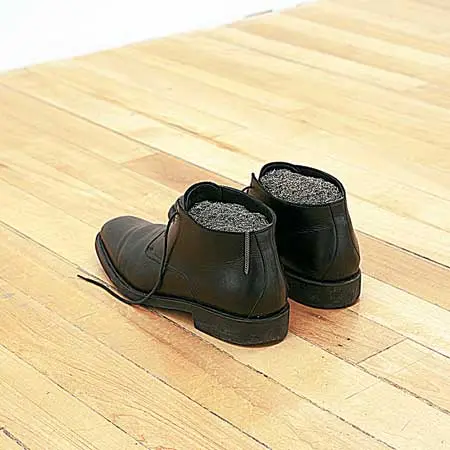
Then—as an end or beginning—two elements denote a closer, even effective, contact with the body that is recent, immediate, and closer to resemble an actual physical presence: a pair of black shoes containing thin chains like those that are often hung by the neck and that completely occupy the inside of the shoe. Not far from them is a black acrylic box with soap and water where the artist washed his face. These two works are those with actual physical footprints of the artist’s body.
As a corollary, we return to the catalog and found the photograph of the poet Mariano Blat naked and asleep on the floor of the gallery. This is a performance for poets.
Trabajo Nocturno (Night Work) is also the title of a 1985 poem by Juan Manuel Inchauspe that is included in the catalog and is part of the proposal. The repulsive encounter early morning (Temprano en la Mañana) with a dead rat and the action of its burial. Immediately followed by an everyday scene of natural beauty, blooming hydrangeas, and a cat that wakes up and asks for “fresh and pure milk.” Stripped state of life, privileged essentiality.
MERCEDES CASANEGRA