
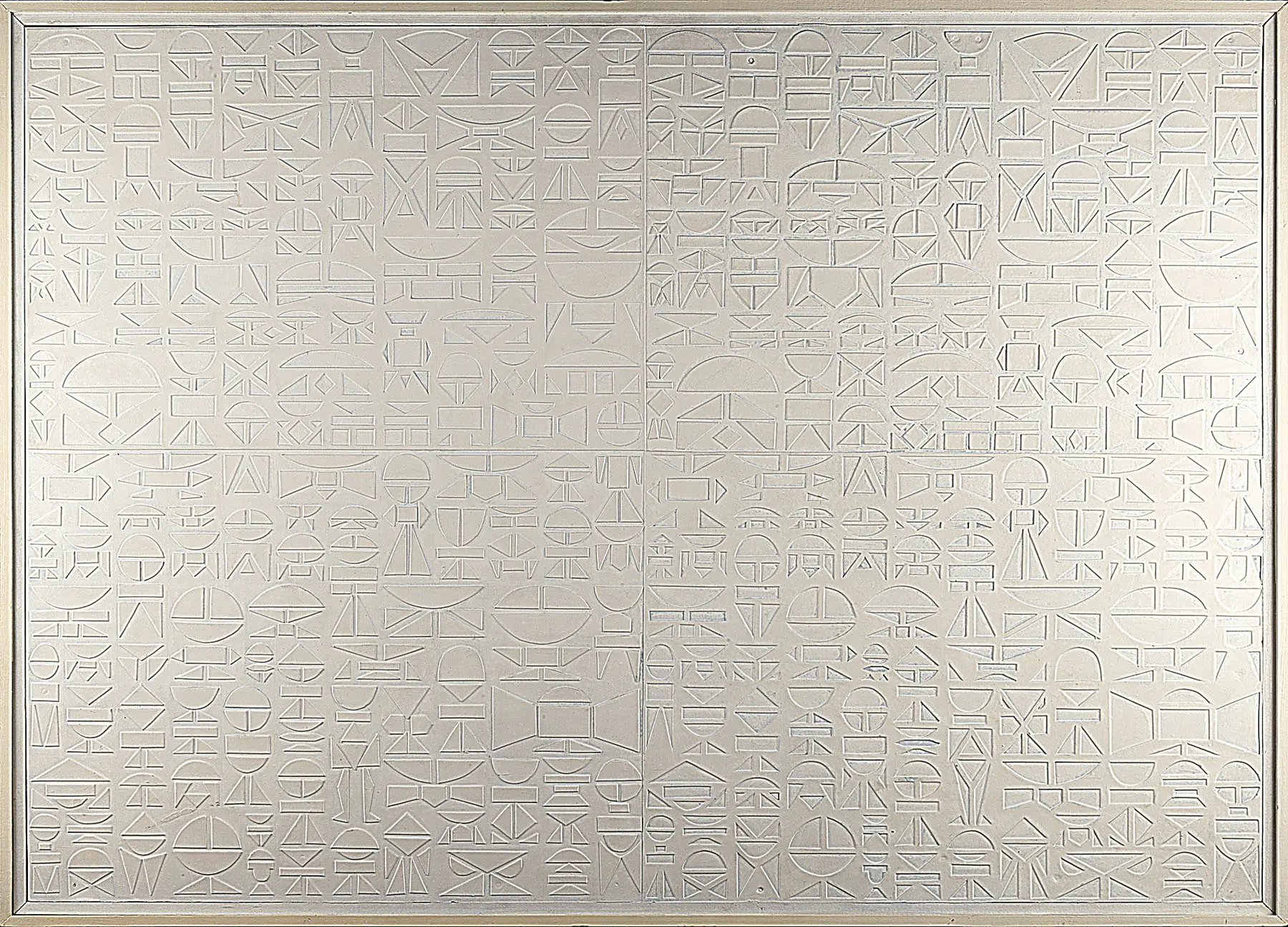
Art curating, a field that eludes normativity in order to build parallel or additional meanings for works and artists, has a limited lifespan in Ecuador. Its intermittence is a reflection of the absence of cultural policies that foster the work of curators. An instance of one such flash of light is the show Ecos del tiempo, curated by Rodolfo Kronfle Chambers at the Casa del Alabado Pre-Columbian Art Museum in Quito. The show opened in November of 2012 and remained open through April of this year. The institution gave the curator an opportunity to review its collection and propose a thesis about its holdings, which resulted in an exhibition composed mostly of works from private collections that are barely known or documented since their creation, something that in general applies to the state of the national visual patrimony as a whole. The thesis evolved from a diachronic reading between ancestral pottery and the cohort of artists who worked during the 1960s. While we perceive iconographic constants in the modern artists with respect to their forebears, we discover, in unison, a lyrical-conceptual universe that rejects clichéd criteria about what is commonly understood as “ancestralism” in Latin America.
This show lends support to the discourse elaborated decades ago by Marta Traba about an “art of resistance” to Western critique, which tends to see Latin American arts as mere handcrafts, an emblem of exoticism, or merely derivative of Europe or the United States. The institutional initiative, the passionate effort of many years on the part of collectors like Enrique Tábara, Estuardo Maldonado, and Oswaldo Viteri in gathering pieces from the diverse cultures that populated ancient Ecuador, has been joined by Kronfle’s vindicating gesture to give renewed dignity to a period in the history of Ecuadorian visual arts in which the gaze was turned upon the evocative possibilities of the context.
When one becomes a teacher in this country, one notes that the vision of most art students remains permeated by the indigenista pathway of artists like Oswaldo Guayasamín, Eduardo Kingman, and Diógenes Paredes, who, for many, are the bar by which even the relationship between art and life is to be measured, with no regard for the fact that their approaches were only the skin-deep. The Ecuadorian artists presented here, active in the late 1950s, a time that represented a point of inflection in the country’s modern discourse, anchored their work to a criterion that destabilizes this gaze.
Archaeology and “ancestralist” painting (both expressions are included in the show) are presented on a single aesthetic and semantic level, seeking, precisely, to define the singularities of the modern in a group of artists who, despite some of them having been educated abroad, opted for the Carpenterian “voyage to the seed.” Their poetics were also permeated by the existence at the time of the Cuban revolution, which influenced them ideologically, the Latin American literature “Boom,” the worldwide confrontation of the Cold War, the 1962 missile crisis, May of ‘68 in France, to mention just a handful of the factors that triggered a sense of radical belonging to a Latin American ontology.
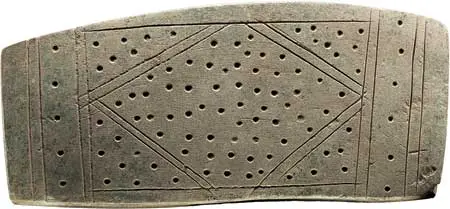
The show includes pre-Columbian works mainly from the following cultures: Chorrera, Guangala, Carchi, Milagro Quevedo, Valdivia, Huancavilca, and Jama-Coaque, next to contemporary works by Enrique Tábara, Estuardo Maldonado, Segundo Espinel, Aníbal Villacís, Oswaldo Viteri, Hugo Cifuentes, and Gilberto Almeida, in a variety of supports but with the preeminence of canvases. The show’s diachronic discourse provokes suggestive readings that give both syntactic temporalities unsuspected connotative notes, and at the same time make it possible for us to discard the idea of supposed progress in the strict sense. This is to say, when we observe different versions of the phallic in erotic works from the Jama-Coaque culture, placed in dialogue with Tábara’s Serie Erótica L´accouplement, Les Cheminées, what is revealed is the biased notion of subalternity to so-called “primitive cultures.” We partake in the diversified perception that such an intimate matter could perhaps be held by ancient thought. These are spontaneous and graceful representations of a topic that could serve as the starting point for an investigation of the marked machismo in Ecuadorian culture. At the same time, with his simple chimneys, Tábara traces the outline of the patriarchal character of dominant modern culture.
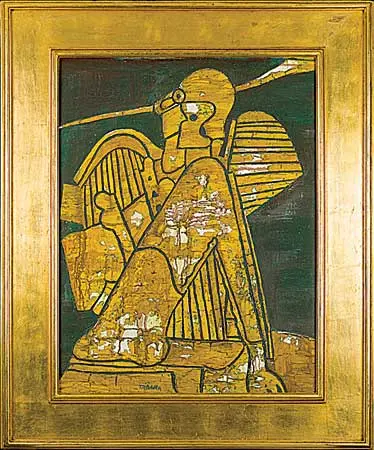
In another segment, we perceive the connection between the work of Gilberto Almeida (La silla, 1965) and items from Carchi culture. The latter are human figures of varied appearance that recline on some furniture. Similarly, Guerrero, by Enrique Tábara, which was also used as a logo for the show, is linked to a male figure ceramic from the Jama-Coaque culture, known for its thick proportions, round face, large eyes, broad nose, and intentional cranial deformation. These figures are also identified by their use of sophisticated headdresses, necklaces, bracelets, and ear plates.
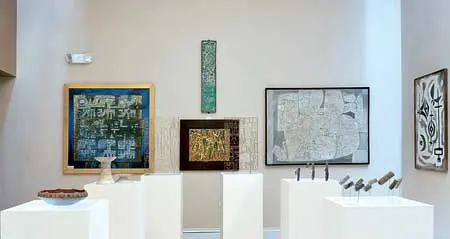
Some works by Estuardo Maldonado (Composición No. 8 and Variedad en la Unidad I) establish connections with figurines from the Valdivia culture, known as the Valdivia Venus, which were made in clay and stone as a kind of talisman to impregnate the earth and propitiate its fertility. They vary in their physiognomy, and these changes are supposed to allude to facets of female development.
In Precolombino by Aníbal Villacís, we perceive a greater adherence to informalist codes of a matteric kind, through the pointed use of textures and impastos for an abstract, more poetic result devoid of figurative features. Yet, the association with works in conch from the Guangala culture is interesting. There is more than one coincidence, and new readings, just like the plot in Carpentier’s short story Viaje a la semilla, where irony and surprise come from the contrast between two different realities.
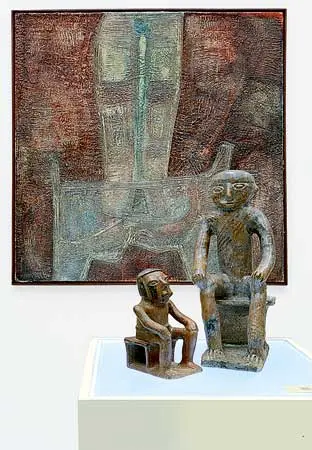
Noticing the work of Estuardo Maldonado (Composición No. 15, Tabú, Tiahuanaco, Precolombino II) in connection with several ceramic items from the Valdivia and Chorrera cultures, while knowing that he denied a filiation with Joaquín Torres-García, asserting that he started to explore that “pre-Columbian veneer” before knowing the Uruguayan’s oeuvre (an event he dates to 1958), is one of the most hilarious anecdotes I have heard in my life. His 1962 bronze Precolombino II is an eloquent example of his links to Torres-García’s constructive universalism, where recursive elements such as fishes, the human figure, graphic elements framed inside rectangles, the predominance of vertical and horizontal lines, reveal a strong indebtedness to his predecessor.
Segundo Espinel is also part of this “archaeological veneer.” We note this when, as is the case with Tábara’s, his works are confronted with plates and bowls from the Guangala culture, filled with geometrizing elements, lines, circles, that tend to be presented as friezes or trimmings, which reinforces their decorative character.
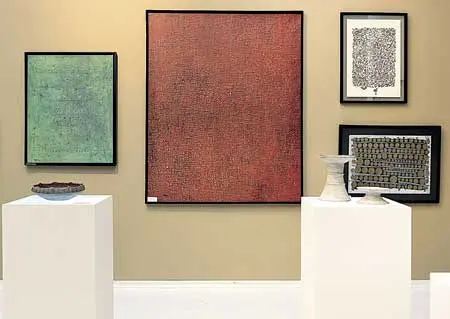
In a different order of arguments, freer in terms of color and pictorial gesturality, are two mixed-technique works by Aníbal Villacís, contrasted with metals from the Carchi and Puruhá cultures that seem to have been used as body ornaments. The experimental character of his use of materials, in this case, granite dust, is characteristic of the language used by the informalists, who explored unusual materials to achieve unusual effects in the compositional space.
Oswaldo Viteri’s canvases, from his series Símbolos, display a more somber palette and are set to a colder key, with a graphic, stylized accent. They have been placed around works from the Jama-Coaque culture that have a similar spirit. The lines are gentle, and in general nothing in any of the proposals or almost nothing, can be associated with the grotesque, carefree, or aggressive elements of the informalist or expressionist gesture of European or North American artists who worked during the same period. The evocations are more subtle, lyrical, and even mysterious.
These voices leave their mark without exerting violence on the canvas or encasing themselves in mystical situations. Their sensibilities induce us to understand Ecuadorians a little better when they say, “Ecuador doesn’t exist.” So much historical loss results in disunion and an “I don’t care” attitude, their carte blanche when confronted with the indifference of those who perhaps see the nation and its inhabitants as inauthentic.
AMALINA BOMNIN