Cultural diversity, the result of constant aesthetic and intellectual quests, is what distinguished the work of Rio-based artist Ivan Serpa (1923-1973). That was the perspective adopted by the curatorship of Adriano de Aquino lê Ivan Serpa, the first entry in the series Olhar de Artista (An Artist’s Gaze) at the Caixa Cultural (Rio de Janeiro). Conceived by the group Coletiva Projetos Culturais, this initiative invites Brazilian artists to curate solo exhibitions of the work of other artists, contemporary or otherwise.
The proposal is for the conceptual function, traditionally delegated to curators, to be dislocated to privilege the critical production of visual arts practitioners who also reflect on them. To commemorate the 90th anniversary of the artist’s birth and the 40th anniversary of his death, a book was also published with more than 100 images included in the show, as well as an unpublished text by Aquino. This made it possible to trace Serpa’s variegated career, whose shifts and breaks in content made significant contributions to the history of Brazilian art.
Rather than emphasizing a specific period in Serpa’s career or one language in which he worked, artist and curator Adriano Aquino explored the multiplicity of Serpa’s trajectory, taking as his starting point an untitled 1973 painting from Serie Geomántica. The work was never completed, and the technical description in the catalog records it as “unfinished.” “The supposed condition of finished only covers the appearance of a work of art as objects conceived for commercial purposes. Unfinished is the definitive condition of all works of art, as it is for all that surrounds us, and indeed for all of us,” Aquino said about his selection.
Serpa went through specific periods in the history of art and a variety of phases. Fascinated by symmetry, he never set aside a modern sensibility, movement, chance, always blunting constructive rigor with poetic subtleties. The pendulous motion described by his career, marked early on by the Best Young Brazilian Artist prize at the 1st São Paulo Biennial in 1951 (where he saw the work of concrete artists like Sophie Taeuber-Arp and Max Bill), was signaled by the diversity of his techniques (collages on paper, drawing, gouache) and by his geometric and expressionistic compositions.
It was during this period that Serpa began to create more abstract works, leaving behind the figurative line he had been developing during the previous decade. Despite the influence of Brazilian modernism, he moved away from nationalistic themes and turned his interests to composition and the rhythm of shapes. In the early 1950s, he became an adherent of constructivism, with its flat geometric shapes and harmonious relationships between figure and ground. His painting of this period is dominated by precise, linear rhythms whose intervals and variations resembled a musical score.
Serpa intervened in the art scene as a painter, professor, and cultural activist; between 1953 and 1954 he founded the Frente group which brought together the Rio-based concrete-art production of people like Lygia Clark, Lygia Pape, Weissmann, Palatnik, Oiticica, and Aluísio Carvão. His works incorporated geometric and objective shapes made using industrial materials and neutral textures and featured the characteristic daring that distinguished Rio-based concrete artists from their São Paulo counterparts, for instance with the use of “less objective” colors such as brown.
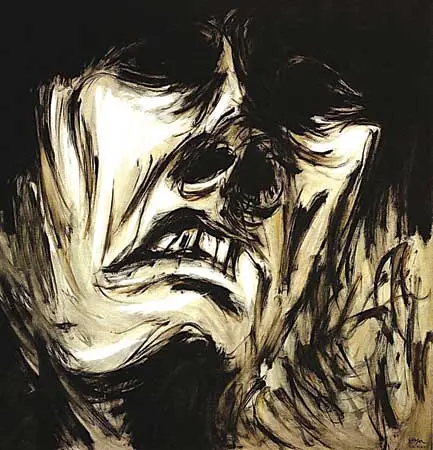
In the early 1960s, Serpa’s work expanded with the use of new parameters, gestures blotches, and color drips, arriving at gestural figurativism with the model of the CoBrA group, which prompted Brazilian critics to include him in New Brazilian Objectivism. With the establishment of military dictatorship in Brazil during the 1960s, the artist entered what critics have called his “black period,” with powerfully dramatic and expressionistic figurative works.
At the end of that decade, Serpa’s career did another somersault, with the series Op Erótica, where, influenced by Op Art, he revisited geometric construction with sinuous, sensual forms. These works have peculiar optic results and marked his “Amazon period.” His recurrent constructive techniques were repetition, progression, and inversion, but with results that are as balanced as they are dynamic.
In his last works, Serpa presented vivid, joyful compositions that above all displayed a poetics of simplicity. At various moments, the artist worked with children, investigating in depth the creative process in childhood. His works revealed the influence of freedom and intuition in creativity. Above all Serpa proved that not even the most rational aesthetic thought can escape the mysteries of subjectivity.
ALESSANDRA SIMÕES