Henri Bergson, the great vitalist philosopher and Nobel laureate, wanted to avoid the “automatisms of a crystallized language.” It is always a challenge to use language to share visions about art that try to escape from this condition, especially when the work calls for an almost pure state of perception. There will be then an attempt to put into words the recollection of an experience in order to bring back the images from the opposite end to the transcript: from memory as that “point of intersection between spirit and matter.”
In the group of photographs presented by Jorge Miño (1973) in the exhibition titled Dreams of Matter at the Galería Praxis, all the images belong to the series In Silence. As its name suggests, the proposal leads to some kind of encounter that is far removed from any of the interruptions that the utilization of a language can produce.
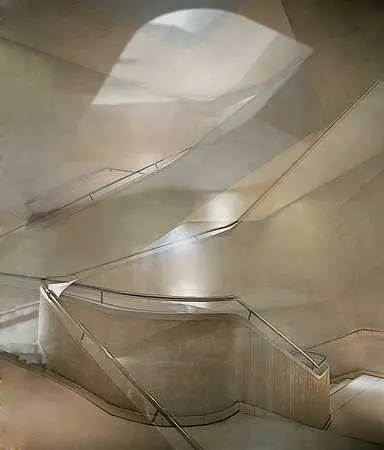
What is the origin of these images and what would their utopian zero degrees be? “Miño brings hundreds of images from his travels and then selects those places that lack the distinctive elements that would render them recognizable. This absence immediately refers us to other qualities of the images... as light underscores the role of textures, “explains curator Ana Martínez-Quijano in the text included in the catalog of the exhibition.
Manipulated by the artist, the images describe enclosed spaces without any openings that convey atmospheres that continuously expand their influence toward those who observe them. There are spaces inhabited by paradoxes, flooded with light and perceived as inexhaustible, as they even appear to grow under the gaze. As they expand towards the viewer, they display a resounding ambiguity: on the one hand, the strength of the material—concrete and metal—and on the other, the intangible: dreams and ghosts. It is therefore necessary to rely on our intuition, to abandon all reason and plunge into that which Bergson called “the time prior to connecting to something useful.”
The reality of the spirit and the reality of matter is expressed in multiple resonances, undifferentiated echoes that disappear into the vast sceneries. Matter is both witness and participant, something located halfway between the subject and its representation. Jorge Miño places himself right in the medium, intervening in photography to transform it, as he alchemically operates with the last material still left to work within the digital age. The result is an image that appears to have dimensioned the very suspension of things, of their existence. This delay is for those that ponder about the before and after of melancholy, the before and after of loneliness.
From then on, each person will let the sensations occur as the images appear as if the show were a sort of intuitive, anachronistic memory. A memory that, going back to Bergson, appeals to the memory-experience of a certain time and space that—although not part of our history—is not unrelated to us. The memory experience is elusive and occurs as pure experience. It is very different from the automatic habit-memory, which we put into action when climbing or descending a ladder or when walking through certain places. But the stairs carved in the images of Jorge Miño cannot be traveled through; they can only be flown over like in a dream.
However, there are in these recognizable urban spaces, the “charming modernism” that Miño references. Could they be transited with the attitude of the flâneur, of the wanderer who discovers the architectures of a known city all the while feeling as if he were in a foreign land? The passerby must then be transformed into a pilgrim. A mysticism emerges that Miño attributes to the artistic process used to create the photographs: to create over the already created, to allow sensations to be manifested without justification. The intentional increase of the dimensions of the space seeks the participation of those who observe: “the image takes you and contains you” he affirms. The viewer is at times a sort of Alice in Wonderland, as he/she must adapt, resize his/her body and spirit to continue revealing infinite enigmas, to be unconditionally immersed into the dreams of matter.
VIVIANA SAAVEDRA