
If you believe, like Walter Pater, the essayist and art critic from the 19th Century, that “Art comes to you proposing frankly to give nothing but the highest quality to your moments as they pass,” then there is a place where such thing can occur: before a painting by Julio Suárez. Two exhibitions were inaugurated last February that presented Suarez’s geometric abstractions: a solo show that included eleven paintings from 2012, organized by curator Juan Carlos López-Quintero at the Museo de Arte de Puerto Rico (MAPR), and a group exhibition at the new Galería Agustina Ferreyra that included one of his paintings from 2013.
The title of the exhibition at MAPR, Julio Suárez: A Specific Place, addresses the artist’s intention with regard to his work. According to Suárez, “I have always wanted to create something for a specific space; that my works become a place… I create paintings and drawings with a single color and a single form, with the illusion that they somehow can be transformed into a specific place when someone is present.”
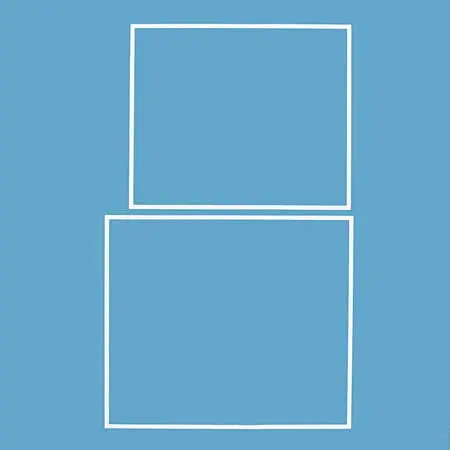
The paintings by Suárez are objects that expand toward the literal space as they attract our attention. Five of the pieces in the exhibition were life-size or larger and with thick stretchers and strong colors—orange, lemon yellow, fiery red—they were eye-catching. Each work represented two geometrical shapes that were adjoined, slightly separated, or superimposed.
When we observed Sin Título (Untitled) we entered a “site-specific” place that was absolutely perfect. A warm and lively blue tone in which two rectangular forms created with white lines were placed one on top of the other with very little space between them. The rectangular shapes were slightly misaligned, and there were very small discrepancies in some of the straight angles. Juárez’s geometry is intuitive, it is connected to the immediate and particular, and its careful subtleties are reminiscent of our own separation and individuality.
His geometric abstraction is based on a slow and fascinating process of painting small changes that compromise the act of observing. Even in its most minimal expression—or "What you see is what you see", a famous quote by Frank Stella that appeared in the 1966 September issue of ARTnews—his abstraction always suggests something. The unique, pure, stack-up forms that appear in several of his paintings, reminded me of the excellent work in stone created by the Incas in Coricancha (Temple of the Sun) in Cusco, Peru.
Beginning in the mid-1970s and until the beginning of the 1990s, Suárez painted in a gestural, expressionistic, style that was free from any boundaries. From 1994 until 1995, after having spent a year drawing, he began to streamline his approach to painting until reaching a pure minimalistic style. He would often draw lines on his drawings by folding the paper or canvas to create defined, clear folds that were projected onto space. Suárez has maximized the effect of an economy of form, color, and line with sculptural installations and found objects, but mainly focuses on painting because the process’s slow rhythm offers him the necessary time and space to envision future paintings.
Uno (One), another work included in the MAPR exhibition, was acrylic on a wood painting that measured 36 square inches. Placed at the center of the panel, there was a black vertical rectangle divided just slightly under the middle point of the image by a black horizontal line. Surprisingly, the white background possessed a slightly perceptible opalescence that set this work apart from the others. This subtle glow evoked atmospheric notions and important ideas.
Uno reminded me of a work by Ellsworth Kelly entitled Window (1948), oil on wood and canvas painting; a sober geometric construction that is part of the collection of the Musée d’Art Moderne de la Ville de Paris. While the title Kelly gave his work originated from the artist’s real experience of the world and its forms, Suárez’s title pays tribute to Onement I (1948) by Barnett Newman, a work similar to Suaréz’s, among other things, for its modest dimensions. Uno and Onement I are inquiries into how the simple line is able to simultaneously divide and unite a composition. As I stood directly in front of Uno, I saw and felt an affirmation of the human presence in the space. Onement I and Uno reveal the work process and thought of each artist. In Onement I, a stripe of masking tape can be observed emerging from underneath the stripe of paint; while in Uno, pencil marks indicated the angles of the black rectangle.
Julio Suárez most recent work, Sin título (Untitled) measured 66 × 66 inches and gave the impression of being the most architectonic of all his canvases, given that the artist rendered the image with solid forms but without the use of lines. Placed against the right edge of the canvas there was an enormous vertical rectangle of a deep purple color and, on top of it, a smaller horizontal rectangle painted in red. The rest of the surface was painted white. A subtle illusion or effect somehow placed the red rectangle behind the purple one. Once again, this painting communicated a great presence with minimal elements. By relying on the powerful strength of form and color, the artist counterbalances concentrated energy and mass with openness and luminosity. There, observing the image, times goes by slowly while we enjoy a specific place that generates a space outside from itself that energizes the area around it.
CHERYL HARTUP