The title of the exhibition is La invención concreta (The Concrete Invention), yet it could very well have been “Chamber Music.” First, because of its scale, small if compared with the Patricia Phelps de Cisneros Collection—one of Latin America’s largest and most significant—and small also in terms of the few rooms it occupies among the outsize exhibition spaces of Madrid’s Museo Reina Sofía, one of Europe’s largest contemporary art institutions. But also because of its content, with some fifty works of art that, as a whole, evoke not so much an overwhelming symphony but the rather more weightless quartet and trio recitals that often took place inside the palaces of a now definitely abolished Europe.
The art, which in our metaphor is the instruments and musical score for this unusual chamber concert, belongs mostly to artists who, emerging onto the scene in the 1950s and 1960s, played a decisive role in the flourishing of the neo-concrete and kinetic art movements in Brazil and Venezuela: Lygia Clark, Helio Oiticica, Franz Weissmann, Alejandro Otero, Carlos Cruz Díez, Jesús Soto. But they are not alone, and they are not isolated.
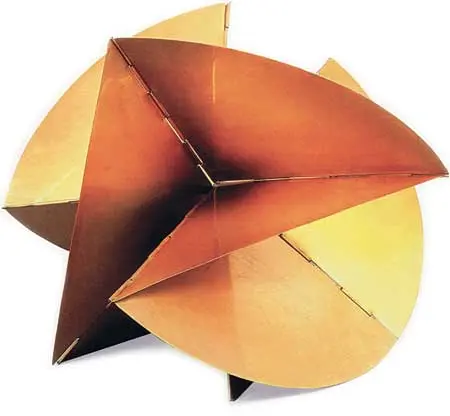
Indeed, the show moves forward and back around what we can call its imaginary center, the neo-concrete and kinetic artists mentioned before, in response to the explicit intention of its curators—Gabriel Pérez-Barreiro and Manuel Borja-Villel—of disassembling the classifications that still dominate the historiography of modern art in Latin America in the second half of the twentieth century. At the bottom of the various groups and movements of an abstract and geometric bent that this history has recognized, the curators believe they have found a common drive, which they attempt to capture with the formula of “the concrete invention.” The term reformulates the title of a movement founded in 1944 in Buenos Aires by Manuel Maldonado and a group of then very young artists: Arte Concreto – Invención, although retaining its most basic objective: “Neither to seek nor to find: to invent.”
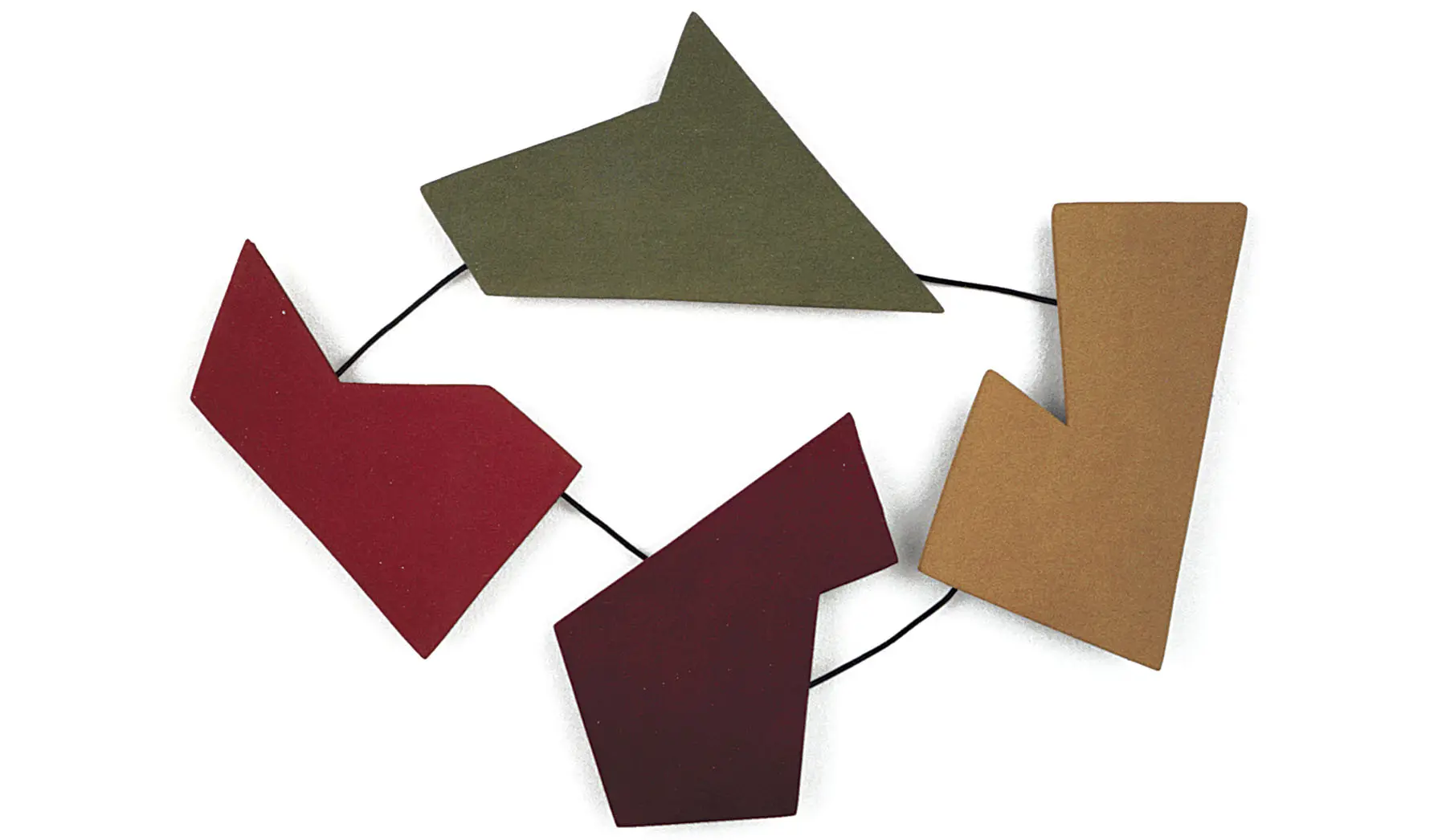
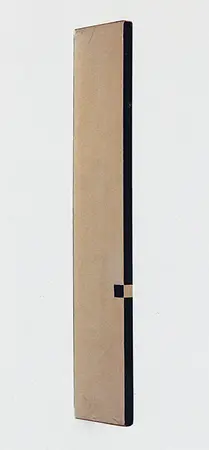
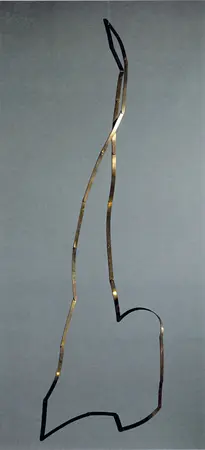
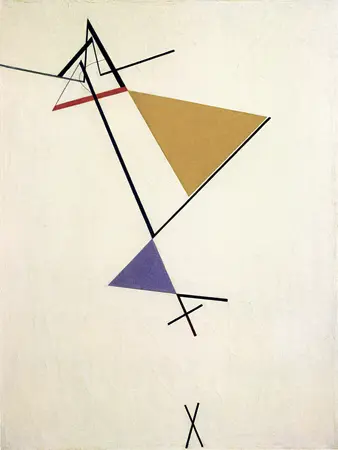
This is why the exhibition moves backward and revisits artists belonging to that movement and to the Madi group, also established in 1944 in Buenos Aires with the shared goal of bringing to bear the lessons of neoplasticism, the Bauhaus, and Soviet constructivism, in a historical context that was especially difficult for the survival of these movements in Europe. This exhibition includes one work by Tomás Maldonado, Composición 208, that, although relatively late in his career (it dates from 1960), represents well the aesthetic Maldonado advocated since the very beginning, as well as notable works by his early companions Alfredo Hlito, Raúl Lozza, Juan Melé, and Juan Alberto Molemberg. There is also an extraordinary work by poet, artist, and Madi theoretician Gyula Kosice, very literally titled Escultura móvil articulada. Dating from 1948, it is an articulated metal band, over two meters in length, that closes over itself and hangs from the ceiling. We had to wait more than two decades for Richard Serra, and especially Eva Hesse, to create their first flaccid sculptures, often also hanging from the ceiling, in the United States. The Madi group is represented also with a pair of works by Rhod Rothfus, but what best embodies the group’s characteristic call to break the frame of the painting and disarticulate it in radical ways in order to extract it from the illusory realm that imprisoned it and transform it into a true pictorial object, is Relieve no. 30, by Raúl Lozza. Dating from 1946, this is a small four-piece construction in painted wood joined by metal rods and placed directly on the wall.
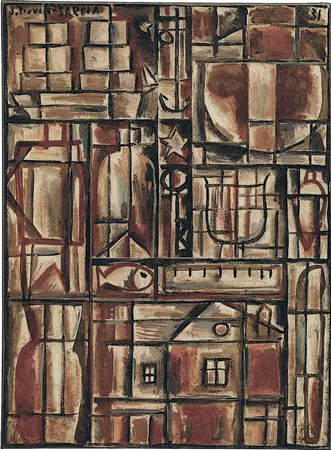
But the exhibition moves even further back in time to honor Joaquín Torres-García, who in the 1940s was a veritable bridge between the River Plate and Paris art scenes. But it was not the Paris of the surrealists, then hegemonic, but that of the artists who, at a European scale, defended abstraction. Artists initially gathered around Cercle et Carré, which was first a group and then a journal, and which also counted Torres-García among its members alongside such relevant figures as Piet Mondrian, Wassily Kandinsky, Georges Vantongerloo, and Pierre Daura, the author of its celebrated logotype. Torres-García, who continued to edit the group’s journal in Spanish after his return to Montevideo, is represented by three paintings from his Paris period: Pintura constructiva, from 1931, and La Estación and Constructivo, from 1932. And by a fourth painting not from the Phelps collection but on loan from MoMA, a true masterpiece whose inclusion in the show speaks of the curator’s desire to highlight Torres-García’s role as a direct link between the European and Latin American art scenes during the difficult period framed between the start of the Great Depression in 1929 and the start of WWII in 1939.
The same desire explains their inclusion of Joseph Albers, represented by a painting from his most emblematic series, Homage to the Square, which, dated in 1972, is nevertheless too late-period to account for the Paris years of this German artist who sought refuge in the French capital after the closing of Bauhaus by the Nazi regime and joined the group Abstraction-création founded by August Hervin and Jean Hélion; Abstraction-création ultimately counted among its members most of the participants in Cercle et Carré, including Piet Mondrian, present in this exhibition with Composition II in Red, Blue, and Yellow, from 1931, also in the MoMA collection.
The reference to historic artists flows, from a temporal point of view, into those two decades that form, as I said, the nucleus of this exhibition, its center of gravity, with the inclusion of works by Max Bill and Pol Bury. One cannot exaggerate the importance that the large Max Bill retrospective held in São Paulo in 1951 has on the education and artistic orientation of Lygia Clark, Helio Oiticica, or Franz Weissmann. Traces of this influence can be seen in many of the works on exhibit by these three Brazilian artists as well as others, lesser-known, like Willys de Castro. Yet it is equally true that these artists were able to add to the lessons of their Swiss teacher the playful, joyful lightness that characterizes Brazilian modernity.
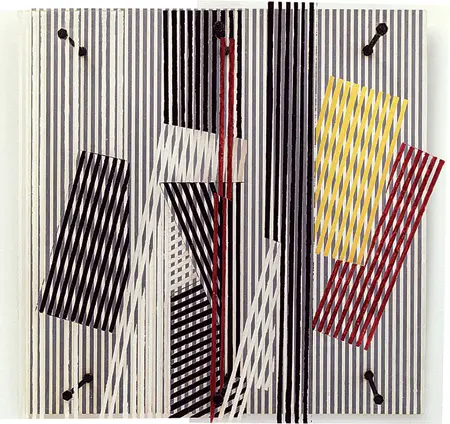
The inclusion of Septante-deux boules, grosses, petites et moyennes, a visual object by Paul Bury from 1964, seems to respond instead to the desire to establish a European counterpart to the Venezuelan kinetic artists. The first problem is that it is relatively late, and the second, that even though it is not to be dismissed, it cannot be offered in substitution of any important work by Vasarely, who, as a founding member of the GRAV (the Groupe de Recherche d’Art Visuel) was the Paris connection that made it possible for Jesús Soto and Cruz-Díez, among other Latin American kinetic artists, to interact with the legacy of pre-WWI European abstraction and constructivism.
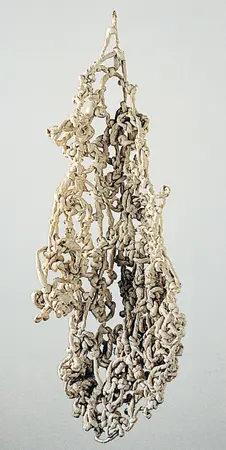
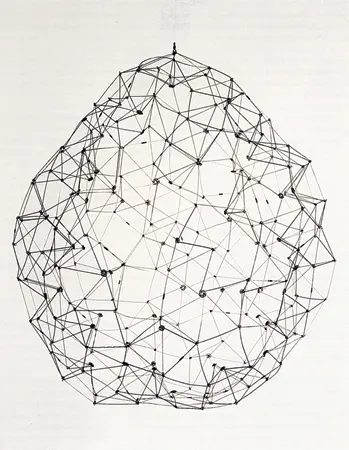
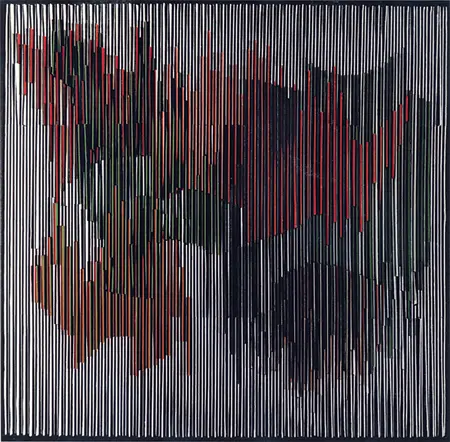
The consequences of choosing “the Concrete Invention” as the show’s leitmotif is put in clear evidence when one encounters the work of Mira Schendel and Gego in a central position in the exhibit. We realize then that the call to invention contained in Tomás Maldonado’s early manifesto did not have to necessarily be answered in geometric terms. That was without a doubt the most common response then and for a long time, but not the only one. This is demonstrated by Schendel and Gego, two artists as talented as they were eccentric in relation to the geometric orthodoxy in the old and new constructivism, whose work can be summarized in an attitude: invention. Their fertile heterodoxy is reinforced by the decision by the curators of this exceptional exhibition to select works by Jesús Soto that, while still optic of kinetic in nature, incorporate a tangle of lines that is not present in his more canonical oeuvre. Such is the case of Cubo de nylon, from 1990. Simply, one extraordinary work of art.
La invención constructive also possesses an important political significance because its opening served, wittingly or unwittingly, as the launching platform for a reordering of the power structures within the Museo Centro de Arte Reina Sofía in Madrid, where it is housed. In response to a 45% reduction in the State’s contribution to the museum’s budget, the current director promoted the establishment of the Reina Sofía Foundation, which will function as the museum’s main benefactor, with a board of trustees composed of three Spanish and nine Latin American members. Patricia Phelps de Cisneros is one of the Latin American trustees, and the exhibition of this selection of works from her collection can be understood as a sneak preview of Reina Sofía’s new strategy.
CARLOS JIMENÉZ
Art critic and independent curator.