In the book Animalités, 1 I insisted that the history of animal-ness is yet to be written and that many of those narratives at the margins, although not marginal, have been told by art despite the ignorance of certain art historiography. Indeed, the relationship between the human and the animal has not only been expressed since the art of antiquity (Greece, China, India, Egypt, pre-Columbian civilizations) but, in a persistence of the anachronistic (Didi-Huberman), contemporary art also offers an account of this distant connection: from Joseph Beuys through Matthew Barney, with Oleg Kulik, Renata Schussheim, Zhang Huan, Yoshua Okon along the way, among others. Repulsa (2011-13), by Leonardo Ramos, is an example of a work of art where the animal element is set in perfect dialogue with the human.
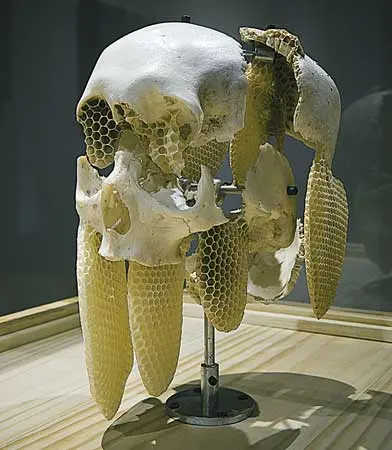
Repulsa is an artistic reflection comprised of drawings, beehives, and bone structures (an animal vertebra and human and animal skulls) protected by glass windows. According to the artist, this work reflects on death and life, and it brings to the fore certain mythical and archetypical elements. “In the end,” Ramos says, “all that is human is taken from the essence of bones, which are what remains and also the beginning; their center contains our being, sculptural objects that surround the sublime act of creation, with forces that are made evident by their resilience. These remains embody a disturbing coincidence between the personal and the impersonal since nothing is closest to us than our bones and nothing is as unknown as death; here the material and the immaterial are not separated, since life and death are alternative revelations of the same reality.”
Bees and their hives become an essential element in Leonardo Ramos’ work. These animals are a perfect metaphor for the continuation of life, the repairing of death, a promise of eternity; art becomes therapeutic. The know-how of the technical domain (tekné) is a matter not only for the artist but for the animal (bees), where those hard-working insects complement and attempt to repair what is irreparable: death. If for the ancient people of Crete these animals born from death itself (from a dead bull, according to Aristaeus) was existence’s very potency and strength, for artists like Beuys, their valuable liquid was the materialization of creative, transformative energy.
Repulsa comprises several drawings on a black ground, where, with subtlety, lines emerge to configure new organized bodies where the organic is brought into question. A golden hue emerges from the shadows, insisting on honey as a synonym of life. The dead in antiquity were embalmed with honey, and in contemporary times, during Beuys famous performance How to Explain Pictures to a Dead Hare (1965), the artist, his head covered in honey as he explained the paintings to a dead hare, insisted that “honey is without a doubt a living substance; human thoughts can also become alive.” 2
The fossilized sperm whale vertebra (23 million years) makes reference to the Leviathan Melveillei, a mythical figure of this mammal that was a preferred prey of seagoing hunters, who drove it to extinction. Jonah’s whale and Moby Dick, among other mythical cetaceans, return in this work as important referents for the artist. With great effort, the bees have repaired and restored part of the vertebra with a hive-prostheses, as if insisting in a genetic re-reading for which they are the perfect interpreters.
The intervention of the bees gains even greater force in the skulls, humans, and animals. The artist has taken the former apart, supporting each piece on a metal structure while retaining its shape. Then the bees do their job by completing a series of strange, fascinating shapes inside the eye sockets; from the temporal bones, for example, emerge several waxy extensions that seem to insist on the fact that time is eternal. These shapes also hang from the remaining bones that comprise the cranial cavity, giving the skull the appearance of a never before seen being.
The skull of a wolf (Canis lupus lycaon), broken in two, is also intervened by the bees, who create shapes (hives) in its interior, where the shape combines with the animal’s dentition as though insisting in the perennial character of the howl. In sum, the work of Leonardo Ramos makes us reflect on the repulsive and at the same time fascinating aspect of death.
NOTES
1. Arcos Palma, Ricardo. Animalités. With the collaboration of several authors, such as Helge Meyer, Charles Dreyfus, Michaël La Chance, Andrés Jurado, Paul Adenne, among others. EditionsInterventions. Quebec, 2013.
2. Dreyfus, Charles. Beuys et l’animal; in Animalités. Op. Cit. p. 12.
RICARDO ARCOS PALMAS