
A first encompassing glance reveals an eloquent variety of three-dimensional objects that are not utilitarian in the least but can be associated with a container or jar coming back to life. The jar as form and concept is one of the oldest presences in clay in the history of humankind. Lidya Buzio has extended the auteur jar towards sculpture, creating significant pictorial forms and experiences, as once again confirmed in this exhibition. Born in Uruguay, next to the Torres-García workshop, she learned that art is a situation as natural as it is professionally serious. There she studied painting and developed an attraction for the ceramic arts before turning twenty. She attended the ceramics workshop helmed by the strict Catalan José Collel, also a student at the Torres-García workshop. Buzio, José Gurvich, and Collel are workshop alumni who have worked in ceramics, a field that wasn’t as present under Torres-García, when painting, drawing, and works in wood took precedence. In 1969, after two years as a student and assistant with Collel, Buzio opened her own studio to create works and teach children. In 1972, she traveled to New York to visit her sister Cecilia (who was married to Horacio de Torres, the son of her late teacher). Since then, Lidya Buzio has lived in the United States, where she studied painting with Julio Alpuy, the noted Uruguayan artist who also studied at the Torres García workshop. In New York, Buzio survived in penury and sacrifice, as the reductive notion that ceramics did not belong in the visual arts was still dominant, until gallerist Garth Clark, still located in Los Angeles, saw her work and offered her a solo exhibition in 1983. Since then, feeling respected in her work, Buzio wrote a key chapter in the history of international ceramic sculpture.
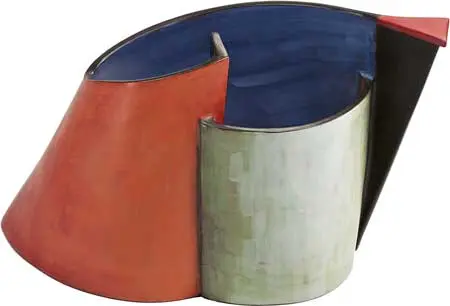
In ceramics, a variety of methods of construction are used (caking, manual extrusion, mechanical extrusion, wheel, plaque). Lidya Buzio works with plaques. Using them, she creates original walls with different three-dimensionalities. In her art, the internal and external volume of each work is significant; she points it out as form, with fragments, with paint, with the architectural/landscape theme, or in abstraction and with color. In her works, we note both vertical and horizontal axes, although her original diagonal axes are a standout feature. She creates a diversity of shapes and proportions: rounded, vulva-like, cylindrical, and some with right angles. In her circular, unclosed works, each plane supports the other and pushes it forward at the same time. We note that the curve and the corner dialogue as propositions of the energy of the notions of the “unending” and the “limit”. This is part of a concept of motion that permeates many of her works. The maritime theme reveals motion, which in her geometric works exists in the inclination of the planes.
It is to be noted the importance of the port-related theme, of Montevideo her native city (a theme also painted by Torres-García), and of the Long Island area where she lives since 1997. Torres-García’s approach is symbolic and schematic; Lidya Buzio develops it as atmospheric, dynamic, and metaphysical, somewhat in connection with Giorgio de Chirico. Protrusions of architectural shapes, wings/clouds, or rigorous geometries alternate in Buzio’s varied creations. In her most recent body of work, size has been reduced to 5 inches in height, and colors are framed by black lines; these are life-affirming works, dominated by a geometric bent. In them, the dynamic element is expressed by means of flaps that function as visual propellants and by color contrasts. The integration of the parts and the whole comes from Buzio’s elaborate pictorial composition and, at the technical level, it is achieved thanks to her knowledge and her system of painting each plaque in isolation and cooking them with the work already set. If they were painted after passing through the furnace, it would be very superficial, as the artist and other important ceramic sculptors have noted. This and other quotations are found in the catalog published for the exhibition, which is a recommended reading.
Buzio’s palate is generous, and it includes both saturated and semi-saturated colors and gray-infused landscapes. The feeling of nostalgia that envelops some of the objects derives from her native Montevideo, a city dominated by gray tones and covered by a foggy River Plate humidity. Although this is not a retrospective, some examples from years ago, with previous proposals by the artist, are found in it, and they are important to appreciate the different periods in Buzio’s trajectory. Lydia Buzio’s work brings forth a balance between the primitive and the intellectual.
GRACIELA KARTOFEL